
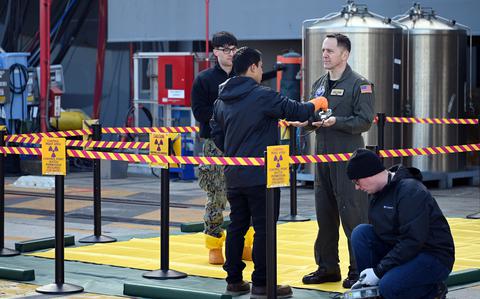
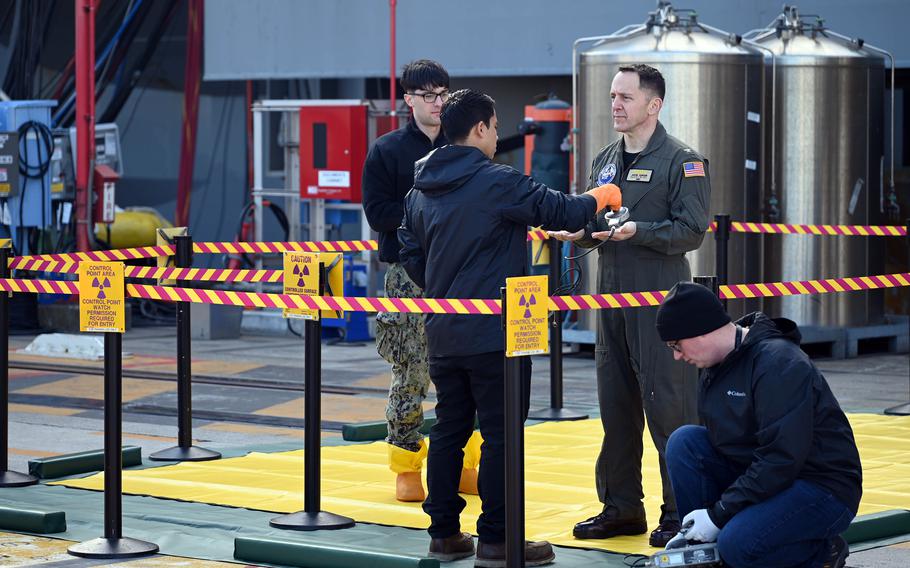
Defense Department civilians check a sailor for radiation during a drill simulating a low-level radiation leak aboard the aircraft carrier USS George Washington at Yokosuka Naval Base, Japan, Dec. 18, 2025. (Alex Wilson/Stars and Stripes)
YOKOSUKA NAVAL BASE, Japan — More than 200 U.S. and Japanese personnel took part Thursday in a joint emergency drill to practice responding to a hypothetical radiation exposure involving a nuclear-powered aircraft carrier.
The annual exercise, now in its 18th year, brought together 134 U.S. service members and civilians and 95 Japanese officials and first responders to rehearse coordination and communication in the event of a radiation incident, according to the Navy.
In the scenario, a U.S. sailor working on a propulsion support system aboard the USS George Washington was exposed to low-level radioactive water leaking onto his hands. Emergency protocols were activated and the sailor was taken to U.S. Naval Hospital Yokosuka for treatment.
The simulated radiation exposure was roughly equivalent to that found in two bananas and lower than naturally occurring radiation in a pot of coffee, according to a Navy media handout.
Participants included Yokosuka base commander Capt. Johnathan Hopkins and Yokosuka Mayor Katsuaki Kamiji.
“All involved parties worked diligently in all aspects of the drill, and we were able to confirm that communication and cooperation between Japan and the United States was well-established, and that the system will function properly in the event of an emergency,” Kamiji told reporters afterward.
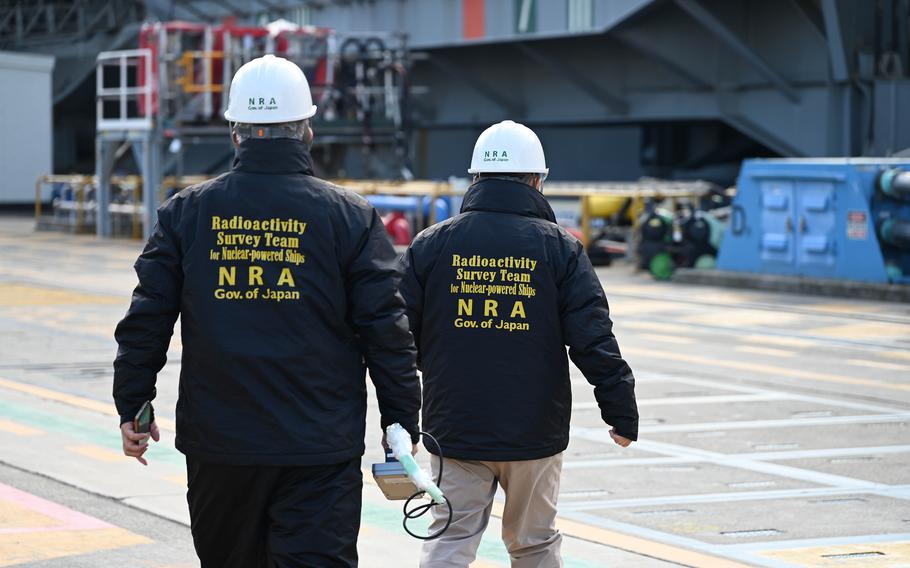
A survey team from the Japan Nuclear Regulation Authority approaches the aircraft carrier USS George Washington at Yokosuka Naval Base, Japan, Dec. 18, 2025, during an annual drill involving a hypothetical radiation leak. (Alex Wilson/Stars and Stripes)
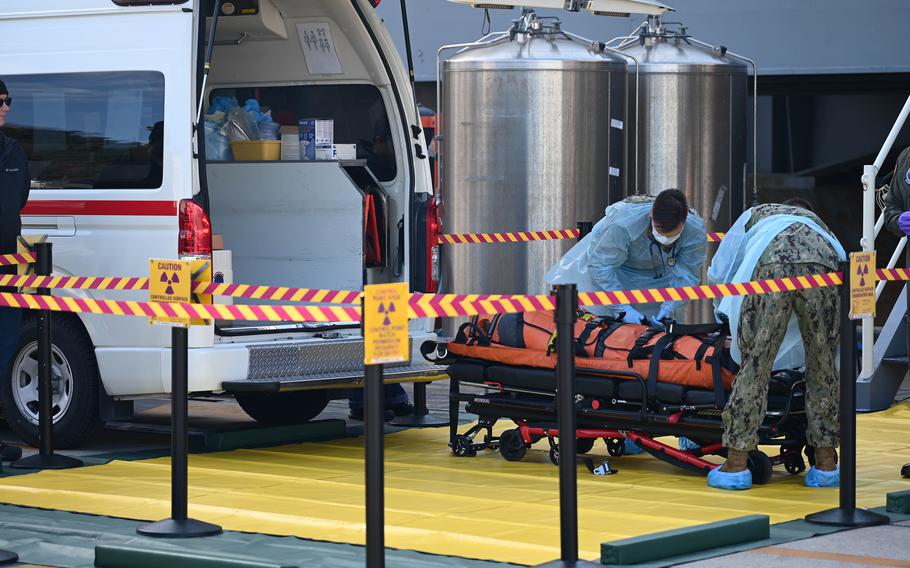
Navy corpsmen load a dummy onto an ambulance during an annual drill that simulates low-level radiation exposure at Yokosuka Naval Base, Japan, Dec. 18, 2025. (Alex Wilson/Stars and Stripes)
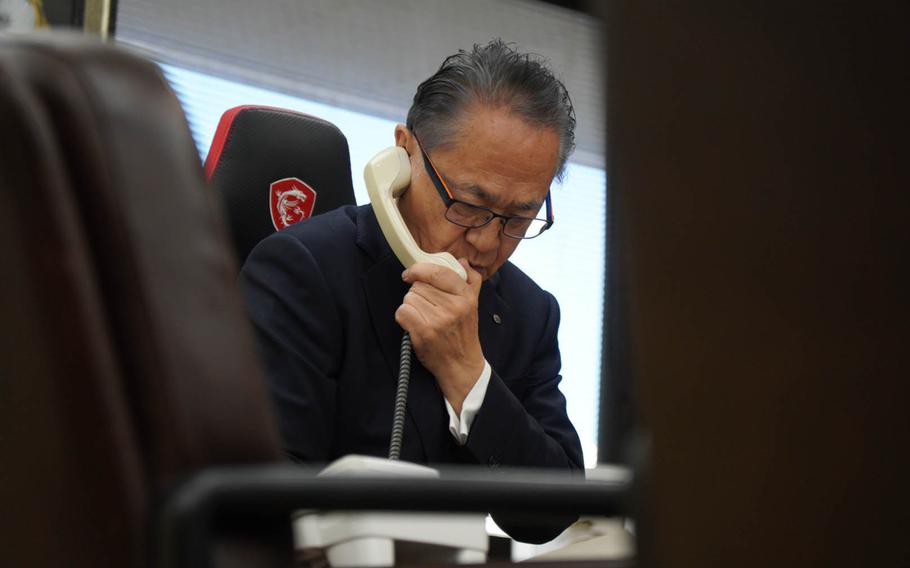
Yokosuka Mayor Katsuaki Kamiji receives a call from Rear Adm. Ian Johnson, commander of Navy Region Japan, regarding a hypothetical radiation exposure as part of an annual drill on Dec. 18, 2025. (Akifumi Ishikawa/Stars and Stripes)
The exercise is intended to address public concerns surrounding the presence of nuclear-powered U.S. warships. The Navy and Yokosuka city have conducted the drill annually since 2007, with the scenario largely unchanged.
Public concerns about radiation risks in Japan go back decades, including a 1999 accident at a nuclear fuel-processing facility in Tokaimura in Ibaraki prefecture that exposed hundreds of people to radiation and killed two workers. Japan’s history as the only country subjected to atomic bombings has also shaped public sentiment.
An activist group — Citizens’ Coalition Concerned About the Homeporting Project of the Nuclear-Powered Carrier at Yokosuka — feels the training is inadequate.
“It’s not realistic,” group leader Masahiko Goto said by phone after the drill. “They need to conduct a drill assuming the worst-case scenario.”
The group, in a Thursday statement to media, called for a training scenario similar to those conducted by nuclear power plants to prepare for meltdowns and other incidents.
The Navy has repeatedly said its nuclear-powered ships have never experienced a reactor accident or released harmful radiation and that extensive safeguards and procedures are in place to prevent such incidents.
Stars and Stripes photojournalist Akifumi Ishikawa contributed to this report.
AloJapan.com