
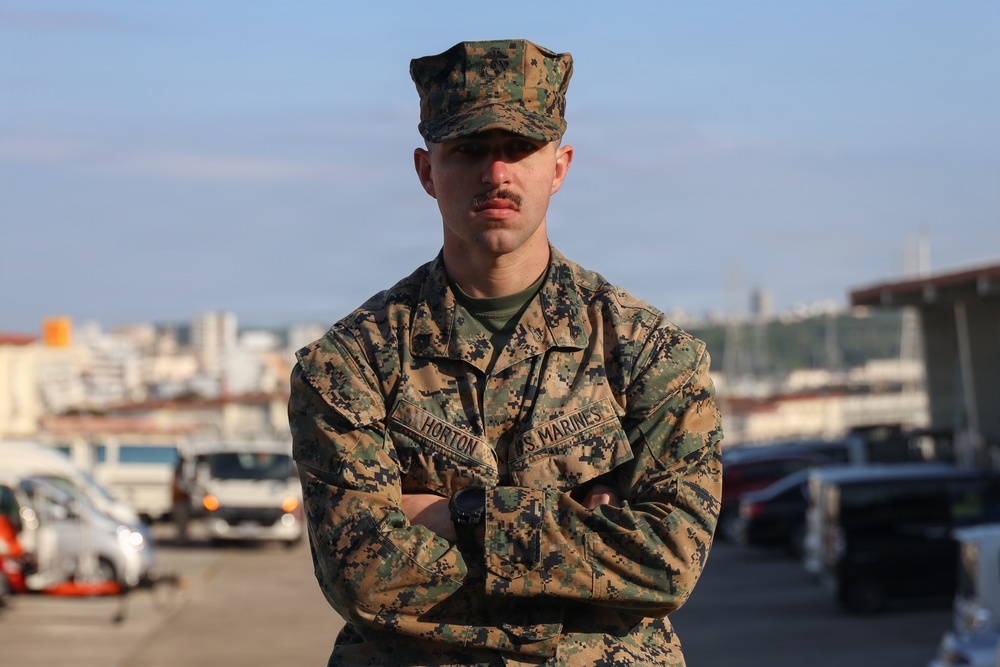
CAMP COURTNEY, OKINAWA, Japan – Rain and cold weather defined much of Artillery Relocation Training Program 25.3 for Ares Battery\, but for Cpl. Lawson Horton\, the conditions became a measure of how well he could prepare and lead his Marines. As a section chief\, he was responsible for their welfare\, safety and readiness throughout the exercise at Camp Fuji.
Horton, a native of Memphis, Tennessee, serving with 1st Battalion, 10th Marine Regiment, currently forward deployed with 3rd Battalion, 12th Marine Regiment, 3rd Marine Division, as a part of the Unit Deployment Program, led a section made up mostly of junior Marines experiencing their first overseas field training. ARTP 25.3 challenged them with inclement weather, rapid mission shifts, and demanding equipment maintenance cycles, offering Horton the opportunity to apply two years of experience as a section chief while developing the confidence and capability of his team.
“My job was to prepare them for combat in an environment like this,” Horton said. “I was responsible for their welfare, safety and making sure they were mentally ready.”
Many of Horton’s Marines had never trained overseas or worked in cold weather. Several had only been in the fleet for eight months to one year. Horton drew on his previous participation in an ARTP and the Winter Mountain Leaders Course in Bridgeport, California, to help them adjust to the environment.
“A lot of them had never experienced real cold,” he said. “But I reminded them they were more prepared than they thought.”
To help his Marines acclimate, Horton emphasized warming layer discipline, adjusting to the cold and their previous trainings. He also made sure the standards were the same for everyone, including himself.
“I never asked them to do anything I wouldn’t do,” he said. “Even when they were cold, wet and exhausted, they still met the mission.”
A mechanical issue with the M777A2 howitzer became one of the section’s biggest challenges. A leak in a critical component forced the crew to operate with limited capability, requiring Horton, his assistant section chief and an artillery mechanic to work together repeatedly to keep the weapon functioning.
“We kept it running for seven days,” Horton said. “We did everything we could to keep the mission going.”
One moment during the exercise stood out to him when a firing mission was called more than three hours after the previous engagement. Horton and his Marines had only 15 minutes before the end of authorized firing hours. They had the added pressure to execute safely, quickly and accurately.
“Once that mission dropped, they executed with full focus and discipline,” Horton said. “Turnaround was about ten seconds per round, no mistakes and rounds on target.”
By the end of ARTP 25.3, Horton said his section completed the field phase without significant issues affecting personnel or equipment. He was most proud of how the Marines developed during the exercise and how they represented their unit in Japan.
“It felt good showing the Japanese military that Ares Battery is professional and capable,” he said.
For Horton, the impact he hopes to leave on his Marines is simple.
“I hope they remember my leadership as selfless and example-driven,” he said. “Leading by example is everything.”
ARTP 25.3 showed Horton how capable his Marines could be when pushed through difficult conditions. Despite the challenges, they grew more confident and cohesive as a team, proving they could adapt, perform, and carry the lessons of the exercise into future operations.
Date Taken:
12.09.2025
Date Posted:
12.17.2025 21:59
Story ID:
554686
Location:
CAMP COURTNEY, OKINAWA, JP
Web Views:
11
Downloads:
0
PUBLIC DOMAIN

This work, Leading Through the Cold, by LCpl Oscar Ocampo, identified by DVIDS, must comply with the restrictions shown on https://www.dvidshub.net/about/copyright.
AloJapan.com