
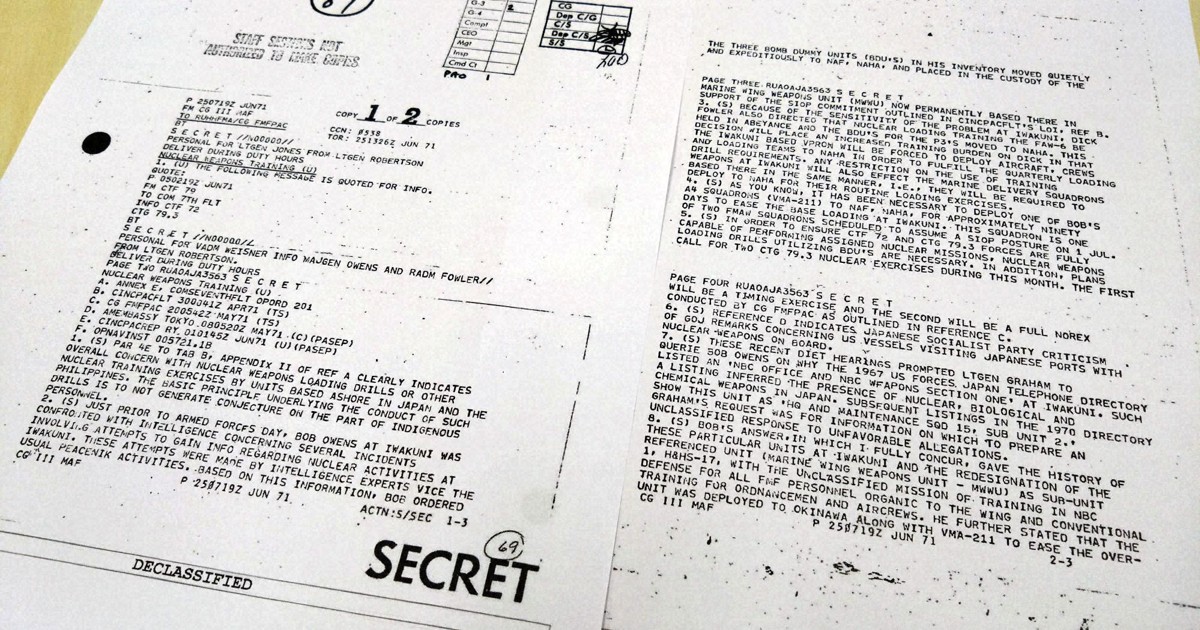
A copy of a declassified telegram sent in June 1971 by the U.S. military’s III Marine Amphibious Force that describes nuclear loading drills at the U.S. Air Force base in Iwakuni, Yamaguchi Prefecture. (Photo not for sale)(Kyodo)
TOKYO (Kyodo) — U.S. forces in Japan secretly transferred dummy nuclear bombs to then U.S.-occupied Okinawa Prefecture in 1971 out of concern that Japan would discover they were being used for training at an airbase on the country’s main island, a declassified document showed Tuesday.
The document reveals how the United States was moving ahead with preparations for possible nuclear strikes against the Soviet Union or China under Cold War contingency planning while being highly sensitive to the strong anti-nuclear sentiment in Japan, which suffered U.S. atomic bombings during World War II in 1945.
Other declassified diplomatic records have shown that U.S. military units stationed in Iwakuni in Yamaguchi Prefecture held multiple mock hydrogen bomb drills in Okinawa between 1971 and 1974.
The latest U.S. document, a telegram sent in June 1971 by the III Marine Amphibious Force in Okinawa to the commander general of the Fleet Marine Force, Pacific, confirms that training to load dummy nuclear weapons onto aircraft was being conducted at Iwakuni.
According to the telegram, the First Marine Aircraft Wing headquartered at Iwakuni learned of multiple attempts by intelligence experts to gain information on nuclear activities at the site just before Armed Forces Day in May 1971.
The unit’s wing commander therefore ordered that the three dummy nuclear bombs in his inventory be “moved quietly and expeditiously” to a U.S. military facility in Naha, Okinawa.
In November 1971, the Japanese government denied the presence of nuclear weapons in the country when pressed in parliament on suspicions that they were moved from Iwakuni to Okinawa in May, but did not mention dummy bombs.
Public interest toward Okinawa was rising as the islands, occupied by the United States since 1945, were due to be returned to Japan in May 1972. U.S. forces stationed in Japan remained concerned that drills conducted in Okinawa might be photographed by Japanese news media.
The units conducting nuclear weapon loading drills at Iwakuni were the attack aircraft unit of the First Marine Aircraft Wing and the patrol aircraft unit of the U.S. Navy’s Fleet Air Wing Six, which kept watch around the Korean Peninsula.
The telegram stated that as the First Marine Aircraft Wing would be assigned in July 1971 to missions under the Single Integrated Operational Plan for nuclear war targeting the Soviet Union and China, “nuclear weapons loading drills utilizing (dummy bombs) are necessary” to ensure it would be able to perform its assignments.
AloJapan.com