
Japan Surgical Robots Market Size and Forecast 2025–2033
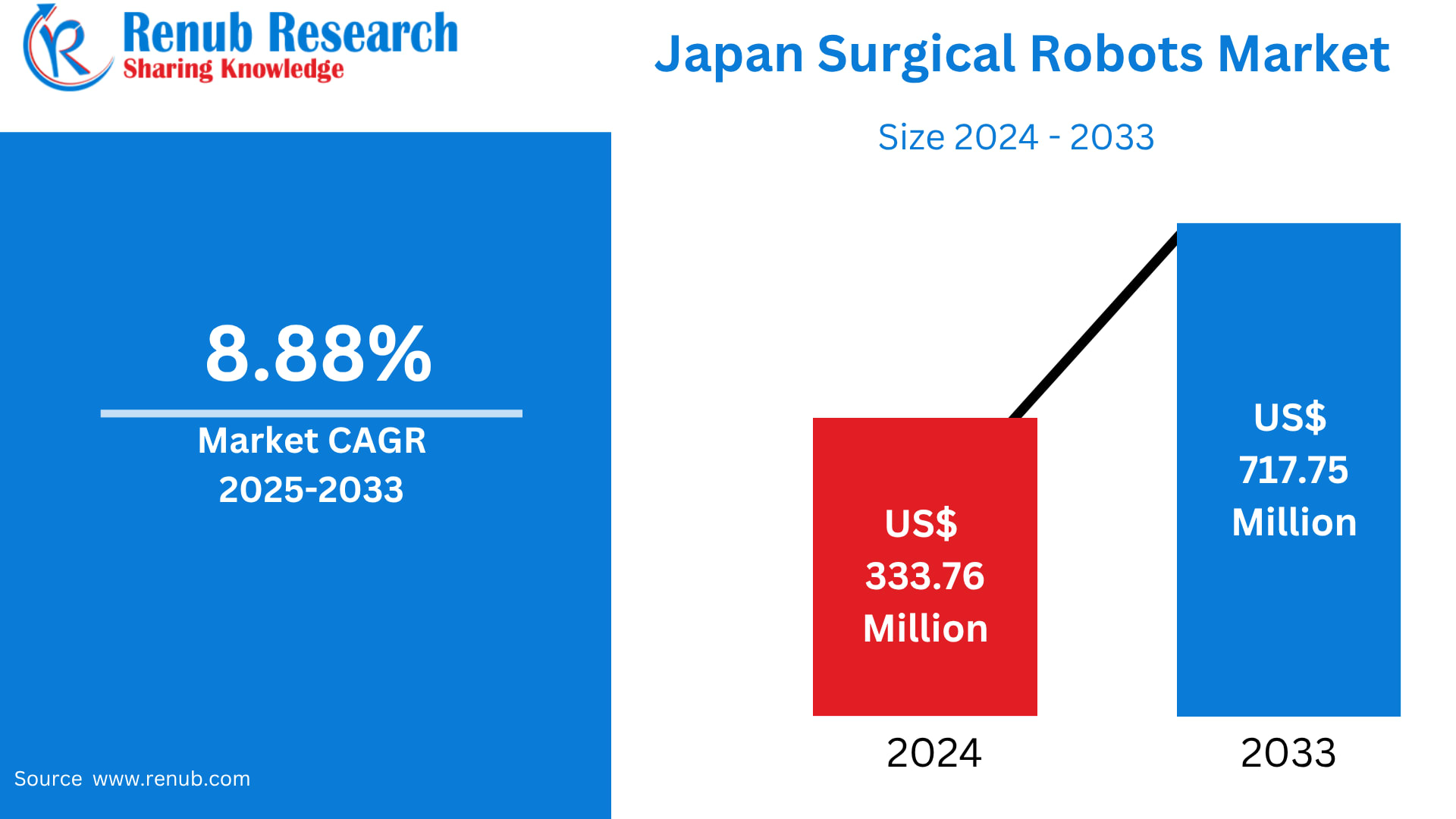
The Japan Surgical Robots Market is entering a transformative phase, driven by rapid advancements in medical robotics, an aging population, and the country’s strong focus on precision healthcare. According to Renub Research, the market was valued at US$ 333.76 million in 2024 and is projected to reach US$ 717.75 million by 2033, expanding at a CAGR of 8.88% during 2025–2033.
Download Free Sample Report
This impressive growth trajectory is primarily fueled by the rising adoption of minimally invasive (MI) surgical procedures, increasing surgical volumes, and continuous innovation in robotic-assisted technologies. Japan’s healthcare ecosystem, known for its emphasis on quality, safety, and technological excellence, is well positioned to embrace robotic surgery as a standard of care across multiple specialties.
Japan Surgical Robots Industry Overview
Surgical robots are computer-controlled systems designed to assist surgeons in performing complex procedures with greater precision, flexibility, and control than conventional techniques. These systems typically feature robotic arms equipped with miniature surgical instruments and high-definition 3D visualization, enabling surgeons to operate through small incisions with enhanced accuracy.
Compared with traditional open surgeries, robotic-assisted procedures offer several advantages, including reduced blood loss, lower risk of infection, minimal scarring, shorter hospital stays, and faster patient recovery. Advanced capabilities such as motion sensors, tremor filtration, data recording, and real-time imaging further improve surgical outcomes.
In Japan, surgical robots are increasingly being used across a wide range of applications, including urology, gynecology, orthopedics, neurosurgery, cardiovascular surgery, and laparoscopy. The growing acceptance of these technologies among both surgeons and patients is reshaping the surgical landscape and driving sustained market expansion.
Key Factors Driving the Japan Surgical Robots Market Growth
Aging Population and Rising Surgical Demand
Japan has one of the world’s oldest populations, with nearly one-third of its citizens aged 65 and above. This demographic shift has led to a sharp increase in age-related conditions such as cardiovascular diseases, neurological disorders, orthopedic complications, and cancer. As a result, the demand for surgical interventions continues to rise.
Surgical robots are particularly well suited for elderly patients, as minimally invasive procedures reduce surgical trauma and postoperative complications. Faster recovery times and shorter hospital stays are crucial benefits for aging individuals who may struggle with prolonged rehabilitation. Consequently, Japan’s aging population remains one of the most influential drivers of growth in the surgical robots market.
Technological Advancements in Robotics
Rapid innovation in medical robotics is significantly enhancing the capabilities of surgical systems. Modern surgical robots integrate artificial intelligence (AI), machine learning, robotic navigation, and advanced imaging technologies to support surgeons during highly complex procedures.
High-definition 3D cameras provide real-time visualization, while robotic arms deliver superior dexterity and precision beyond human limitations. AI-enabled systems assist with surgical planning, improve accuracy, and help reduce errors. These technological improvements are expanding the scope of robotic surgery, making it suitable for more complex and delicate operations, and accelerating adoption across Japanese hospitals.
Government Support and Strategic Investments
The Japanese government plays a pivotal role in promoting advanced healthcare technologies. Through initiatives such as the Future Medical Technology Strategy, the government actively supports the integration of robotics into healthcare systems nationwide. Public funding, subsidies, and grants encourage hospitals and research institutions to adopt robotic surgical platforms and invest in innovation.
Additionally, government-backed training programs aim to enhance surgeon proficiency in robotic-assisted procedures, particularly in regional and rural healthcare facilities. This proactive approach not only improves access to advanced surgical care but also positions Japan as a global leader in medical robotics innovation.
Challenges in the Japan Surgical Robots Market
High Costs and Affordability Issues
Despite strong growth prospects, the high cost of surgical robots remains a significant barrier. The acquisition, installation, and maintenance of robotic systems require substantial capital investment. Ongoing expenses related to software upgrades, disposable instruments, and system servicing further increase the total cost of ownership.
While large metropolitan hospitals can absorb these costs, smaller clinics and rural healthcare providers often face financial constraints. This disparity limits widespread adoption and creates uneven access to advanced surgical technologies across the country.
Limited Awareness and Training Among Surgeons
Another challenge is the lack of comprehensive training and hands-on experience among surgeons. Robotic-assisted surgery requires specialized skills that differ from conventional surgical techniques. Many healthcare institutions struggle to provide sufficient training opportunities due to time constraints and heavy workloads.
Without adequate education and exposure, some surgeons remain hesitant to fully embrace robotic systems. Addressing this challenge requires expanded training programs, simulation-based learning, and stronger collaboration between hospitals, academic institutions, and device manufacturers.
Japan Surgical Robots Market Regional Analysis
The adoption of surgical robots in Japan is highly concentrated in major metropolitan regions, where healthcare infrastructure, patient demand, and financial resources are strongest.
Tokyo Surgical Robots Market
Tokyo dominates the Japanese surgical robots market as the nation’s largest healthcare and innovation hub. The city’s advanced hospitals and research centers are early adopters of robotic-assisted surgery, supported by strong government funding and access to skilled professionals. High patient volumes and extensive training programs further accelerate market growth, making Tokyo a trendsetter for the rest of the country.
Kansai Surgical Robots Market
The Kansai region, including Osaka, Kyoto, and Kobe, plays a crucial role in Japan’s medical robotics ecosystem. Osaka’s hospitals are rapidly adopting robotic systems to enhance surgical outcomes. Notably, Kobe is home to Medicaroid, the developer of Japan’s domestically produced “hinotori” surgical robot, which represents a major milestone in reducing reliance on imported systems. Strong academic-industry collaboration positions Kansai as a key growth region.
Aichi Surgical Robots Market
Aichi Prefecture, with Nagoya as its capital, benefits from a robust industrial base and advanced healthcare infrastructure. The installation of domestically developed surgical robots in local hospitals has improved affordability and accessibility. Aichi’s strong manufacturing ecosystem fosters innovation and collaboration, supporting continued growth in robotic surgery adoption.
Market Segmentation Overview
By Component
Surgical System
Accessory
Service
By Area of Surgery
Gynecological Surgery
Cardiovascular
Neurosurgery
Orthopedic Surgery
Laparoscopy
Urology
Other Areas of Surgery
By Cities
Tokyo
Kansai
Aichi
Kanagawa
Saitama
Hyogo
Chiba
Hokkaido
Fukuoka
Shizuoka
Competitive Landscape and Company Analysis
The Japan surgical robots market is highly competitive, with both global and domestic players driving innovation and adoption. Key companies profiled in the market include:
Intuitive Surgical Inc.
Stryker Corporation
Johnson & Johnson
Renishaw PLC
Accuray Incorporated
Titan Medical Inc.
Medtronic PLC
Smith & Nephew PLC
Zimmer Biomet
Each company is analyzed based on overview, key personnel, recent developments, SWOT analysis, revenue performance, and strategic initiatives. Increasing focus on partnerships, localized manufacturing, and technology upgrades continues to shape the competitive landscape.
Final Thoughts
The Japan Surgical Robots Market is on a strong growth path, supported by demographic trends, technological innovation, and proactive government policies. While challenges such as high costs and training gaps persist, ongoing investments and domestic innovation are steadily addressing these barriers.
With the market expected to nearly double in value by 2033, surgical robots are set to become an integral part of Japan’s healthcare system. As minimally invasive procedures become the norm and robotic technologies continue to evolve, Japan is well positioned to remain at the forefront of global medical robotics innovation.
AloJapan.com