
A few seconds’ walk from the thronging mass of tourists swarming Kyoto’s Hanamikoji Street in the hopes of seeing a geisha, there sits a comparatively deserted lane. It’s so quiet, in fact, that you may think that you’d been magically transported from Gion, one of Kyoto’s busiest and most historic districts, to a sleepy countryside village. For the majority of people visiting Kyoto, there’s nothing of note in this back alley.
But, for anyone with an interest in fabric and craft, it’s the main event. This is the location of Taiga Takahashi’s only physical store, an unassuming lesson in tasteful design and Japanese tradition that yields one of the most beautiful retail experiences in Japan, if not the world (hyperbole be damned).
Launched in 2017, Taiga Takahashi takes the name of its late founder and upholds his one core principle: resurrecting relics of the past to create artifacts for the future. After graduating from London’s prestigious Central Saint Martins art college, Takahashi moved to New York where he began his label, originally dealing in womenswear and evolving to its current form several years later. Today, it meticulously reimagines vintage workwear clothes, gently adjusting fit and shape before cutting its hoodies, sweaters, jeans, and jackets from rare fabrics painstakingly sourced and milled to recreate an authentic vintage handfeel.
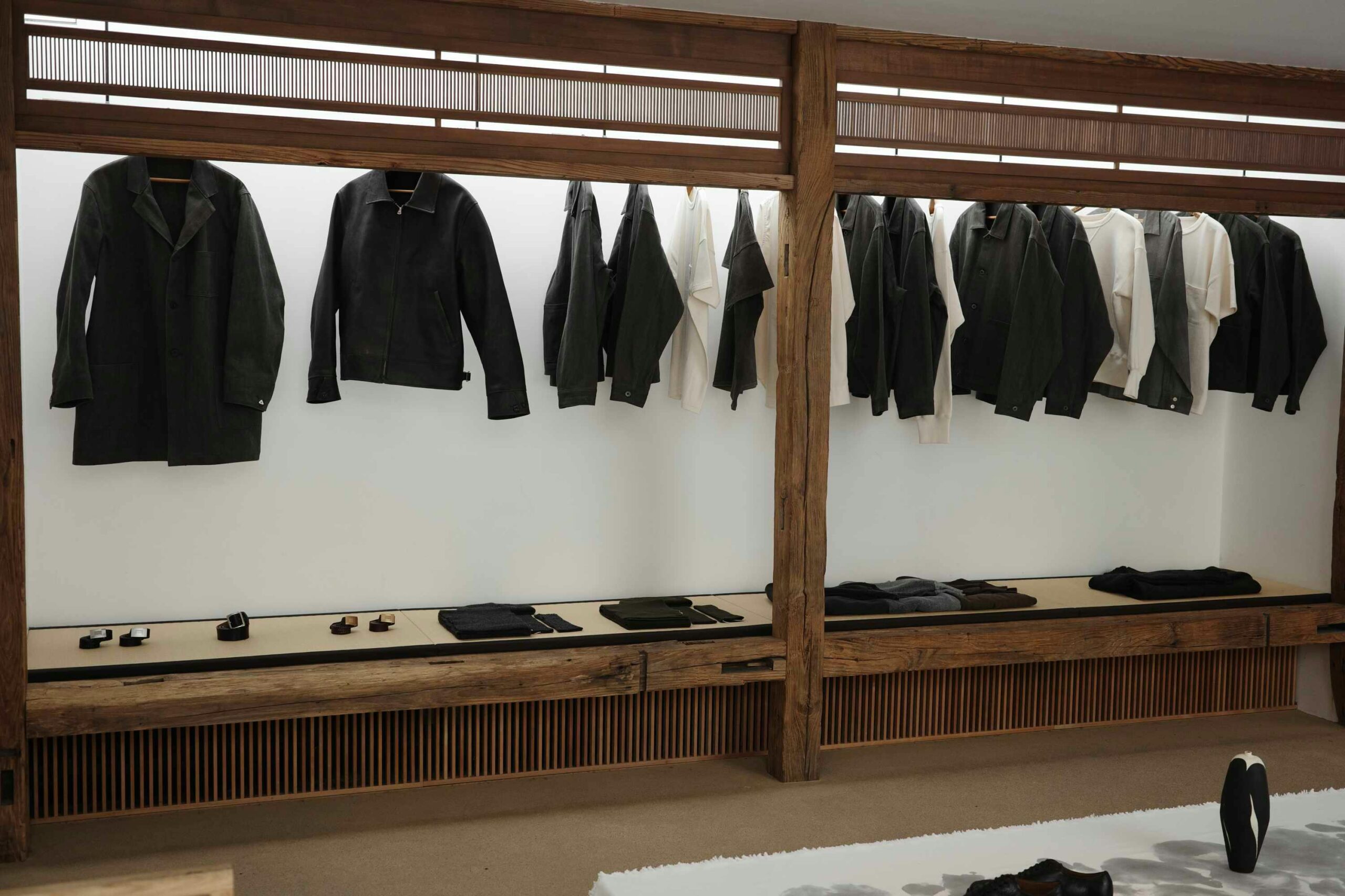
There is no better physical manifestation of the label’s core conceit than Taiga Takahashi’s Gion shop: part clothing store, part exhibition space, part traditional tea house. Positioned in the middle of a row of machiya — wooden townhouses that date back to the Edo period about 400 years ago — the store is easy to miss. The only recognizable signage is a soccer ball-sized lightbulb bulb etched with the initials “T.T.” above a doorway from which hangs a white noren, or fabric divider, that obscures any view inside. Inside, there is an ethereally beautiful space characterized by white walls and aged wood that captures the harmonious interplay between clean modernity, the past, and nature. Only a single rail of clothing runs along the wall; the space is split evenly between art installations and garments. A traditional kare-sansui, or rock garden, designed by artist Chisao Shigemori fills the view from the rear window, its carefully arranged gravel breaching the boundary between exterior and interior.
“What are materials today?” This question, printed directly on the wall outside T.T, offers a guiding principle for the layout of the store this season, connecting everything within it. The rotating installations, like Masatoshi Izumi’s monolithic stone sculpture that greets guests at the entrance, speak of nature’s permanence in a manner that mirrors the clothing, all inspired by historic shapes and crafted from all-natural fabrics and dyes. Trousers cut from rope-dyed raw denim woven on one of the oldest shuttle looms in Okayama hang alongside mud-dyed sweatshirts cut to recall those of the ’50s, spotlighting Takahashi’s talent for elevating what could’ve been ordinary workwear into heirlooms through exquisite fabrics and artful treatments both human and organic.
Such is the driving philosophy behind everything under T.T’s roof. This is not a brand that’d beckon customers with a glossy storefront. Instead, the mysterious store invites only those willing to explore. In doing so, it pulls willing guests into Taiga Takahashi’s world, physically and conceptually. The goal becomes experiencing the space rather than merely buying clothes. This is not window shopping as we know it — actually, there are no street-facing windows at all — but it is the idealized end point, where browsing without intent is not only enjoyable but encouraged. In today’s world where the bottom line is increasingly the only line that matters for fashion labels; where major heritage luxury houses are quietly producing pieces in the same factories as fast fashion retailers to maximize profit; where social media perpetually pedestals conspicuous consumption, Taiga Takahashi proposes an act of defiance: the opportunity to prioritize experience over purchase.
So, I bought a pair of jeans, obviously.
AloJapan.com