
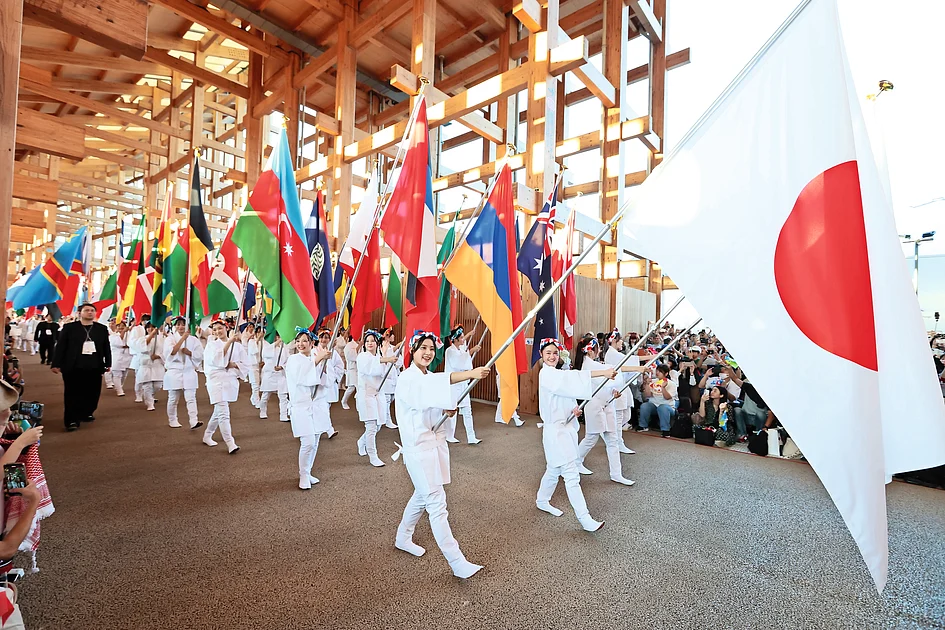
When Expo 2025 Osaka, Kansai, Japan officially concluded on October 13, it marked the end of a six-month experiment in how the world gathers, collaborates, and plans for what comes next. Hosted on Yumeshima, a reclaimed island in Osaka Bay, the World Expo welcomed more than 29 million visitors and brought together 165 countries, regions, and international organisations — the highest level of participation in Japan’s Expo history.
Conceived as the first World Expo of the post-Covid era, Expo 2025 was framed as a moment of global reconnection and recalibration. Its central theme, “Designing Future Society for Our Lives,” marked a notable shift in the history of World Expos — positioning life itself at the core of the conversation. Rather than treating technology as spectacle, the Expo focused on how design, systems, and policy can support and sustain human life in all its dimensions, responding to the defining pressures of our time, from climate change and ageing populations to digital transformation and public health.
A Site Designed for Connection and Experimentation
The setting itself embodied this ambition. The Expo site was master planned by Sou Fujimoto Architects and defined by the Grand Ring, a vast wooden circular structure that earned Guinness World Record recognition. More than an architectural landmark, the Grand Ring functioned as a continuous public realm, physically and symbolically linking national pavilions, modular shared structures, and open civic spaces. Guided by the design philosophy of “Unity in Diversity,” the circular layout encouraged exploration and interaction, bringing together varied cultures, ideas, and experiences within a single shared framework. This emphasis on connection over isolation echoed the Expo’s broader vision, reinforcing the site’s role as both a unifying spatial gesture and a platform for global exchange. Recognised by Guinness World Records as the world’s largest wooden architectural structure, the Grand Ring stood as a powerful embodiment of this ambition.
Across 184 days, the Expo unfolded around three guiding ideas — ‘Saving Lives, Empowering Lives, and Connecting Lives’ which shaped exhibitions on healthcare innovation, sustainability, space exploration, digital governance, and community-centred urban design. Yumeshima also operated as a live testing ground for future cities, piloting cashless payment systems, reservation-based crowd management, and circular-economy initiatives that treated resources, materials, and waste as part of an interconnected system rather than isolated challenges.

A Platform for Diplomacy, Culture, and Global Dialogue
Public engagement reached unprecedented levels. Average daily attendance exceeded 160,000 visitors, surpassing Expo 2005 Aichi, while total ticket sales crossed 22 million. Visitor sentiment remained strong throughout the six-month run, with more than 70 per cent reporting satisfaction and expressing interest in returning or recommending the Expo.
Beyond public participation, Expo 2025 played a significant diplomatic role. A full calendar of National and Special Days drew senior delegations from around the world, with dozens of heads of state, royalty, presidents, and prime ministers attending. Business and academic exchanges ran in parallel, reinforcing the Expo’s function as a neutral platform for dialogue at a time of increasing geopolitical complexity.
Architecture as Cultural Expression
Among the many national pavilions, the UAE Pavilion stood out as one of the Expo’s most distinctive and widely discussed contributions. Built using more than two million palm fronds shipped from the UAE to Japan, the pavilion reinterpreted traditional Emirati materials through contemporary architectural language. Ninety palm-frond columns formed a shaded oasis, merging cultural identity with sustainable construction practices.
The pavilion’s narrative centred on space, sustainability, and healthcare, expressed through its theme, “Earth to Ether.” One of its most striking elements was a palm-frond rocket inspired by Japan’s H2A launch vehicle — the same rocket that carried the UAE’s Hope Probe and KhalifaSat into space. Crafted entirely by Emirati hands, the installation became a powerful symbol of scientific partnership and cultural exchange between the two nations. The pavilion’s impact was recognised with a BIE Bronze Award for Architectural and Landscape Design, placing it among the top three self-built pavilions larger than 1,500 square metres at the Expo.
As Expo 2025 drew to a close, its legacy was formally articulated through the Expo 2025 Osaka, Kansai Declaration, announced on the final day. Shared globally, the declaration consolidated the Expo’s outcomes into a framework for continued collaboration, reinforcing commitments to sustainability, innovation, and human-centred development beyond the physical event.
Fifty-five years after Osaka first hosted a World Expo under the banner of technological progress, Expo 2025 returned to the same city with a more reflective ambition. Rather than offering definitive answers, the Expo asked how societies might design futures that protect, empower, and sustain life — exploring how communities can heal, connect, and endure amid global crises. In doing so, it left behind not only structures and statistics, but a shared blueprint for how international cooperation might evolve, grounded in the preservation of life, the diversity of lifestyles, and a collective commitment to a brighter and more sustainable future.
Expo 2025 Osaka at a Glance
Dates: April 13 to October 13, 2025
Duration: 184 days
Location: Yumeshima Island, a purpose-built artificial island in Osaka Bay, Konohana Ward, Osaka Prefecture.
Theme: Designing Future Society for Our Lives
Participants: 165 official participants, including 158 countries and regions and seven international organisations — the highest participation ever recorded for a World Expo in Japan.
Why It Mattered: Expo 2025 marked the world’s first post-COVID World Expo, symbolising global reconnection after years of restricted travel. It also stood out as Japan’s most internationally diverse Expo, reinforcing the country’s role as a global platform for dialogue on sustainability, innovation, and future living.
Visitor Numbers: The Expo attracted 29,017,924 visitors over six months, including more than 3.4 million season pass holders.
Attendance: Average daily attendance reached around 160,000 visitors — 134.5% of Expo 2005 Aichi.
Ticket Sales: A total of 22,069,546 tickets were sold, surpassing Expo 2005 Aichi by 31.5%.
 Kushmita Bose
Staff Writer

As a passionate storyteller and content writer, Kushmita Bose loves weaving narratives that inform, inspire, and entertain. Whether she’s unraveling tech revolutions, dissecting industry reports, or bringing a brand’s journey to life, Kushmita thrives on transforming ideas into captivating stories.
When she’s not busy crafting content, you’ll probably find her daydreaming about her next travel adventure.
AloJapan.com