
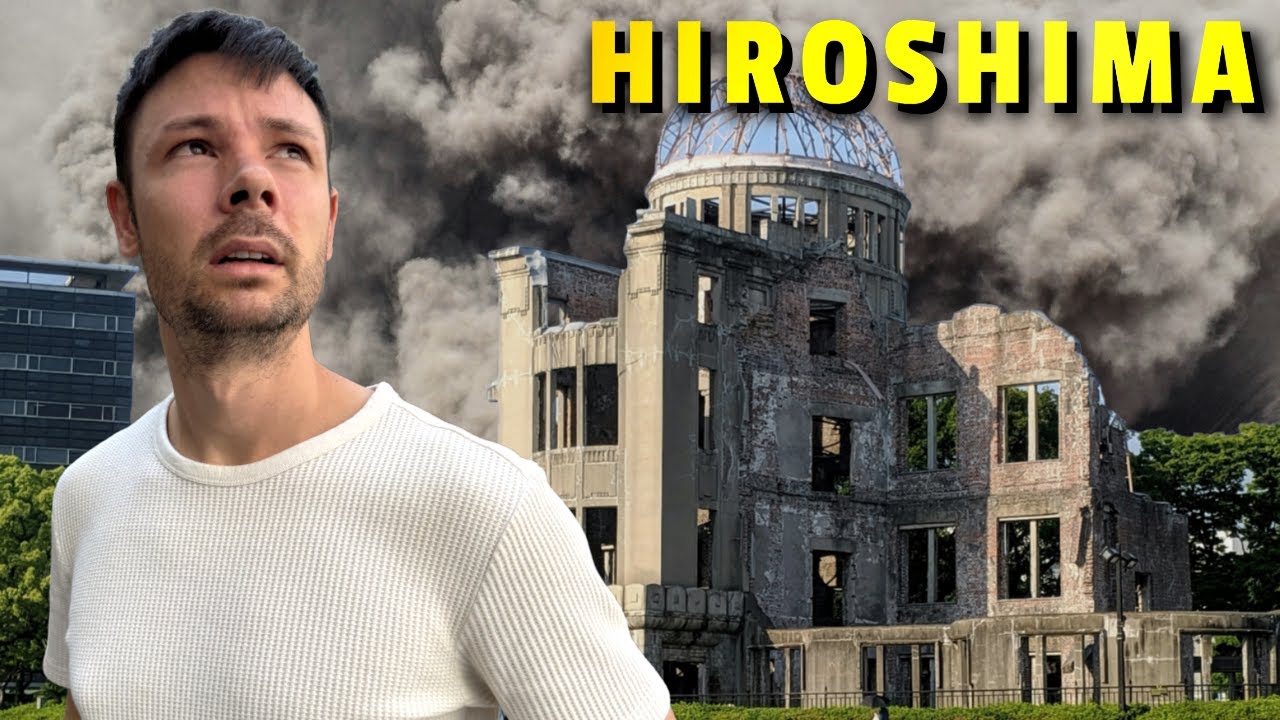
Visiting the World’s First Atomic Bomb City – Hiroshima
Hiroshima. There are places in the world where history feels distant, and then there are places where it never truly leaves. Hiroshima is one of them. On August 6th, 1945, at exactly 8:16 a.m., the time most people were arriving at work, the first atomic bomb ever used in war was dropped. In a single moment, Hiroshima was consumed and the world entered the nuclear age. Tens of thousands were killed instantly with countless more suffering for generations. But what is it really like here today? We visit Hiroshima on August 6th, the 80th anniversary of the bombing. Oh, I actually just feel chills right now. We witness people gathering to honor loved ones, floating lanterns, flowers laid, and the confronting reality of an entire city wiped out in minutes. It’s a little bit of an eerie feeling being here. Hiroshima’s past is powerful enough to overshadow its true beauty. Yet, Hiroshima today may surprise you. It is modern, resilient, and unforgettable. This is the story of Hiroshima today. Okay, so we’ve just checked into our room here in Hiroshima, and I have to actually just give you a room tour because I did not expect a room to look like this. Let me just give you a quick look of what it looks like. First of all, we’ve got a massive TV with a little front section over here. We’ve even got a coffee maker, a little espresso machine. This is our large comfy bed. We’ve got the massive comfy robes which are super cool. And then we’ve got a little relaxing area. We’ve even got a desk and a nice chair. But look at the view we have of Hiroshima. We are about a 1 minute walk away from the train station where we just left our Hello Kitty train. And this here is what Hiroshima looks like. Did you expect Hiroshima to look like this? Because I certainly didn’t. And I am very very happy that we have come here finally just to really get a real feel of what it looks like. This is absolutely spectacular. We’re going to have a small rest for about 10 minutes and then we’re going to head out. But here is where we will be staying. So let’s go see Hiroshima. After a few minutes in the hotel room, we’ve now come to the center of town. We made it. So, you see this really cool street car behind us. This is what we actually took from our hotel to get to the dome and the atomic bomb site. There was a flat fee of 240 yen per person. And it’s pretty much like a tram or like a they call it a street car and super convenient. Today is the 6th of August and on the 6th of August in 1945, that’s when the atomic bomb hit Hiroshima. To this day, exactly 80 years ago, and I don’t know how we timed that to come and visit here on that day. That wasn’t on purpose. In the center of Hiroshima, they actually have different sites to remember what happened in 1945. So that’s why we’ve come here. I can actually see the site right now, right behind you. So let’s go have a look. From my knowledge, this is called the atomic bomb dome. And from what we’ve read, this building was in the epicenter as the bomb hit right on this site. And it’s one of the very few buildings, if not the only building, that survived the blast. And they’ve in fact kept it as is, just to show and remember what happened. I think I’ve been here for a total of 5 seconds and I’ve already got like a chill down my spine. This is one of the last last remainings of I think it was one of the only remaining buildings. It’s the only one. It’s pretty much in its skeleton form right now. But just to think that exactly 80 years ago, something absolutely horrific happened here. And we’re just reading all the little stones like this was put here by the city of Hiroshima. And it’s just like a little guarded fence around just to preserve this area. And you can actually see the fallen bricks still around. And there’s still like all the remains in there kind of left untouched. Oh, I actually just feel chills right now. This is pretty much the only remains that we can see from that devastating atomic bomb. It’s really sad to say, but 80 years ago, there were people minding their business, having a normal day when this complete tragic event happened. And I think when your eyes see something like this, it actually shows how devastating it was. As Chev said, it’s in its skeleton form and you can see none of the glass remains. That is all completely shattered. Most of the walls are gone. It’s not like they’re broken. They’re completely gone. There’s obviously this main outer wall, which you can see is made with really big bricks, and I assume that’s why it’s still standing. But all the bricks on the inside or the walls made with smaller bricks have disappeared. and the skeleton on top. As Chev said, all the glass fell down. And I’m not sure what this building was before. This just shows the power and the devastation that that bomb caused. It’s a little bit of an eerie feeling being here. As you can see around me, there are many, many people that have come to see this, but it’s relatively quiet. No one’s really saying anything. And you can actually feel, it’s difficult to show you that on camera, but you can feel that something really serious happened here. As we mentioned, today is the 80th anniversary. And I see over here there’s a few ladies who are actually playing I think it’s the flute. And I assume they’re playing this in remembrance of what happened. A lot of these ladies are elderly and they might have known someone, maybe it was a family member or friend during that time as well. And I just read that 140,000 people lost their lives only in Hiroshima. That’s besides Nagasaki where it happened as well on this day right here. It’s the weirdest feeling because we are honestly surrounded by the most modern buildings. We took one of the most modern trains today. Staying in a hotel, everything is normal life and yet you just know that something terrible has happened here. That’s just how you feel. Like there is a certain sadness in the air. Especially because today is the day. I think what people are trying to do is pay their respects, pay their remembrance, and just remember what happened today should never ever happen again. I think what’s actually happening here is you can get a little blank piece of paper and then you can actually draw something or paint a picture for peace. So that’s really cool. You can write a little message or you can draw a picture. It’s completely up to you to always be peaceful or to bring more peace into the world, which I think is quite special. Everybody right now has got crayons. They got a blank piece of paper. They got some paint. So all around here there’s all different ages of people, not only children, drawing little pictures in remembrance, obviously writing a message. I’m not going to show you what every person’s picture and message is because I’m sure that’s quite personal for them, but this is quite special that they’ve created this little area for everyone to draw. I think it’s good to remember what happened here. That’s why they’ve left this atomic bomb site and it’s why they’re having a day like today. All the people are writing their messages over there, but I’ve seen over here what they do is they then fold them up and they put them on a cardboard box. And I’ve just read a message that they’re going to take all of these and they’re going to put them on the lake and turn them into lanterns and float them down the river, which is really heartwarming to have all of these messages go out, flow along the river. Obviously, the sign is for peace, and I think nothing is more peaceful than a lantern going through the river and sort of letting all these happy messages go. But thousands of people have all written messages, pictures, drawings, there’s rainbows, there’s pictures of earths, people have drawn the atomic bomb site, flowers, suns, all different majority happy messages. And that’s really nice to see and really special. What a way to dedicate and remember what happened here. Hiroshima is a unique and interesting place to visit and quite the contrast to the Hello Kitty train we took this morning. We’ve been taking lots of trains here in Japan, the Hayabusa, the Nomi, and the Ayanashi. But with all of this train travel, having bulky, unreliable luggage can be a challenge since you only have 2 minutes to hop on the highspeed train before it leaves. But we’ve been gliding through these train stations with ease using Level 8 luggage. So, we opted for the most reliable and sturdy luggage set that we could find. Level 8 has the functionality and the space that we need for fulltime travel. The best part is the 360° silent wheels that allows us to hop on and off these bullet trains. They’re also scratch resistant, have a wider handle for comfort, and are super lightweight. Since we travel as a pair, we opted for two vibrant carry-on cases which have loads of space inside. Whether you’re a long-term traveler like us or going on a quick vacation, Level 8 has loads of amazing designs that guarantee you arrive in style. So, when you’re ready, use our code chev 10 to unlock a 10% discount. Click the link in the description to get started. So, here is a beautiful river where all the lanterns are going to get set off. And I can see there’s even more already put here with their little candles on the inside ready to be set afloat. Also, look how many people have come to the water’s edge specifically to remember what happened. And today is a Wednesday and it’s midafter afternoon and so many people are here. It’s actually quite crazy how 80 years ago this beautiful river once carried the ashes, the sorrow, all that pain and all those memories. Now, it’s just a beautiful river that people come to and it actually just symbolizes a city that’s been rebuilt. You can see them setting up all the lanterns. They’re putting them here. They’re stacking them up there. And I think that reflects the message and the contrast that we wanted to show you today. We took a very happy, jolly, cute, technologically advanced train this morning. But there’s also this side of Japan, and it just shows the rebirth and the development that Japan has had over the last 80 years. To think that this entire area as this was the epicenter was completely washed away to now having high-rise buildings, hotels. It’s absolutely beautiful. It’s pristine. It’s clean. I think that shows the resilience of the Japanese people. So here is the atomic bomb dome which is the remains of that building. And then here we have a beautiful fountain. But opposite that on this side, I’ve just seen one of the most modern and futuristic buildings I think I’ve ever seen. And that proves the point that we’re saying is how far Japan has come. That building is overlooking the atomic bomb dome. In only 80 years, to have come so far is staggering. Just behind me, a couple of people were doing a protest, which has just ended. But I’ve actually seen a lot of people with a lot of signs that say no more war, only peace. It’s actually mindboggling that to this day we still have a war when we know how much damage it can do. So hopefully this is a reminder to everybody that we only want peace in this world. We don’t want any more war. And I think today is one of those days where we’re just going to have to remember that and remember peace above everything. Yes, she is in fact a board of information just outside the sort of buffer zone of the atomic bomb dome. And apparently it’s called that because on top of this building which used to be like an exhibition hall, there was a beautiful green dome which obviously completely vanished when the bomb hit. It also says that the bomb was let go 600 m above this exact zone. Apparently it exploded before it even hit the stone. And that’s why some of the walls and the structure are still in place. And from my knowledge, when an atomic bomb ignites or explodes, it’s the same temperature as the sun. And you can actually see on this building, there’s a lot of burn marks. And that’s why most of the buildings around here vanished. But you can see some of the structural work is still intact. And even some of like the metal rods are sticking out of this building. Apparently, they were unsure if they should keep this like this. Obviously, it creates a lot of really bad and sore memories. And all these buildings in the background, you can see, are new. They’re high-rise. They’re all modern. Then you just have this. And I’m glad that they kept it just to remember this. Just beyond the atomic bomb dome are different monuments scattered around this area. So, we’re going and seeing them. And behind me is one of them. This is actually the Children’s Peace Monument, and it’s to commemorate all the thousands of children that lost their life during the atomic bomb blast. And you can see all of these glass domes with paper cranes inside. And that’s to commemorate a amazing little girl who actually died from leukemia about 10 years after the atomic bomb. And apparently it was from the radiation of the bomb. And she used to make these paper cranes and that’s why they put them here. And apparently she made a thousand paper cranes in the hopes of recovery, but unfortunately didn’t make it. But some of them are actually here. There are thousands of little paper cranes. That’s kind of a special way to remember that. Right behind me, there is a long, long line of people. And it’s actually amazing because they’re actually waiting just to go up to the front of the memorial to pay their respects and to lay some flowers down to do a little prayer, light some incense. And the Japanese flag is actually at half mass because obviously it’s a very very special special day. So that makes a lot of sense. The line goes on and on and on. It even goes past around the corner and it’s actually quite amazing because there are some monks that are praying as well and everybody has come to pay their respects. But what’s the most incredible is that everybody is waiting in the line calmly, peacefully. Nobody’s shouting, nobody’s pushing in line. They all just come to pay their respects. And that’s that’s really really eye opening. As the sun’s gone down, thousands of people have now gathered around the site and along the river. And it is just a sight to see how many people 80 years later want to remember and never forget what happened here. And in fact, they’ve lit all the lanterns that we saw earlier, and they are now flowing down the river beautifully, which I think is such a fitting end to the day. I cannot believe the chances that we came here on the 6th of August on such a special anniversary and to see it all lit up and to see how far Japan has come. We were able to go into the museum, but of course, we couldn’t take any pictures and videos. But if you come here, please go and see the museum because it’s spectacular and definitely worth it. Some real highs this morning and some real thoughtful lows this afternoon to remember and I think just be grateful. And if you have any information on what happened here in Hiroshima or what happened in Nagasaki, please just put them in the comments below because this has been fascinating to learn about as well. I think we’re going to bed with some very grateful hearts and we’ll see you in the next video.
Check out our favorite travel luggage by clicking the link
(Use code: “SHEVANDDEV10” for 10% off) https://www.clkmg.com/LEVEL8/ShevAndDev
Visiting the World’s First Atomic Bomb City – Hiroshima
There are places in the world where history feels distant — and then there are places where it never truly left.
Hiroshima is one of them.
On August 6th, 1945, at exactly 8:16 in the morning — the time most people were arriving at work — the first atomic bomb ever used in war was dropped. In a single moment, Hiroshima was consumed, and the world entered the nuclear age. Tens of thousands were killed instantly, with countless more suffering for generations.
But what is it really like here today?
We visit Hiroshima on August 6th — the 80th anniversary of the bombing. We witness people gathering to honor loved ones, floating lanterns, flowers laid, and the confronting reality of an entire city wiped out in minutes.
Hiroshima’s past is powerful enough to overshadow its true beauty — yet Hiroshima today may surprise you. It is modern, resilient, and unforgettable.
This is the story of Hiroshima today.
#japan #hiroshima #travel
CLICK HERE FOR REWARDS: https://www.youtube.com/channel/UCzjxQJtI4GqGaBwFagqv1AQ/join
Travel insurance: https://safetywing.com/?referenceID=Shevanddev&utm_source=Shevanddev&utm_medium=Ambassador
Music: https://www.epidemicsound.com/referral/4kuuoa
Want to support us? Buy us a coffee 🥳☕️
https://www.buymeacoffee.com/shevanddev
Paypal: https://paypal.me/shevanddev
Connect with us 🥰
Instagram: https://www.instagram.com/shev_n_dev/
Facebook: https://www.facebook.com/shevanddev/
TikTok: https://vm.tiktok.com/ZSJFeXuGa/
9 Comments
Is Hiroshima on your bucket list? Check out our favorite travel luggage by clicking the link
(Use code: "SHEVANDDEV10" for 10% off) https://www.clkmg.com/LEVEL8/ShevAndDev
Well there is Nagasaki.
I love your videos ❤
Nice work sir.❤
Such a great job on this video, as always.
Great video ❤❤ thank you
Hi guys
If you get a chance, you need to go to the Japanese imperial war museum. I’ll definitely get a perspective that is totally mind blowing how awful the war really was from a Japanese soldier’s perspective.
Great video. I love your videos. Keep it up