
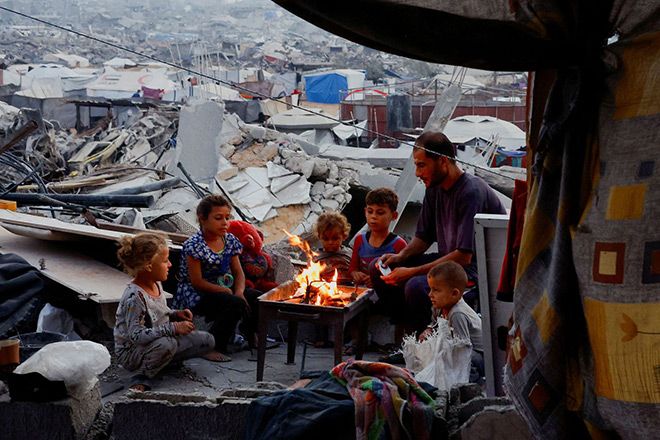
The government will dispatch civilians to work in an international body tasked with providing humanitarian assistance to Gaza and monitoring the cease-fire, and is looking for those with experience in the enclave to send.
Takeshi Okubo, who was appointed ambassador for Gaza reconstruction assistance in November, explained what Japan is seeking to do in an interview with The Asahi Shimbun.
The Civil Military Coordination Center (CMCC) was set up in October by the United States and military officers and civilians from about 50 nations, including Israel, Germany and Egypt, are participating.
“We are searching for experts from assistance entities and nongovernmental organizations who are knowledgeable about the area,” Okubo said.
The main tasks for the Japanese civilians will be humanitarian support, an early rebuilding of the health care system and the devastated infrastructure.
Okubo visited the CMCC located in Kiryat Gat in southern Israel in early December and informed his counterparts about Japan’s intention to dispatch civilians. U.S. and Israeli officials expressed high expectations for personnel contributions by Japan.
Under the Gaza peace plan engineered by U.S. President Donald Trump, the CMCC would play a key role in Gaza assistance under the Board of Peace, once it is established with Trump serving as the chair.
Pointing to the fact that Palestine is not part of the CMCC, Okubo said, “Arab nations hold concerns about a peace plan that is completely U.S.-led and with Palestine not participating. We want to establish a presence by taking part in the center.”
Okubo has served as ambassador to Lebanon as well as ambassador in charge of Palestinian affairs. He retired from the Foreign Ministry in 2022.
The U.S.-led peace plan has already run into a number of problems, including the establishment of an International Stabilization Force (ISF) to maintain the cease-fire and law and order in Gaza, as well as disarming the Hamas militant group.
By sending civilians to the CMCC, Japan hopes to fulfill a role in humanitarian assistance while also maintaining its stance of cooperating with the United States.
There are other signs of division as the United States and Israel did not take part in the November ministerial-level meeting of the Palestine Donor Group organized by the European Union and Palestine.
Regarding Japan’s aim, Okubo said, “While showing consideration toward the United States, which is a major player, we also want to put together an effective strategy and tactics for Palestinian assistance. Japan has equally good relations with all the relevant nations so we are in an important position (for implementing assistance). We had only a few options.”
According to the Palestine public health ministry, about 380 people have died in Gaza after the cease-fire from attacks by the Israeli military.
The second stage of the Gaze peace plan calls for deploying the ISF to Gaza and disarming Hamas.
But Okubo said there was no telling if Hamas could be disarmed because of uncertainty over the actions of nations such as Qatar and Turkey, which have ties with Hamas. He added that no nation wanted to be part of forcefully disarming Hamas.
He said it was highly unlikely that the Self-Defense Forces would be sent to Gaza because it would not have a clear duty and because a complete cease-fire had not yet been put in place.
Unlike the United States, Japan has been willing to provide assistance to Palestine. The supplementary budget now before the Upper House includes 25 billion yen ($160 million) in financial support that would go to Palestine through international organizations.
“There are no limits to the support needs,” Okubo said. “We want to provide support that protects the lives of each individual. We also want to help with disposing of unexploded bombs and providing rehabilitation education and prosthetic legs for children in Gaza suffering from psychological trauma because they have lost loved ones.”
AloJapan.com