
The Japanese Ministry of Defense announced plans for a squadron at Chitose Air Base to transition from the F-15J to the F-35A.
The Japanese Ministry of Defense (MoD) has announced plans for a squadron at Chitose Air Base, in Hokkaido, to transition to the F-35A Lightning II 5th generation fighter. Three squadrons of the new jet have already been assigned to Misawa and Komatsu air bases, with a total of two squadrons planned at each base.
Chitose’s new squadron
The MoD selected Chitose as the location for its fifth planned squadron after a comprehensive review. According to a file released by the Ministry, key factors behind the decision include sufficient space to host the necessary facilities and support infrastructure, good training conditions (including available airspace and the ability to coordinate with other F-35A units) and efficient aircraft replacement.
Japan plans to acquire 147 F-35s in total, with 40 of them included in the current five-year defense buildup plan running from FY 2023 to 2027. The jets that have already been funded up to FY 2024 will continue to go to the squadrons at Misawa and Komatsu, and the eight that have been requested under the FY 2026 budget are planned to be the first assigned to Chitose, with deliveries scheduled to begin in FY 2030.
 A pair of F-15DJs with the 201st TFS (Tactical Fighter Squadron). (Image credit: JASDF)
A full squadron of 20 aircraft will eventually be based at Chitose. It is stated that one of the pre-existing squadrons at Chitose, either the 201st or 203rd TFSs – both of which fly the F-15J/DJ, will be transitioning to the new jet, with the other keeping its older F-15s.
Since the F-35A will replace the squadron’s F-15s on a one-to-one basis, the total numbers stationed at the base will remain roughly the same. The MoD plans to start surveys and design work for necessary facility upgrades in the upcoming FY 2026, but it does not expect major overall personnel changes.
JASDF F-35 Squadrons
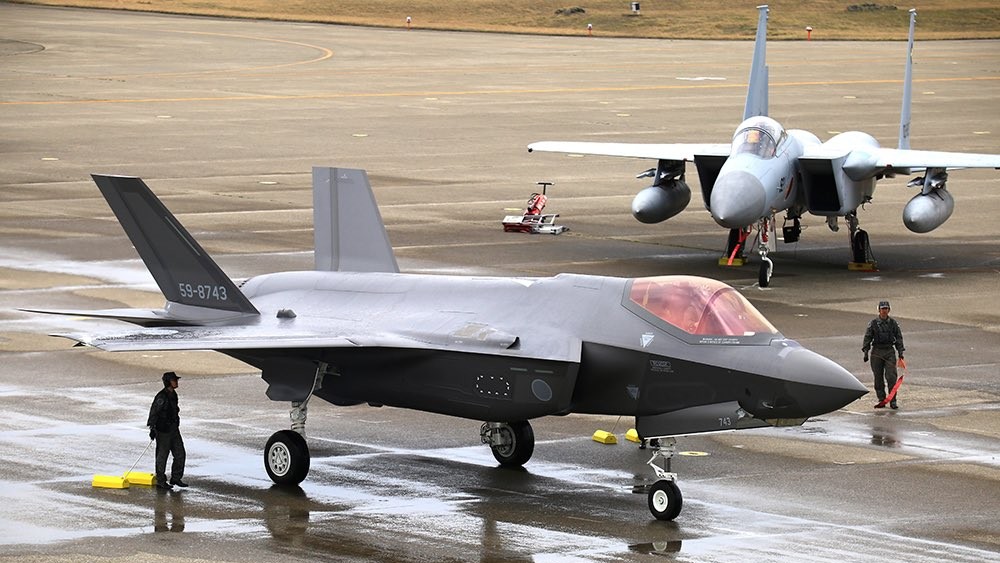
The JASDF already has three squadrons operating the jet: the 301st and 302nd TFSs based in Misawa have operated the type since 2020 and 2019 respectively, while the 303rd TFS based in Komatsu just began transitioning from the F-15J/DJ and operate both types for the time being.
 A JASDF F-35A taxiing at Misawa Air Base. Note the lack of a squadron insignia. (Image credit: JASDF)
It appears that units flying older airframes are being given priorities in terms of the F-35A’s delivery. The 301st and 302nd both operated F-4EJ Kais, while the 303rd operates pre-MSIP F-15s with less capabilities compared to its counterparts at Naha, for example.
Some of the airframes at Chitose are also older units of the long-serving Eagle that have yet to receive MSIP upgrades.
The F-35 in Japan
Japan’s security environment grew increasingly complex in recent years, with neighboring countries rapidly modernizing their air forces, particularly in the introduction of new types, some with stealth capabilities. Foreign military flights near Japanese airspace have also become more frequent.
To reinforce and strengthen defensive capabilities, Japan continues to expand its fleet of F-35s with both the CTOL (Conventional Take-Off and Landing) F-35A and STOVL (Short Take Off and Vertical Landing) F-35B variants. These aircraft offer more advanced networking systems, higher survivability, and improved situational awareness in comparison to the older F-15J/DJs and F-2A/Bs that are also in service with the JASDF (Japan Air Self-Defense Force).
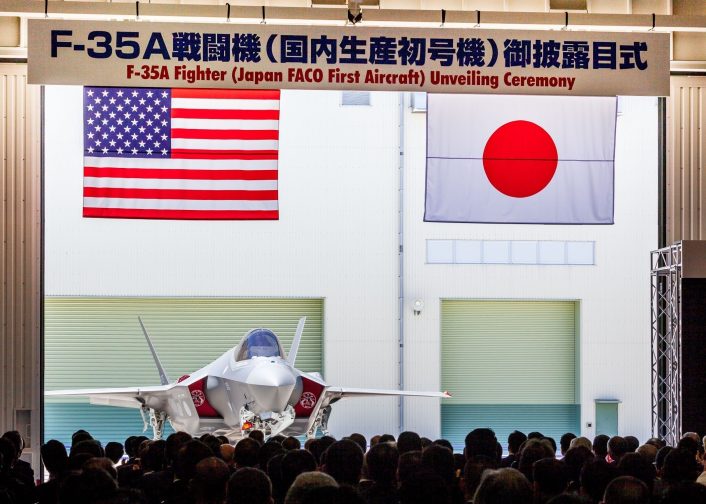 The unveiling of the first Made-in-Japan F-35A. This airframe was involved in a crash in 2019 and was lost. (Image credit: Lockheed Martin)
Of the 147 planned jets, 105 are set to be the A model with the remaining 42 being the B model – making the country the largest non-U.S. operator of the type worldwide. The deliveries of the F-35B started in 2025, with the aircraft operating at Nyutabaru under a “Temporary F-35B Flight Squadron,” although the MoD has disclosed plans to stand up the first permanent unit as the 202nd TFS.
The country is also unique in that it houses one of the FACO (Final Assembly and Check-Out) facilities of the jet in Nagoya, operated locally by MHI (Mitsubishi Heavy Industries). Only three such facilities exist worldwide, with the other two being in Italy and the U.S.
The FACO facility’s functions include the final assembly of F-35A airframes (the JASDF’s B models are being built exclusively in Lockheed Martin’s Fort Worth plant), flight testing, and MRO (Maintenance, Repair, Overhaul) for F-35 airframes in the Asia-Pacific region.
AloJapan.com