
Moment 7.5-magnitude earthquake hits JapanYour support helps us to tell the story
From reproductive rights to climate change to Big Tech, The Independent is on the ground when the story is developing. Whether it’s investigating the financials of Elon Musk’s pro-Trump PAC or producing our latest documentary, ‘The A Word’, which shines a light on the American women fighting for reproductive rights, we know how important it is to parse out the facts from the messaging.
At such a critical moment in US history, we need reporters on the ground. Your donation allows us to keep sending journalists to speak to both sides of the story.
The Independent is trusted by Americans across the entire political spectrum. And unlike many other quality news outlets, we choose not to lock Americans out of our reporting and analysis with paywalls. We believe quality journalism should be available to everyone, paid for by those who can afford it.
Your support makes all the difference.Read more
Japan has recorded a series of powerful aftershocks in the past several hours, including a magnitude 5.7 earthquake near the east coast of Honshu and a 4.9 earthquake in the Hokkaido region shortly after.
Two smaller quakes, of magnitudes 3.2 and 3, were also detected near the southern coast of Honshu.
On Tuesday, Japan’s weather agency issued its highest-level warning that a megaquake could follow Monday’s powerful tremor.
The warning covers approximately 800 miles (1,300 kilometres), stretching from Japan’s northeastern coast from Chiba, just east of Tokyo, to Hokkaido.
Monday night’s earthquake injured at least 51 people, according to the Fire and Disaster Management Agency. It also triggered widespread tsunami warnings, with waves of up to 70cm reported in several coastal communities.
The quake struck at around 11.15pm in the Pacific Ocean, roughly 50 miles off the coast of Aomori.
Tuesday’s notice was the first time this top-tier alert has been issued since the warning system was launched in 2022.
Japan turns to drones to warn people during natural disasters
Japan is increasingly using drones to help warn people during natural disasters, such as tsunamis and floods, especially in situations where human staff may not reach danger zones quickly enough or safely.
The push for drone use began after the 2011 tsunami, when municipal workers died while trying to alert residents.
Drones equipped with loudspeakers, cameras, and GPS can fly over rivers, coasts, and crowded areas to broadcast evacuation messages, officials told Japan’s Mainichi.
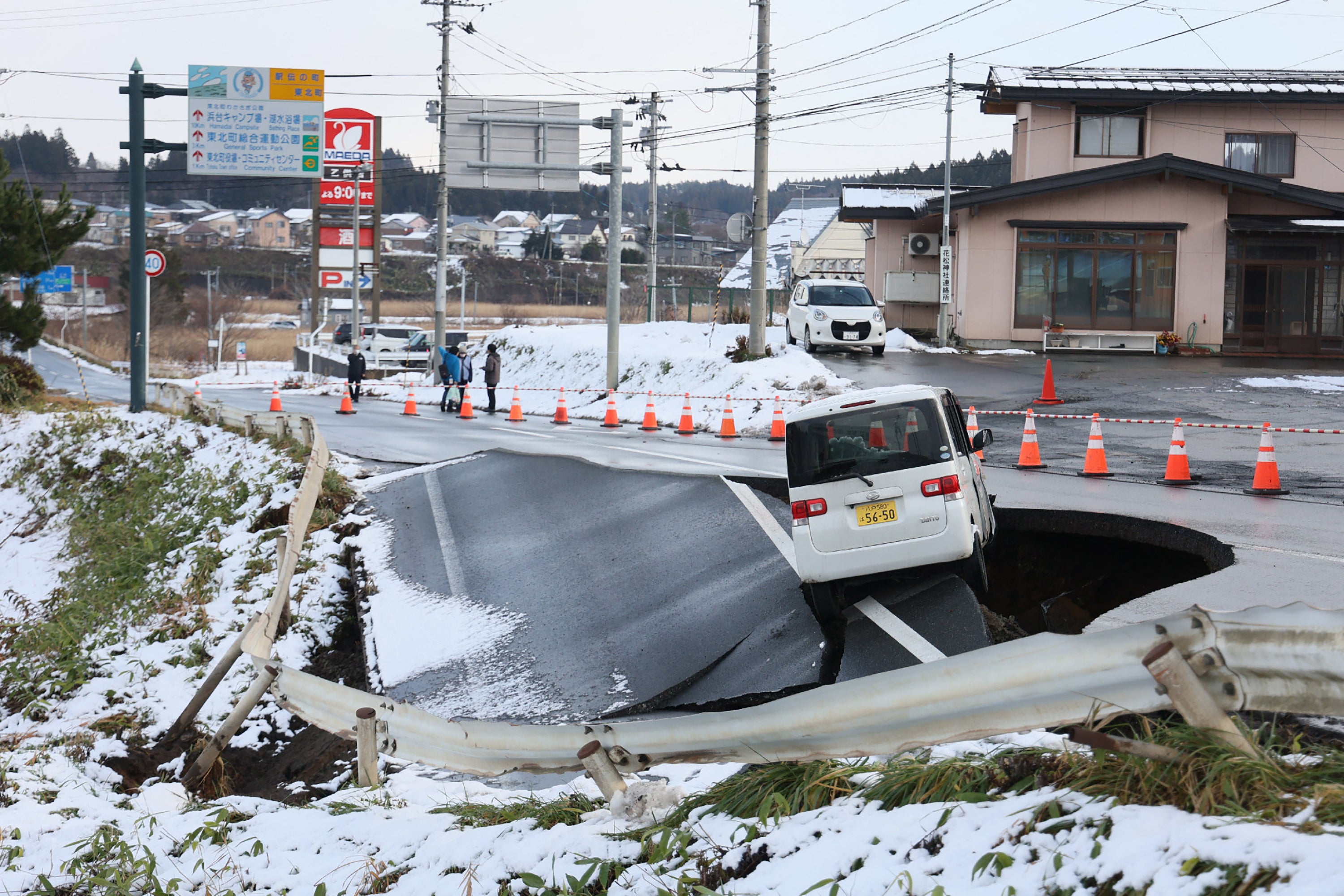 A vehicle rests on the edge of a collapsed road in Tohoku town in Aomori Prefecture on 9 December 2025, following a 7.5 magnitude earthquake off northern Japan (Photo by JIJI Press / AFP via Getty Images)
Cities like Tokushima, Sendai, Miyako, and Tsubata have begun using or testing the technology.
Sendai already uses drones that automatically launch when a tsunami warning is issued.
“It takes time for staff to gather, especially at night or on holidays, so this system offers high responsiveness. It can save lives,” a Sendai city official was quoted as saying.
Maroosha Muzaffar11 December 2025 18:30
Hachinohe pub secures bottles as megaquake advisory issued
An employee at a local pub in Hachinohe City in Aomori Prefecture was seen securing bottles and glasses with tape at the pub after Monday’s magnitude-7.5 earthquake struck off northern Japan, scattering dishes and other items.
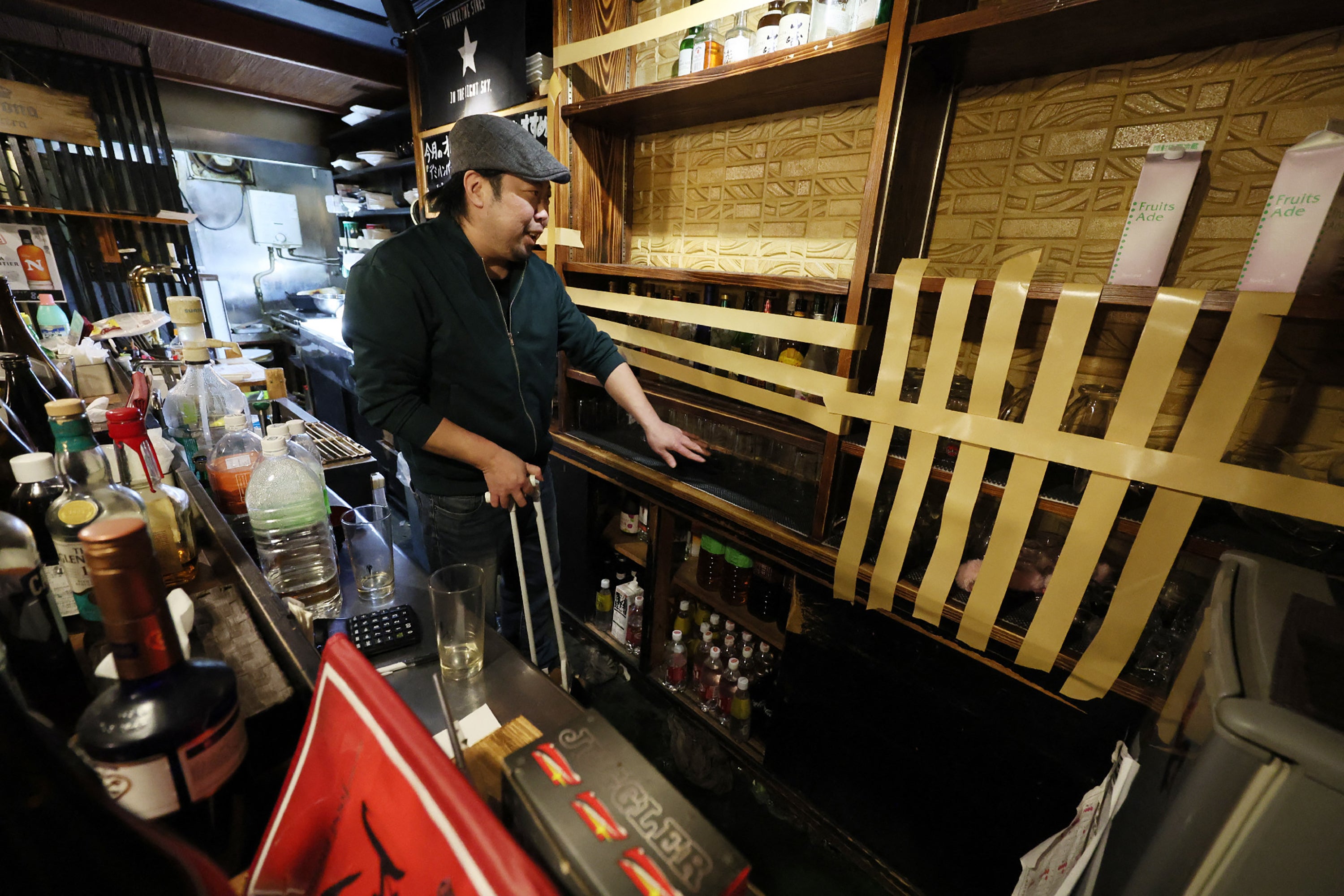 An employee uses adhesive tape to reinforce bottles and glasses to prevent them from falling at a pub (JIJI Press/AFP via Getty Images)
The nation’s weather agency has also issued a rare megaquake advisory and asked the public to stay vigilant for the next week.
The quake on Monday night injured about 51 people, damaged roads, and left thousands without power amid freezing temperatures.
Maroosha Muzaffar11 December 2025 17:30
Japanese weather agency updates number of aftershocks post Monday’s 7.5-magnitude earthquake
Japan experienced a powerful earthquake on Monday at 11.15pm local time off the coast of Aomori Prefecture, followed by a series of aftershocks over the next several days.
According to the Japan Meteorological Agency’s latest statement, from 11.00pm on 8 December to 2.00pm on 11 December, a total of 25 earthquakes of seismic intensity 1 or higher (on the Japanese earthquake intensity scale that runs from 0 to 7) were recorded.
On 9 December alone, there were a total of 16 aftershocks, according to the JMA statement.
Maroosha Muzaffar11 December 2025 16:30
Multiple tremors including one of magnitude 5.7 strike Japan
Japan has recorded a series of powerful aftershocks in the past several hours, including a magnitude 5.7 earthquake near the east coast of Honshu and a 4.9 earthquake in the Hokkaido region shortly after.
Two smaller quakes, of magnitudes 3.2 and 3, were also detected near the southern coast of Honshu.
These come after the magnitude-7.5 earthquake that struck the country on Monday night, after which a megaquake advisory was also issued.
Maroosha Muzaffar11 December 2025 15:30
What might happen if a major trench earthquake strikes
The Japanese authorities have put in place a megaquake advisory after a magnitude-7.5 earthquake struck northern Japan.
It warns that the chances of a huge earthquake of magnitude 8 or higher are greater for roughly a week after Monday night’s sizeable tremor.
A post on the Japan Meteorological Agency website provides some projections for what the impact might be if a particularly large megaquake strikes an ocean trench off Japan.
It says a megaquake of the highest class is an extremely rare event, occurring “once every thousand years or even less frequently”.
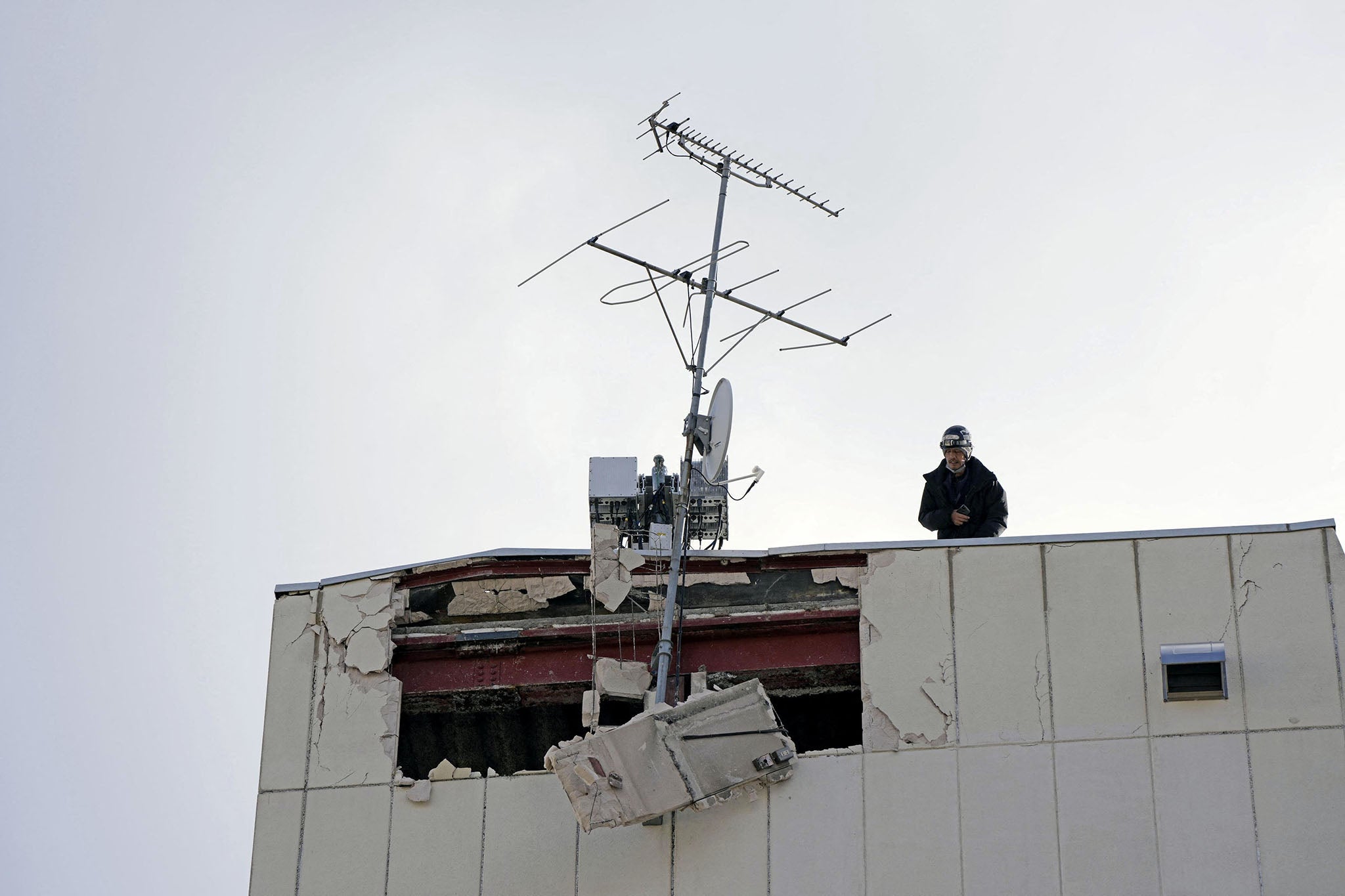 The damaged wall of a building in Hachinohe in Aomori Prefecture, northeastern Japan, on 9 December 2025, following a strong earthquake the previous night in this photo taken by Kyodo (Reuters)
The damage and casualties caused would vary depending on the season, time of day, and weather conditions.
The forecasts show that Hokkaido could face tsunamis between 10 and 20 metres, with Erimo Town possibly seeing nearly 30 metres.
Western Hokkaido areas like Tomakomai and Hakodate might get around 10 metres.
In Aomori, Hachinohe could experience tsunamis over 25 metres, while the Pacific coasts of Iwate, Miyagi, and Fukushima might see 10–30 metres.
The strongest shaking is expected in Hokkaido, with Akkeshi Town possibly reaching intensity 7 (on the Japan earthquake intensity scale), and areas east of Erimo reaching 6+.
Northern Honshu, including the Pacific coasts of Aomori and southern Iwate, could also feel 6+ intensity shaking.
Maroosha Muzaffar11 December 2025 14:30
Understanding Japan’s seismic activity and megaquake advisory
Japan sits at the junction of several tectonic plates, making it one of the most seismically active regions in the world.
While earthquakes are common, some of the most powerful and dangerous ones originate from ocean trenches.
Monday’s magnitude-7.5 earthquake in northern Japan has brought attention back to the Japan Trench and the Chishima Trench.
A trench earthquake occurs along a deep crack in the ocean floor, called a trench, where one tectonic plate slides beneath another in a process known as subduction.
Over years or decades, stress builds as the plates get stuck.
When that stress is suddenly released, it can produce a powerful megathrust earthquake.
Because these earthquakes occur under the ocean, they often generate tsunamis, which can be extremely large and destructive.
The Japan Trench, off the east coast of Honshu, and the Chishima Trench, off northern Hokkaido and stretching toward the Kuril Islands, are key locations for these events.
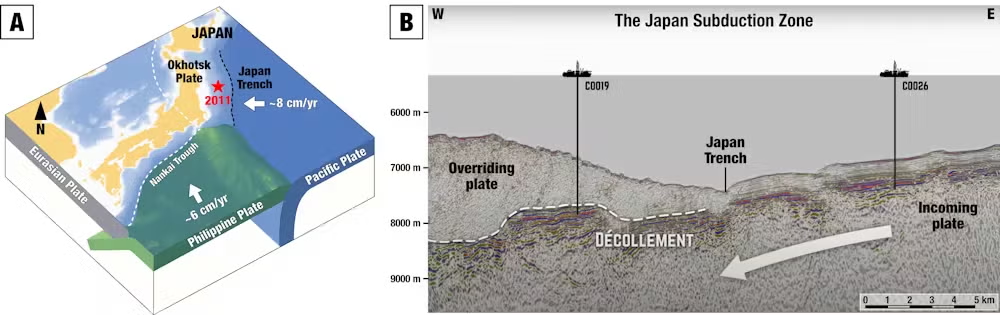 The tectonic plates in the Japan subduction zone are responsible for major earthquakes. The 2011 Tohoku earthquake is indicated by a red star (M. Brunet)
These trenches have produced some of Japan’s most devastating earthquakes, including the 2011 Tohoku earthquake, a magnitude 9.0 megathrust quake that triggered massive tsunamis along the coast.
Historical patterns show that magnitude-7 or higher quakes in these regions can be followed by even larger earthquakes, according to the Japanese Meteorological Agency (JMA).
This is why Japan established a megaquake advisory system – a special alert to warn residents of northern Japan when the risk of a major trench-type earthquake and tsunami is elevated.
Maroosha Muzaffar11 December 2025 13:30
Megaquake advisory remains in effect
Authorities have confirmed that the megaquake advisory remains in effect following Monday’s earthquake in northern Japan.
Multiple powerful aftershocks have also rocked Japan in the two days since, although none on a par with Monday night’s 7.5-magnitude tremor.
Residents and travellers in affected areas have been urged to stay vigilant, follow official guidance, and monitor updates from the Japan Meteorological Agency.
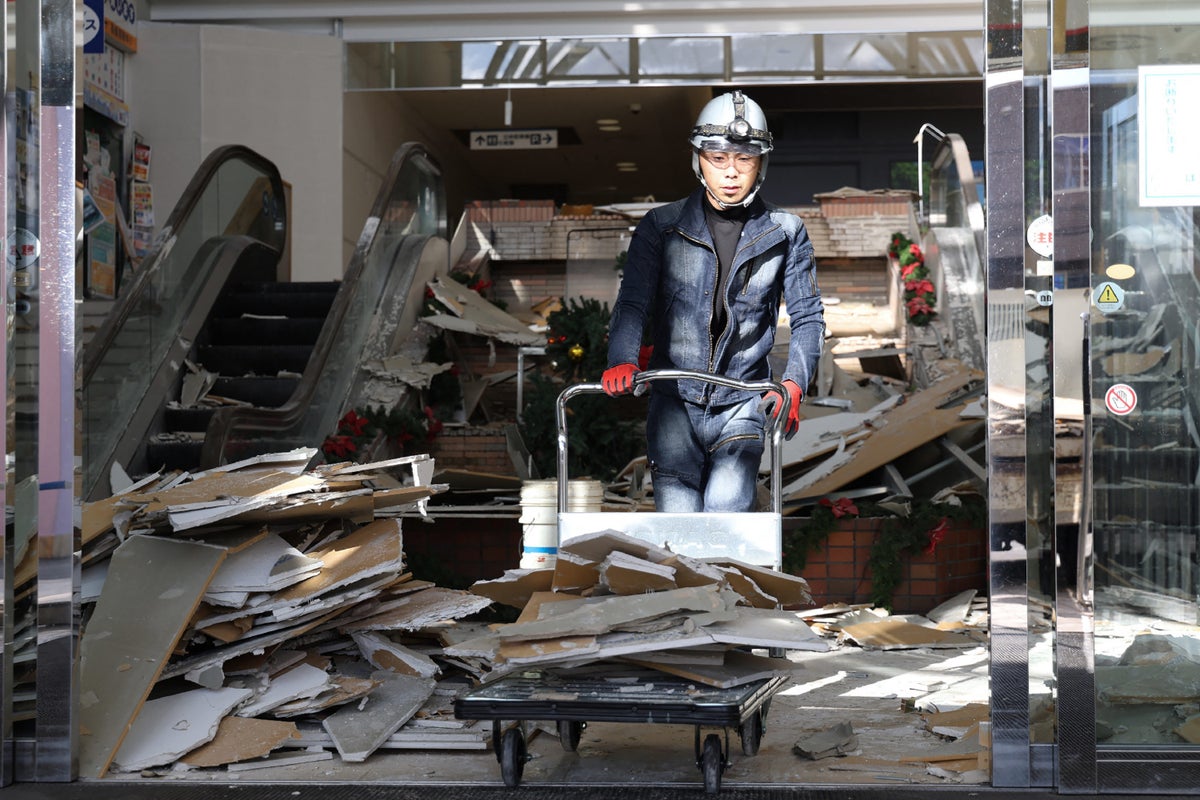
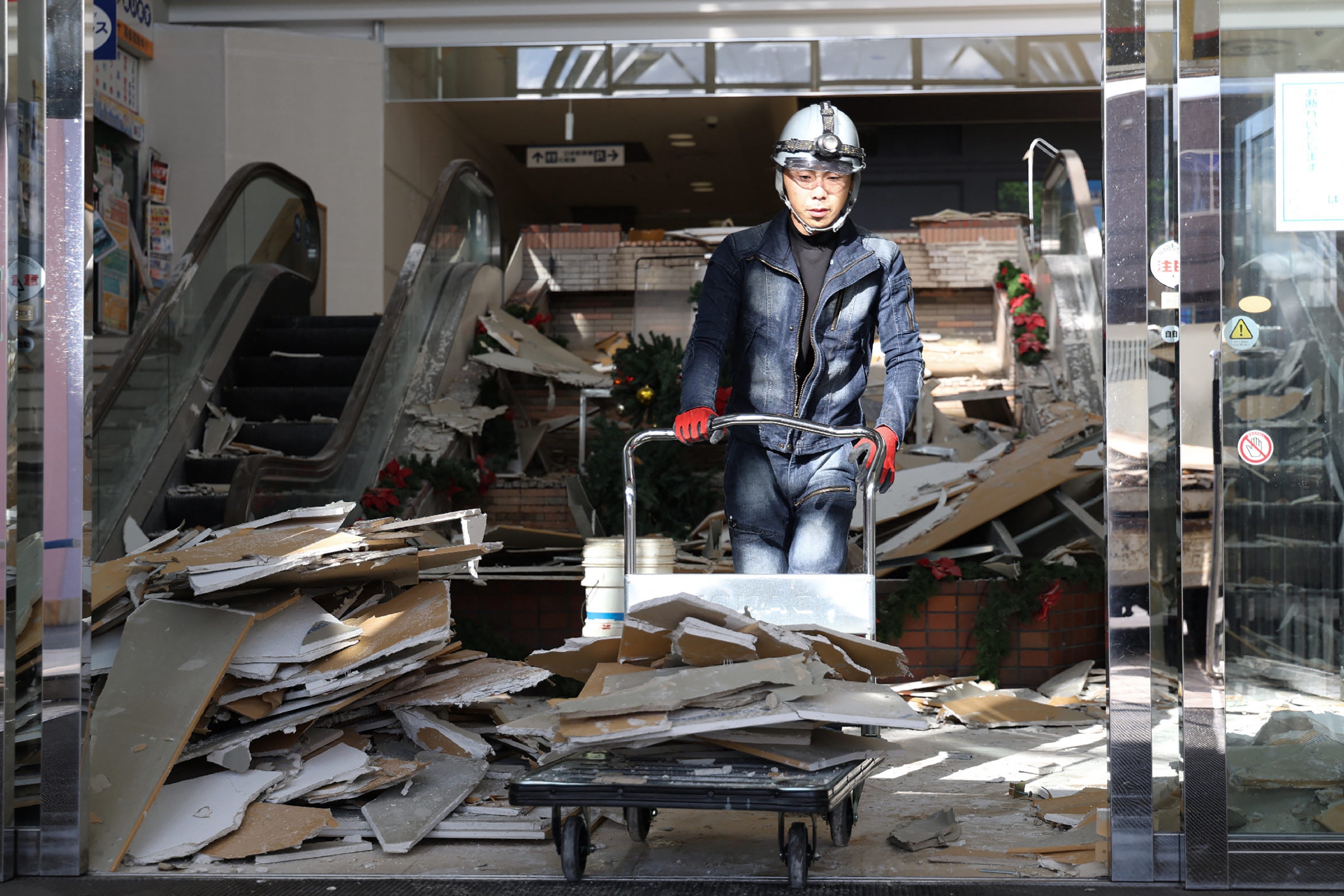 A worker clears debris at a shopping centre damaged by the earthquake in Hachinohe City, Aomori Prefecture, on 9 December 2025 (JIJI Press/AFP via Getty Images)
The megaquake advisory is in effect until 16 December. Officials estimate there is a one in 100 chance of the “big one” – an earthquake of magnitude 8 or higher – striking.
Citizens across 182 municipalities in seven prefectures along the Pacific coast, ranging from Hokkaido in the north down to Chiba Prefecture, have been asked to stay vigilant and keep megaquake grab-and-go emergency kits ready in case of any emergency.
Maroosha Muzaffar11 December 2025 12:30
Safety recommendations for residents and travellers
People in Hokkaido, Tohoku, and Pacific coastal areas from Hokkaido to Chiba – where a megaquake advisory is in effect – have been advised by the authorities to:
Stay away from coastal areas Check evacuation routes and nearby shelters Prepare emergency supplies (water, food, portable toilet, lights, chargers) Secure furniture and household items to prevent injuries Follow updates from local governments, JMA, and official emergency channels
Maroosha Muzaffar11 December 2025 11:30
Japanese weather agency issues updated safety advisory
The Japan Meteorological Agency (JMA) has issued updated guidance after the recent magnitude 7.5 earthquake in northern Japan.
JMA warned that in regions that felt strong shaking, the chances of house collapses and landslides have increased.
Residents have been urged to avoid dangerous locations like coastal areas unless necessary, monitor seismic activity and rainfall, and follow updates from local authorities.
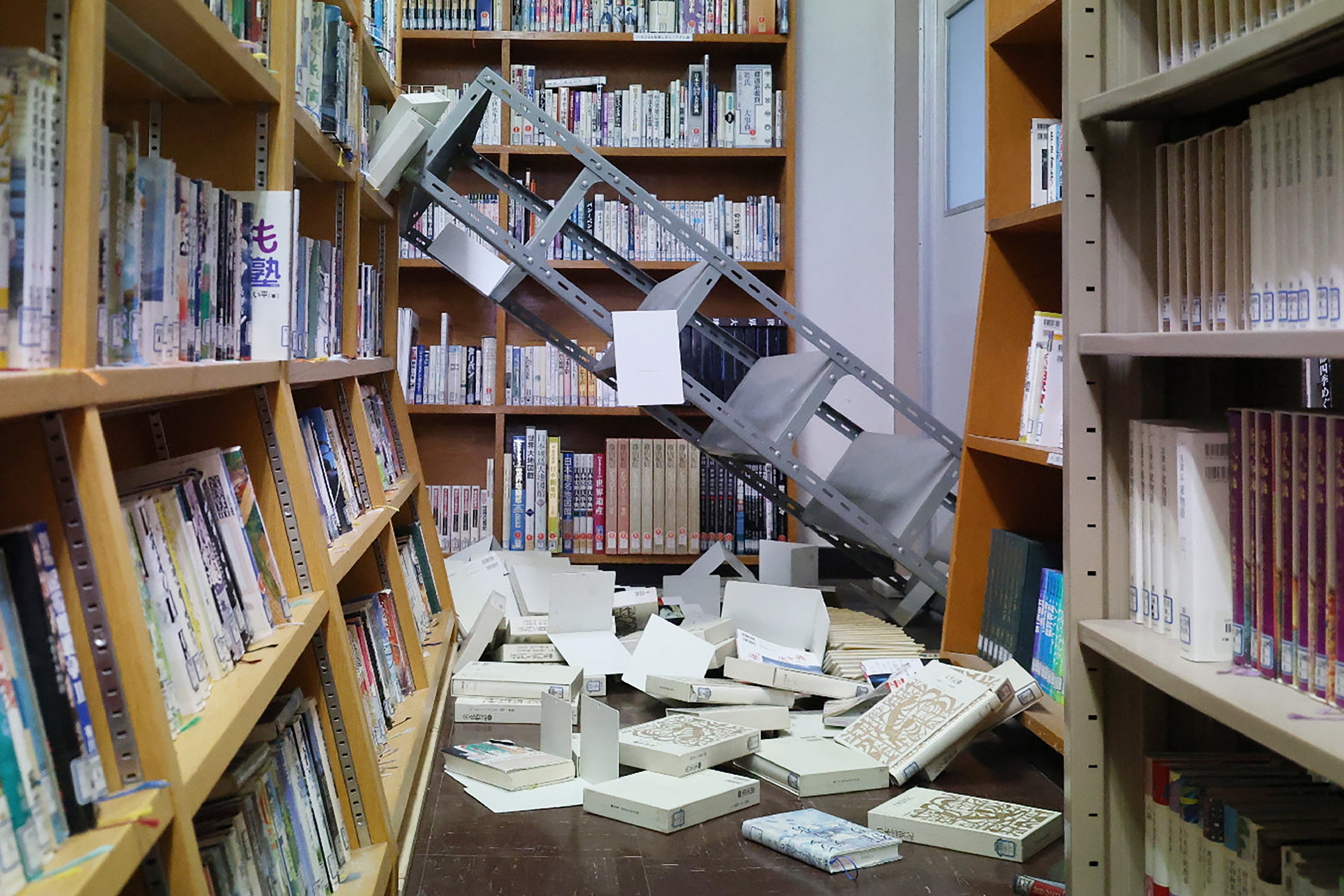 Collapsed bookshelves at a high school library are seen in Hachinohe City in Aomori Prefecture on 9 December 2025, following a 7.5 magnitude earthquake off northern Japan (JIJI Press/AFP via Getty Images)
JMA also warned that strong aftershocks – potentially up to shindo 6+ (Japanese earthquake intensity scale that runs from 0 to 7) may occur for about a week, with the highest risk in the first two to three days.
JMA says that till midnight Tuesday, residents in affected areas are asked to take special preparations, reaffirm their usual disaster readiness, check supplies, and confirm evacuation routes.
Maroosha Muzaffar11 December 2025 10:30
Mapped: Japan aftershocks after 7.5-magnitude earthquake
Japan has experienced a series of aftershocks following Monday night’s powerful earthquake off the coast of Aomori.
The initial quake, which struck around 11.15pm, about 50 miles offshore, injured at least 51 people and triggered tsunami warnings, with waves reported up to 70cm.
Since then, more than a dozen aftershocks have struck, ranging in magnitude from 1 to 6.4. A magnitude 6.4 earthquake struck off eastern Aomori Prefecture at 3.22pm local time on Tuesday.
Yesterday, a magnitude 5.7 aftershock hit near the east coast of Honshu, followed by a 4.9 quake in Hokkaido.
Smaller tremors of magnitudes 3.2 and 3 were also detected near the southern coast of Honshu.
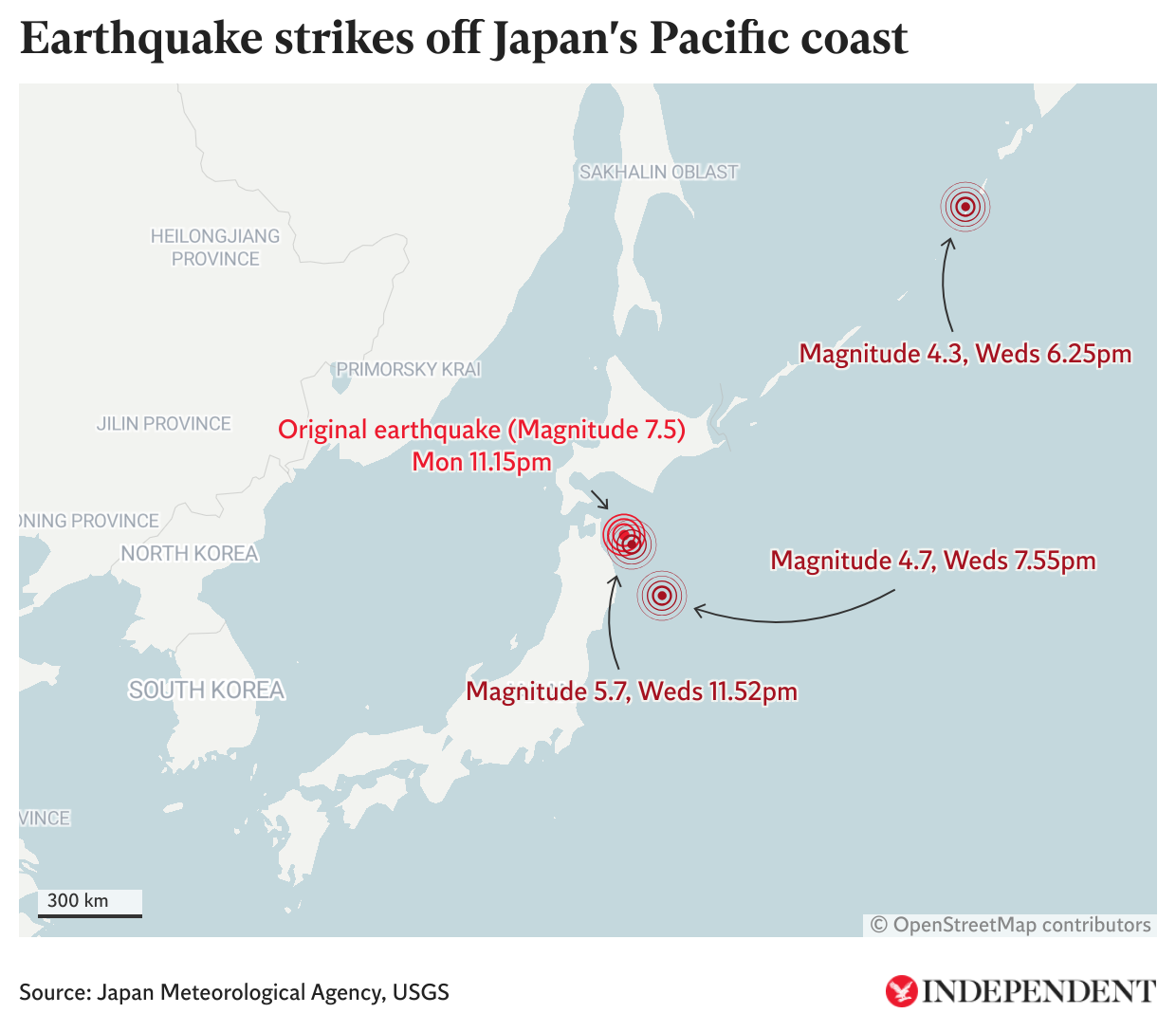 (Japan Meterological Agency/USGS/The Independent)
Maroosha Muzaffar11 December 2025 09:30
AloJapan.com