
Japanese Art and Spiritual Deer
Lee Jay Walker
Modern Tokyo Times
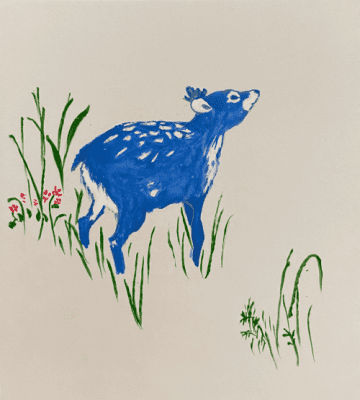
Sawako Utsumi, a contemporary artist from northern Japan, infuses this artwork with a quiet yet profound spiritual resonance. By reimagining the coloration of the deer, she gently invokes the Shinto belief that deer are sacred intermediaries—messengers of the Kami who bridge the visible world with the realm of the divine. The spiritual element remains understated, but its presence is unmistakable, lingering like a whispered blessing in the composition.
In this piece, Utsumi pays homage to Kamisaka Sekka (1866–1942), yet she moves far beyond homage alone. Her distinct palette deepens the emotional register of the scene, transforming the deer into a living symbol of purity, seasonal transience, and the subtle dialogue between humanity and nature. Through her colors and contours, the artwork becomes both a respectful nod to tradition and a contemporary meditation on spiritual presence—an image where the sacred breath of Shinto quietly glows beneath the surface.
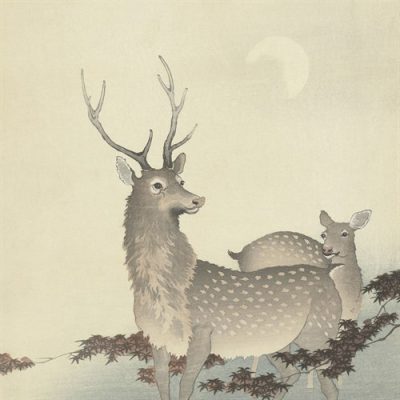
The art piece above is by Ohara Koson (1877–1945), a master of kachō-ga whose delicate touch continues to enchant art lovers across generations. Unlike the subtle, spiritually infused approach of Sawako Utsumi, Koson turns his gaze entirely toward the unadorned beauty of the deer itself. He seeks not hidden symbolism, but the poetry of form, stillness, and natural grace.
Kachō-ga traditionally centers on birds and flowers, yet Koson’s artistic curiosity extended far beyond these motifs. He crafted luminous images of animals and serene landscapes, each rendered with a sensitivity that transforms observation into quiet lyricism. The radiant deer above—captured with elegance, restraint, and a reverence for nature—reveals the depth of his vision. Through Koson’s brush, the world becomes hushed and crystalline, allowing the viewer to feel the gentle heartbeat of the natural realm.
The Toledo Museum says, “Ohara Koson was a master of the kacho-ga print—images of the natural world, but particularly of birds and flowers… Koson’s aim was to balance a naturalistic portrayal of his subjects with a decorative sensibility—and a desire to convey the spirit of the birds he depicted.”
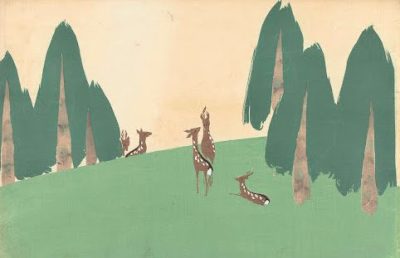
Kamisaka Sekka (1866–1942) illuminated the Rinpa world with a brilliance that felt both ancestral and boldly new. Revered as an innovator, he carried the classical Rinpa spirit into the modern age, expanding its visual language while honoring its poetic roots. His rendering of deer in the artwork above reveals this rare fusion of tradition and individuality—a quiet yet unmistakable declaration that Sekka walked his own artistic path.
Within the gentle curves and luminous forms, one senses an artist who understood that nature is not merely observed but felt. The deer becomes more than an elegant motif: it is an emblem of refined sensitivity, a creature shaped by Sekka’s ability to distill beauty into its most essential, rhythmic lines.
The Saint Louis Art Museum captures his significance with fitting clarity: “The artist, Kamisaka Sekka, is widely regarded as one of the last great masters of the Rinpa school and holds a unique position in the history of Japanese modern art.”
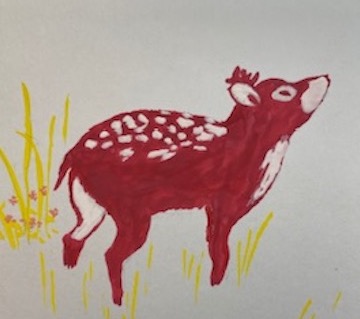
The final art piece above is also by Utsumi—echoing the sensibilities of the first—yet deepening her contemplative engagement with Shinto symbolism. Once again, she places the deer at the heart of the composition, not merely as a creature of the forest, but as a quiet emissary of the unseen. In Shinto thought, the deer has long stood as a messenger of the Kami, moving with an elegance that seems to slip between the material and the ethereal. Utsumi captures this liminality with deliberate tenderness.
Here, the deer becomes a bridge between realms—neither fully grounded in the physical world nor entirely released into the spiritual. Her palette glows with a muted sanctity: subtle tones that seem to vibrate with the presence of something greater, something gently divine. This is not a direct depiction of sacred forces, but a soft, reverent murmur of their proximity, as though the Kami have passed by moments before, leaving a quiet trail of light upon the canvas.
In Utsumi’s hands, the spiritual essence of the deer is not illustrated, but felt. It lingers in the silence between colors, in the breath of space around the form, and in the atmosphere that settles over the entire artwork. What emerges is a vision where the sacred is not declared—it simply abides, shimmering beneath the surface like a hidden prayer.
https://fineartamerica.com/featured/the-spirit-of-the-deer-sawako-utsumi.htmlThe Spirit of the Deer
https://fineartamerica.com/featured/shinto-and-the-shadow-of-the-past-illuminated-sawako-utsumi.html?newartwork=true Shinto and the Shadow of the Past Illuminated
ttps://fineartamerica.com/featured/deer-and-the-sacred-kami-sawako-utsumi.html?newartwork=true Deer and the Sacred Kami
ttps://fineartamerica.com/featured/deer-and-the-four-winds-in-japan-sawako-utsumi.html Deer and the Four Winds in Japan
https://fineartamerica.com/featured/japanese-deer-and-the-four-winds-sawako-utsumi.html Deer and the Four Winds

Modern Tokyo News is part of the Modern Tokyo Times group
http://moderntokyotimes.com Modern Tokyo Times – International News and Japan News
http://sawakoart.com – Sawako Utsumi’s website and Modern Tokyo Times artist
https://moderntokyonews.com Modern Tokyo News – Tokyo News and International News
PLEASE JOIN ON TWITTER
https://twitter.com/MTT_News Modern Tokyo Times
PLEASE JOIN ON FACEBOOK
https://www.facebook.com/moderntokyotimes
AloJapan.com