
As someone staring down the barrel of untangling a box of Christmas lights, I won’t lie, a not tiny part of me wants to throw them in the bin and replace the whole lot with a fresh set from the shop. (I must stress, I won’t be doing that. But the urge still stands.) However, Restory is a cosy game that appeals to the better angel of my nature, the part that will patiently untangle the lights so they can be enjoyed for another year.
Restory sets you up as the manager of a small Tokyo electronics maintenance shop at the turn of the millennium. Customers bring you broken devices to painstakingly disassemble, clean, and replace their broken parts, restoring them to working order. Though you can also order broken devices and spare parts online using your delightfully dated PC.
Watch on YouTube
The money you earn from your work goes on rent and bills, and paying for the licenses to allow you repair more complicated and valuable tech. Though, from my time with the demo, the management side of Restory is on the lighter side – you aren’t going to be adjusting the prices to undercut nearby businesses or seeking out unofficial parts to restore devices, for instance.
Due for release in 2026, if you head over to Steam you can take part in Restory’s first playtest. I’ve spent an hour with the demo so far and I’m enjoying its mix of management game and simulator, but there are aspects that aren’t quite gelling for me yet.
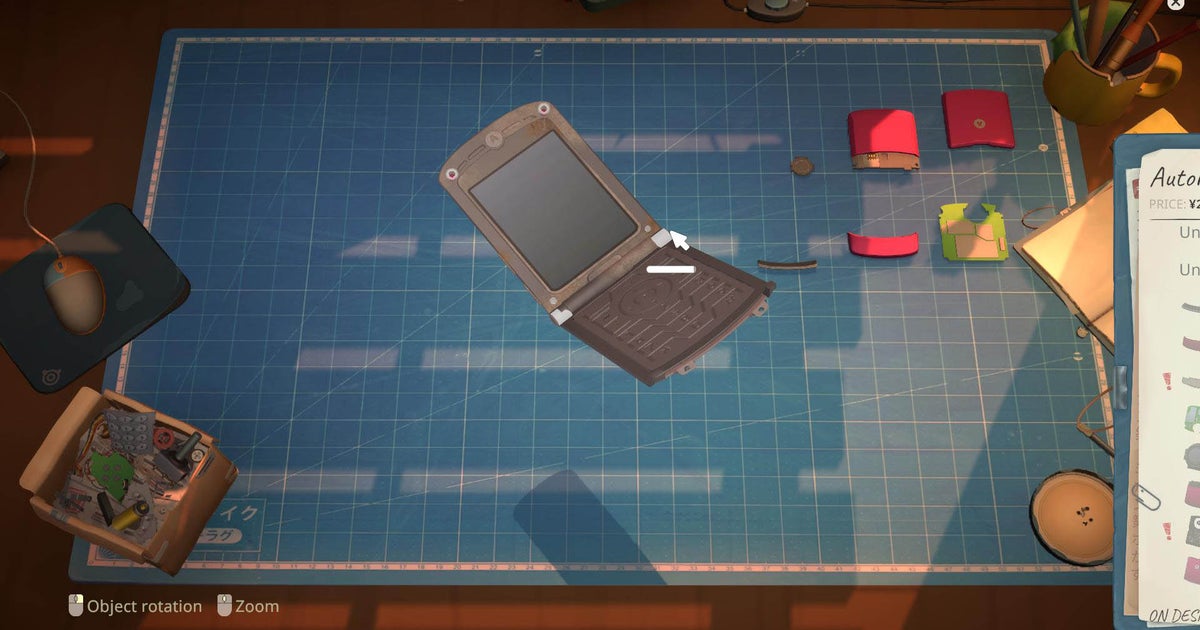
Restory’s repair jobs, at least as I’ve discovered in the demo, are fairly simple. You disassemble a device. Slide broken parts straight into the bin under your workbench. Order new parts from your computer terminal. Clean the dirt, dust, and rust from the pieces that remain. Fit everything back together and return it to the customer. In a game about restoration, the items in your hands feel both disposable and interchangeable, even as the stories speak to the items being unique.
Image credit: Rock Paper Shotgun / Tinybuild / Mandragora
One of the joys of other restoration cosy games, such as Assemble With Care, comes from fiddling with the innards of machines. Rotating camera mirrors, spooling tapes, connecting wires in an effort to diagnose the problem with the machine you’re repairing. It may only be a slight puzzle to solve, but that connection with the kit in your virtual hands makes the action meditative. You contemplate the object in front of you.
Assemble With Care may be an unfair comparison, as you only encounter each of its objects once, making them unique within the game. Whereas Restory is a longer game in which you encounter the same device repeatedly. While the (off-brand) recreations of 2000s tech, such as a ‘Pokia’ 3310 and an ‘Autorolla’ Razor, initially inspired feelings of nostalgia, by the fifth time I was unpacking a handset that looked identical to the others that preceded it, the devices lost their lustre. If even the colourshemes of the phones or the tamagotchi were to vary it might make each repair job more distinct.
However, there is still a tonal mismatch between treatment of objects in Restory and its stories. In one, for instance, a security guard arrives at your store requesting you fix his flashlight. The torch is rare, he says, and important to him. So I buy another one online, strip it for parts and repair his flashlight to return to him. While he leaves happy, cannibalising one item to fix another seems at odds with the messaging of the game.
Image credit: Rock Paper Shotgun / Tinybuild / Mandragora
While broadly the customer stories are enjoyably told – such as the recluse who lives above your store, who communicates with you via messages and items lowered to your window in a plastic bucket – they don’t all work so well. In the listing details of an off-brand Tamogotchi on the in-game auction site, a seller writes “It was my son’s. I don’t understand these things… Please don’t let it die. I can’t get my son back, but at least his memory lives on.” What could be a poignant story, instead feels cheapened for its throwaway nature compared to the time lavished on the guard who wants his flashlight fixed. Especially as you can immediately strip the toy to pieces to distribute among other broken toys.
What is already on Restory’s workbench made for a distracting hour, but hopefully between now and release it can gain a little more variety. There is a version of running a small electronics shop – buying, restoring, and selling items to meet rent and pay bills – that could be thoroughly absorbing. PC Building Simulator, Hardspace: Shipbreaker, and Trash Goblin show how diverting these kinds of granular manual work can be. It’s just not yet clear if Restory will become one of them.
AloJapan.com