
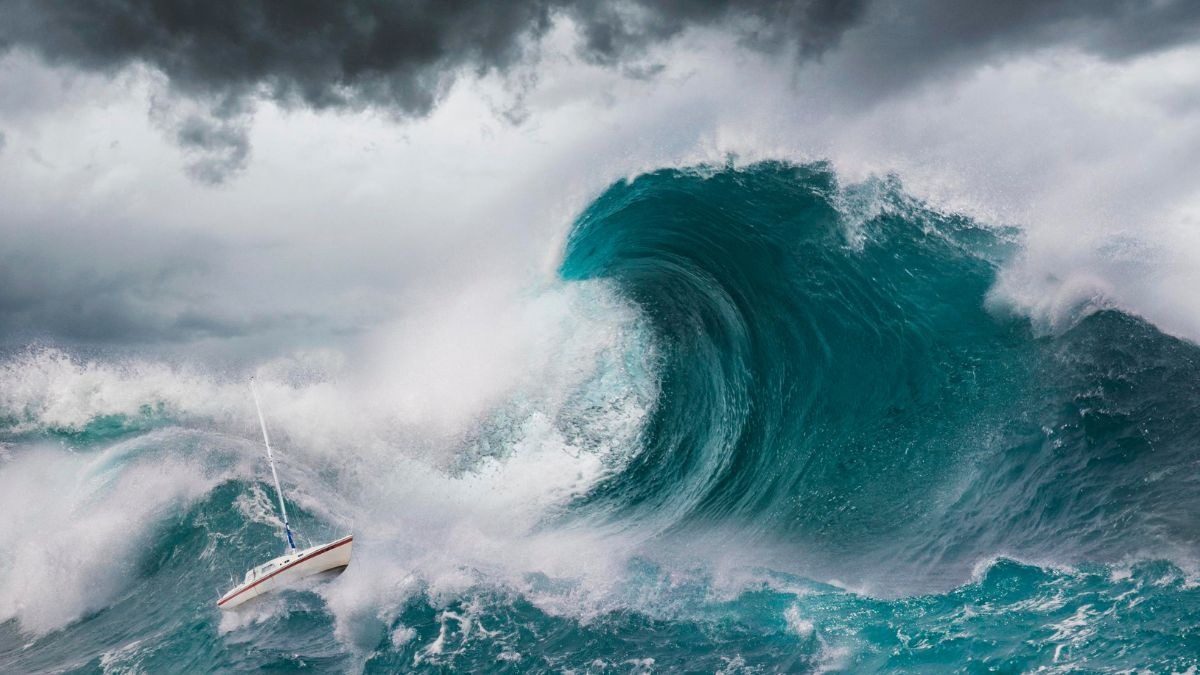
Japan, where tremors are extremely common, is living under an official “subsequent earthquake advisory”, a first for the Hokkaido–Sanriku coastal region.
On December 8, a magnitude-7.6 earthquake struck off the eastern coast of Aomori Prefecture. The following day, the Japan Meteorological Agency (JMA) issued the advisory, warning that a much larger earthquake, a megaquake of magnitude 8 to 9, could hit the offshore trench from Hokkaido to Sanriku within the next week.
Earthquakes often trigger tsunamis because sudden vertical movement of the seafloor displaces a huge column of water above it, releasing immense energy.
HOW HIGH CAN TSUNAMI WAVES REACH?
The burning question on everyone’s mind is how high the tsunami waves could reach.
Official Japanese government simulations, released in 2021 by the Cabinet Office’s Central Disaster Management Council, paint a grim picture for the Hokkaido-Sanriku stretch. In the worst-case scenario, tsunamis could exceed 30 metres (98.4 feet) along parts of eastern Hokkaido and the Sanriku Ria Coastline, Japan’s longest and most rugged submerged river-valley coast. Narrow bays and local topography may amplify waves still further.
In low-lying areas, inundation could extend 10 to 20 kilometres inland, with the first surge arriving just five to 10 minutes after the fault ruptures beneath the sea floor. Such an event could claim up to 2,00,000 lives, roughly 80 per cent of them through drowning.
The size of an earthquake that generates a tsunami is measured by Moment Magnitude (Mw), which reflects total energy across all wave frequencies. The 2011 Tohoku earthquake, Mw 9.0, produced the highest instrumentally recorded tectonic tsunami run-up in history: 40.5 metres (133 feet) at Miyako, Iwate. Run-up is the maximum vertical height seawater reaches on land, showing both destructiveness and inland penetration.
Location of the March 11, 2011, magnitude-9 earthquake epicenter (star on globe, red dot on map). (Photo: USGS)
The zone now under advisory lies immediately north of the 2011 rupture, in a segment of the Japan Trench that has not cracked since 1677.
These giant waves are possible because the Pacific Plate is sliding westward beneath the plate carrying northern Japan at about eight centimetres per year. A sudden rupture could lift the sea floor by more than ten metres.
The 2011 Tohoku earthquake, Mw 9.0, produced the highest instrumentally recorded tectonic tsunami run-up in history: 40.5 metres at Miyako, Iwate. This is an animation of the 2011 tsunami. (Photo: USGS)
Japan’s steep, narrow bays then act as funnels, allowing waves to grow dramatically taller, according to the United States Geological Survey.
As of December 10, the probability of a megaquake occurring remains low, about one in a hundred. Yet, Japan is taking no chances: even a one per cent risk of a 100-foot wall of water is reason enough to stay vigilant.
– Ends
Published By:
Radifah Kabir
Published On:
Dec 10, 2025
Tune In
AloJapan.com