
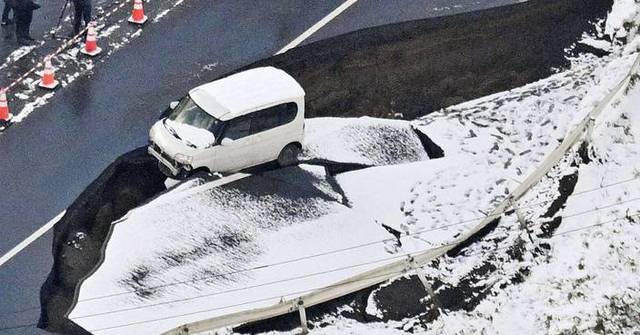
TOKYO (AP) — Japan issued a megaquake advisory Tuesday after a magnitude 7.5 earthquake struck off the eastern coast of Aomori, the northernmost prefecture of Japan’s main island of Honshu, and just south of the northern island of Hokkaido. Damage from this quake was modest — 34 mostly mild injuries and some damage to roads and buildings.
Officials said the advisory is not a prediction and the probability of a magnitude 8 or larger quake is only about 1%. But there’s hope the advisory will serve as a wake-up call for a quake that could have the devastation of the 2011 disaster that killed nearly 20,000 people and destroyed a nuclear plant.
There’s said to be an increased risk of a subsequent, magnitude-8 or larger quake within the next week. Officials are urging residents, especially along coastal areas, to be well prepared so they can grab an emergency bag and run as soon as possible if a bigger quake hits.
This advisory seemed mindful compared with another advisory last year. The southern half of Japan’s Pacific coastline received a “Nankai Trough” megaquake advisory in the summer of 2024, but the ambiguity of that warning led to panic buying of emergency food, event cancellations and business closures.
The Japan Meteorological Agency says Monday’s powerful quake temporarily increased potential risks in the regions of Hokkaido and the Sanriku coast. That’s where the Pacific Plate beneath Japan forms the two trenches — the Japan Trench and Chishima Trench — that have caused many large quakes in the past.
Experts say the deadly quake and tsunami in 2011 was caused by movement associated with the Japan Trench. It spans from off the eastern coast of Chiba to Aomori, and the Chishima Trench goes from the eastern coast of Hokkaido to the northern islands and the Kurils.
In explaining the advisory, the JMA said the magnitude 9.0 quake on March 11, 2011, that devastated large swaths of Japan’s northern coast occurred two days after a magnitude 7.3 temblor that occurred at the Japan Trench off the eastern coast of Iwate, one of the hardest-hit areas in that disaster as well as in Monday’s quake.
The 2011 quake caused a tsunami that battered northern coastal towns in Iwate, Miyagi and Fukushima prefectures. The tsunami, which topped 15 meters (50 feet) in some areas, slammed into and destroyed the Fukushima Daiichi nuclear power plant. That created deep fears of radiation that linger to this day.
Another offshore megaquake in the Hokkaido-Sanriku area could cause up to a 30-meter (98-foot) tsunami in the region, kill as many as 199,000 people, destroy up to 220,000 houses and buildings, and cause estimated economic damages of up to 31 trillion yen ($198 billion), according to an estimate by the government. It says as many as 42,000 people could suffer from hypothermia in the winter.
The areas covered by the advisory extend across 182 municipalities from Hokkaido to Chiba Prefecture.
Japan’s separate advisory for an even more damaging megaquake stemming from the Nankai Trough, which affects the southern half of Japan’s Pacific coast, was activated for the first time last August after a magnitude 7.1 quake occurred off the eastern coast of Miyazaki.
In a 2013 damage estimate for a possible Nankai Trough megaquake, the government said a magnitude 9.1 quake could generate a tsunami exceeding 10 meters (33 feet) within minutes, killing as many as 323,000 people, destroying more than 2 million buildings and causing economic damage exceeding 200 trillion yen ($1.28 trillion) in the region.
Officials are stressing that the latest advisory has no prediction for any megaquake happening at any specific time or location, a Cabinet official for disaster prevention, Tsukasa Morikubo, told a news conference early Tuesday. He called on residents to be cautious and prepared while continuing their daily activity and work.
Officials urge people to keep an emergency bag containing a few days’ worth of daily necessities along with shoes and helmets. People in the region are also advised to discuss evacuation procedures with family members and sleep in day clothes, not in pajamas, so they can flee immediately. Furniture should also be fixed to the floor or the wall.
The designated municipalities explained the advisory on their websites and started inspecting stocks of relief goods and equipment to be used at evacuation centers.
Iwaki City in Fukushima urged residents to register for emergency emails, while officials in the town of Oarai in Ibaraki Prefecture, northeast of Tokyo, inspected wireless communication devices.
Japan’s first megaquake advisory in August of last year contained a lot of scientific jargon. It worried and baffled many across the country. Some towns closed beaches and canceled annual events, disappointing many travelers during Japan’s Buddhist holidays.
Many people postponed planned trips and rushed to stock up on rice, dried noodles, bottled water and portable toilets, leaving shelves empty at many supermarkets in western Japan and even Tokyo, which is outside of the at-risk area.
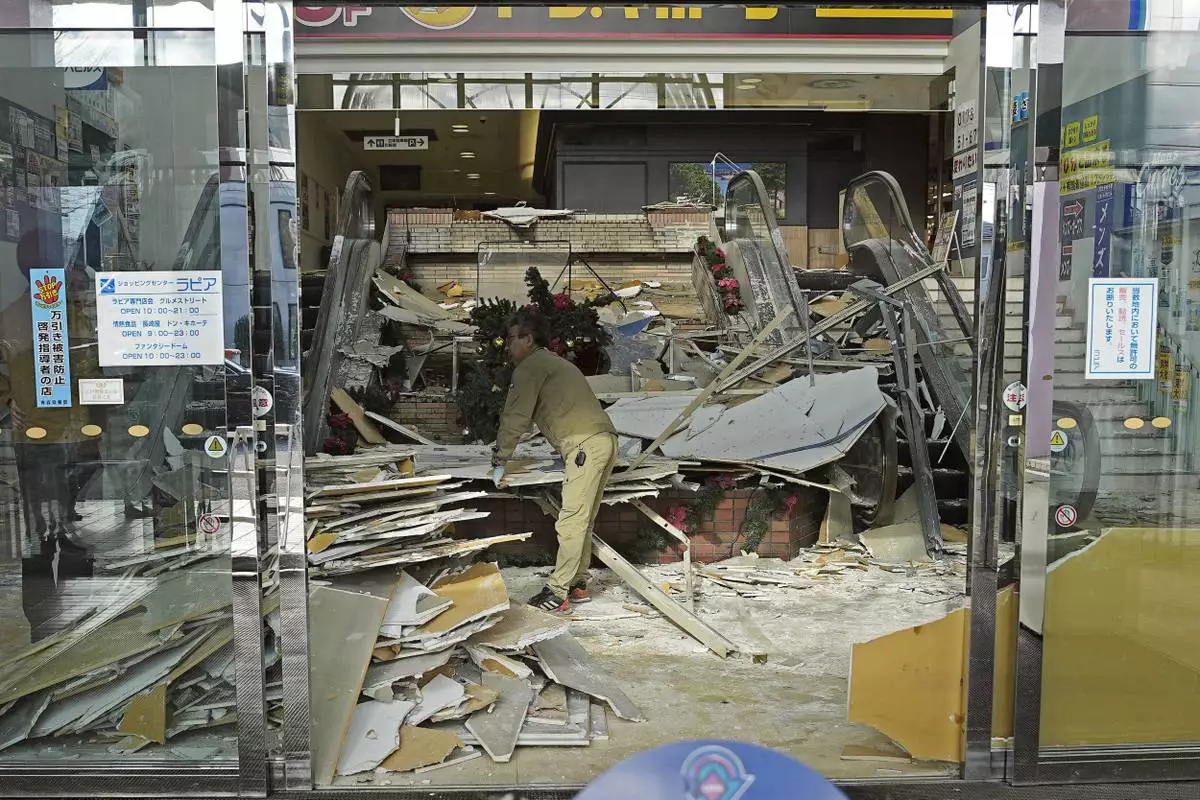
A man clears the debris from a powerful earthquake at a commercial facility in Hachinohe, Aomori prefecture, northern Japan Tuesday, Dec. 9, 2025. (Ren Onuma/Kyodo News via AP)
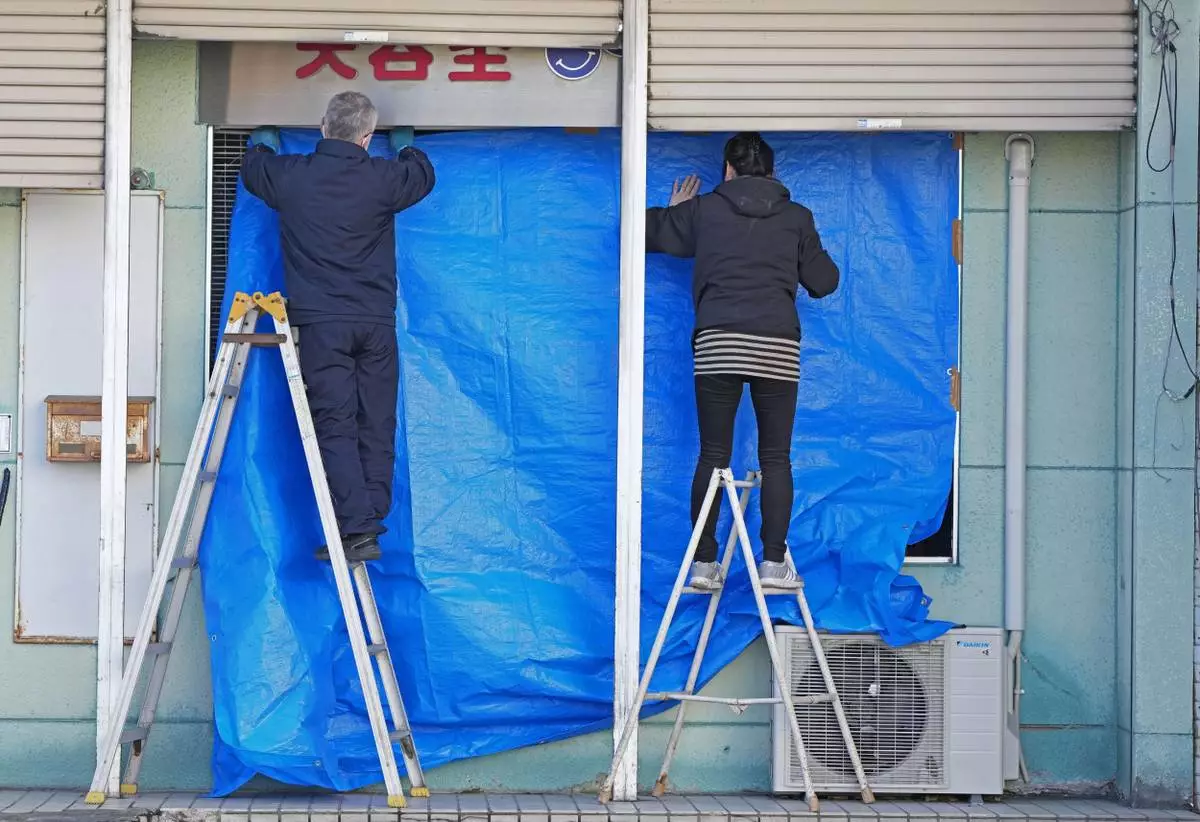
People cover the broken glasses with a blue sheet at a beauty salon in Hachinohe, Aomori prefecture, northern Japan Tuesday, Dec. 9, 2025, following a powerful earthquake on late Monday. (Kazuki Kozaki/Kyodo News via AP)
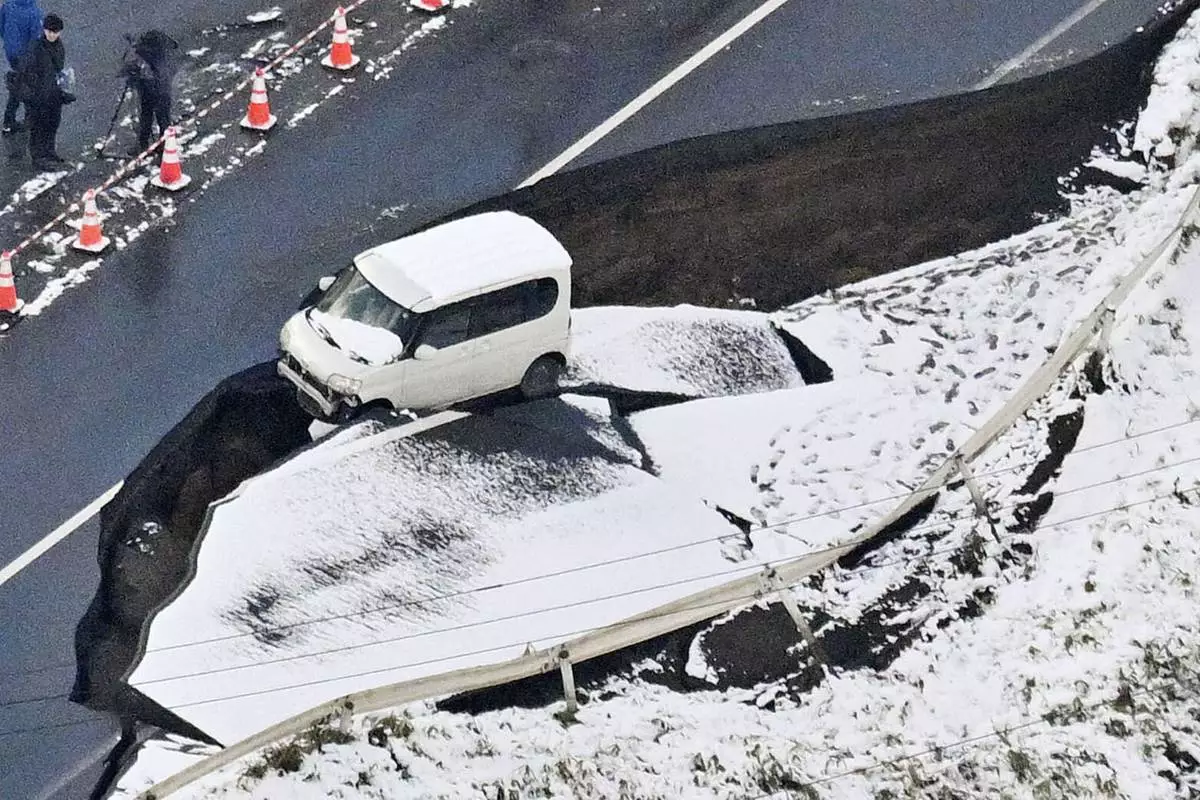
This aerial photo shows a vehicle sitting on a damaged road in Tohoku town, Aomori prefecture, northern Japan Tuesday, Dec. 9, 2025, following a powerful earthquake on late Monday. (Kyodo News via AP)
THE HAGUE, Netherlands (AP) — Judges at the International Criminal Court sentenced a leader of the feared Sudanese Janjaweed militia to 20 years imprisonment Tuesday for war crimes and crimes against humanity committed in the catastrophic conflict in Darfur more than two decades ago.
At a hearing last month, prosecutors sought a life sentence for Ali Muhammad Ali Abd–Al-Rahman who was was convicted in October of 27 counts of war crimes and crimes against humanity that included ordering mass executions and bludgeoning two prisoners to death with an ax in 2003-2004.
“He committed these crimes knowingly, willfully, and with, the evidence shows, enthusiasm and vigor,” prosecutor Julian Nicholls told judges at the sentencing hearing in November.
Abd-Al-Rahman, 76, stood and listened, but showed no reaction as Presiding Judge Joanna Korner passed the sentence. He was handed sentences ranging from eight years to 20 years for each of the counts for which he was convicted before the court imposed the overarching joint sentence of 20 years.
She said that Abd-Al-Rahman “not only gave the orders that led directly to the crimes” in attacks that largely targeted members of the Fur tribe perceived as supporting a rebellion against Sudanese authorities, he “also personally perpetrated some of them using an ax he carried in order to beat prisoners.”
The court’s prosecution office said that its staff would study the sentencing decision to decide whether to “take further action.” The office could appeal the sentence and renew its call for a life term.
The office said in a written statement that it sought a life sentence “owing to the extreme gravity of the crimes Mr. Abd-Al-Rahman was convicted of — murders, rapes, torture, persecution and other crimes carried out with a high level of cruelty and violence as a direct perpetrator, as a co-perpetrator and for ordering others to commit such crimes.”
It added that it also took into account the large number of victims, that included at least 213 people who were murdered, including children, and 16 women and girls who were victims of rape.
Abd–Al-Rahman, who is also known as Ali Kushayb, is the first person convicted by the ICC for atrocities in Sudan’s Darfur region, where trial judges ruled that the Janjaweed crimes were part of a government plan to stamp out a rebellion there.
The ICC has a maximum sentence of 30 years imprisonment, but judges have the discretion to raise that to life in extremely grave cases. Abd-Al-Rahman’s time in detention before and during his trial will be deducted from the sentence.
Abd-Al-Rahman’s crimes were committed more than two decades ago, but violence continues to plague Darfur as Sudan is torn apart by civil war. ICC prosecutors are seeking to gather and preserve evidence from a deadly rampage last month in a besieged city in the region.
The latest alleged atrocities in famine-hit el-Fasher “are part of a broader pattern of violence that has afflicted the entire Darfur region” and “may constitute war crimes and crimes against humanity,” the ICC statement said, noting that evidence could be used in future prosecutions.
Korner said that ICC sentences are imposed as a deterrent to prevent other crimes in the future.
“Deterrence is particularly apposite in this case given the current state of affairs in Sudan,” she said.

Presiding judge Joanna Korner enters the court room to read the verdict for Ali Muhammad Ali Abd al-Rahman, a leader of the Sudanese Janjaweed militia, at the International Criminal Court, ICC, in The Hague, Netherlands, Tuesday, Dec. 9, 2025. (AP Photo/Peter Dejong, Pool)

Ali Muhammad Ali Abd al-Rahman, a leader of the Sudanese Janjaweed militia, enters the court room at the International Criminal Court, ICC, in The Hague, Netherlands, Tuesday, Dec. 9, 2025. (AP Photo/Peter Dejong, Pool)

Deputy Prosecutor of the International Criminal Court Nazhat Shameem Khan waits to hear the verdict of the International Criminal Court, ICC, for Ali Muhammad Ali Abd al-Rahman, a leader of the Sudanese Janjaweed militia, in The Hague, Netherlands, Tuesday, Dec. 9, 2025. (AP Photo/Peter Dejong, Pool)

Ali Muhammad Ali Abd al-Rahman, a leader of the Sudanese Janjaweed militia, at the International Criminal Court, ICC, in The Hague, Netherlands, Tuesday, Dec. 9, 2025. (AP Photo/Peter Dejong, Pool)

Ali Muhammad Ali Abd al-Rahman, a leader of the Sudanese Janjaweed militia, waits to hear the verdict of the International Criminal Court, ICC, in The Hague, Netherlands, Tuesday, Dec. 9, 2025. (AP Photo/Peter Dejong, Pool)
AloJapan.com