
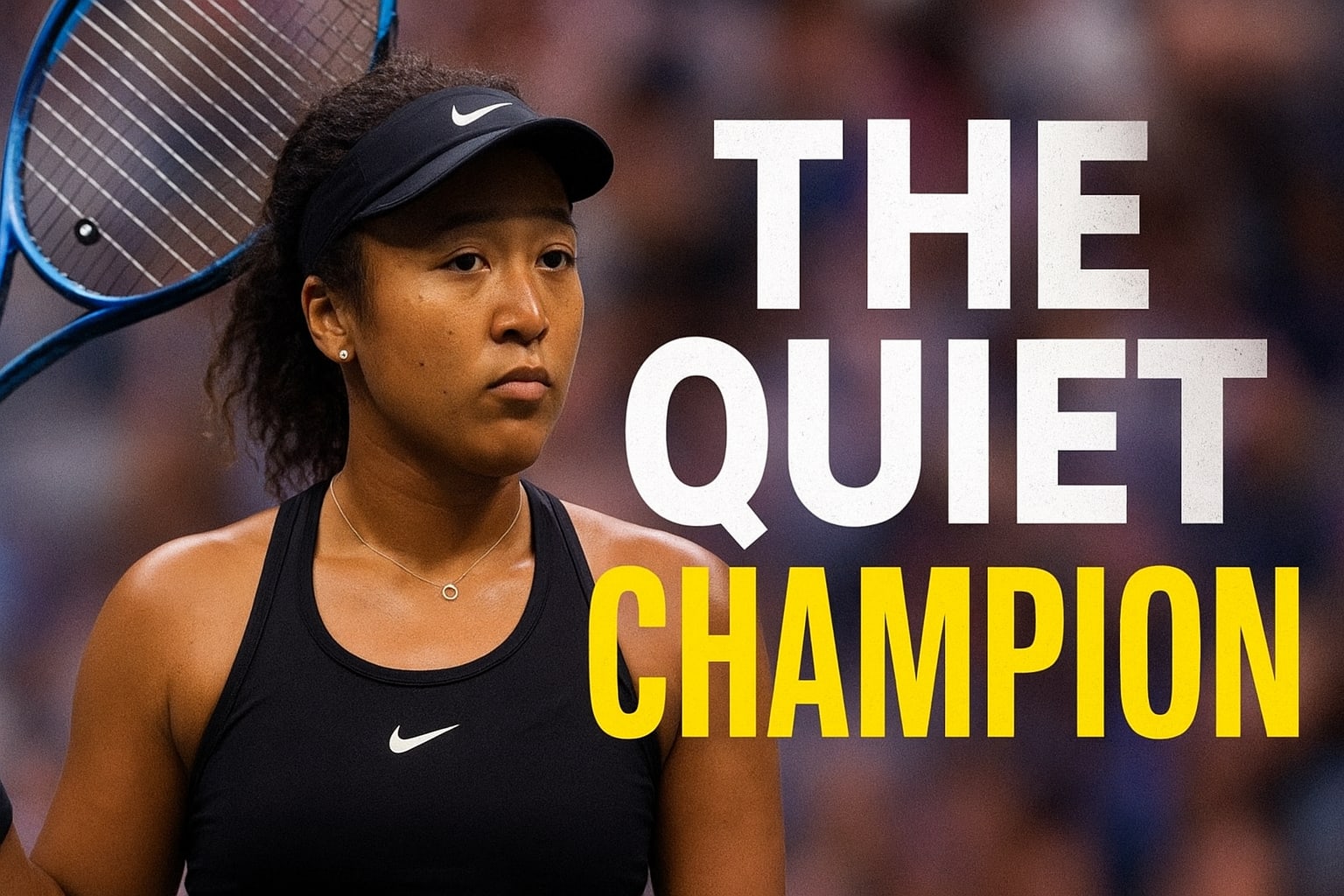
Naomi Osaka: The Quiet Assassin Who Burned the Rulebook
Behind the trophies and the headlines lies a brutal truth. Discover the raw, unfiltered story of Naomi Osaka, the athlete who broke the silence on mental health and changed sports forever.
Introduction: The Girl Who Didn’t Make Sense
In the sleek, sanitized world of professional tennis, Naomi Osaka was a glitch in the matrix.
Tennis loves a specific archetype: The bubbly teenager. The fiery warrior. The graceful queen. It demands you pick a lane, pick a flag, and play the part. You smile for the cameras, you answer the stupid questions, and you pretend that hitting a yellow ball over a net is the most important thing in the universe.
Naomi Osaka didn’t do any of that.
She walked onto the court with her head down. She wore headphones like armor. She spoke in a voice so soft you had to lean in to hear it. She looked like she wanted to be anywhere else but in the spotlight.
But then the ball was tossed, and the “shy girl” vanished. In her place was a cold-blooded assassin. A woman who could hit a forehand at 100 miles per hour without blinking. A player who didn’t grunt, didn’t scream, and didn’t celebrate until the job was done.
The world tried to put her in a box. Was she Japanese? Was she American? Was she Haitian? Was she Black? Was she Asian?
Naomi Osaka didn’t fit in your boxes. So she burned them.
This isn’t a story about a tennis prodigy. This is a story about a woman who was forged in isolation, broke under the weight of the world, and had to rebuild herself piece by jagged piece.
Part I: The Impossible Blueprint
To understand Naomi, you have to understand the desperation that built her.
She wasn’t discovered at a prestigious country club in the Hamptons. She wasn’t groomed by the French Federation. She was the product of a wild, borderline delusional gamble by her father, Leonard Francois.
Leonard was Haitian. Her mother, Tamaki, was Japanese. They lived in Japan until Naomi was three, then moved to Long Island, New York. They didn’t have money. They didn’t have connections.
But Leonard had a TV. And on that TV, he saw Richard Williams coaching Venus and Serena. He saw two Black girls from Compton dominating a white sport. And he decided, with zero tennis experience, “I can do that.”
It sounds inspiring now because we know the ending. At the time? It was madness.
They moved to Florida to chase the dream, but not the “Florida” you see in brochures. There were no immaculate clay courts or private coaches. There were public park courts with cracks in the asphalt.
Naomi and her sister, Mari, hit thousands of balls a day. Not hundreds. Thousands.
And here is the brutal part of the “prodigy” myth: Naomi wasn’t even the best one. For years, her older sister Mari destroyed her. Naomi lost 6-0, 6-0 constantly. She wasn’t the “chosen one.” She was the little sister trying not to get embarrassed.
That dynamic creates a specific kind of hunger. It’s not the hunger of someone who is told they are special. It’s the hunger of someone who is used to losing and decides, quietly, “Never again.”
They were outsiders in every sense. In Japan, they were hafu (mixed), not “Japanese enough.” In America, they were Black girls in a sport that was overwhelmingly white. Naomi learned early that she didn’t belong to a tribe. She belonged to the baseline.
Part II: The Nightmare Victory
Fast forward to September 8, 2018. Arthur Ashe Stadium. The US Open Final.
This was supposed to be the Disney moment. The 20-year-old rising star facing her idol, the legendary Serena Williams.
It should have been a passing of the torch. Instead, it was a train wreck.
You remember the match. But you probably remember the drama—the code violations, the smashed racket, the “thief” accusation, the umpire Carlos Ramos stiffening his spine.
What people forget is what it felt like for the 20-year-old girl standing on the other side of the net.
Imagine playing the biggest match of your life. You are dismantling the greatest player of all time. You are winning. And 24,000 people are screaming. But they aren’t screaming for you. They are screaming in rage.
The atmosphere wasn’t electric; it was toxic. The air was thick with anger.
When Naomi won match point, she didn’t fall to the ground in ecstasy. She walked to the net, visor down, face hidden. She looked like she had just committed a crime.
Then came the trophy ceremony. The boos were raining down. Not necessarily at her, but at the situation, at the umpire, at the establishment. But to a 20-year-old standing on a podium, it all sounds the same.
She pulled her visor down over her eyes to hide her tears.
Serena Williams, realizing the horror of the moment, put her arm around her and told the crowd to stop. But the damage was done.
When the announcer asked her how it felt to win her first Grand Slam, Naomi Osaka didn’t say, “I’m so happy.” She didn’t thank her sponsors.
She said: “I’m sorry it had to end like this.”
She apologized for winning.
That moment broke something in the narrative of sports. We want our champions to be arrogant. We want them to conquer. We don’t know what to do with a champion who is traumatized by her own victory.
That night, Naomi Osaka became a global superstar. But she also learned a dark lesson: Success doesn’t feel good. It feels heavy.
Part III: The Mask of Silence
For the next two years, Naomi dominated. She became World Number 1. She signed deals with Nike, Louis Vuitton, Nissan. She was the highest-paid female athlete in history.
But the “shy girl” was getting tired of being quiet.
In 2020, the world exploded. George Floyd was murdered. Breonna Taylor was murdered. The streets were burning with protests.
Tennis, as usual, tried to stay polite. It’s a “gentleman’s sport.” You don’t bring politics onto the court.
Naomi didn’t care.
At the 2020 US Open, she arrived with seven face masks. Seven matches to the final. Seven names of Black victims of police violence.
* Round 1: Breonna Taylor
* Round 2: Elijah McClain
* Round 3: Ahmaud Arbery
* Round 4: Trayvon Martin
* Quarterfinals: George Floyd
* Semifinals: Philando Castile
* Finals: Tamir Rice
Reporters asked her, “What is the message you wanted to send?”
She looked dead at the camera and said: “What was the message that you got?”
She wasn’t asking for permission. She was forcing the white-collar, country-club world of tennis to say the names of dead Black people on prime-time television.
She won the tournament. She held up the trophy. But the masks were the real victory. She proved that you could be quiet and still be the loudest person in the room.
Part IV: The Crash
Then came May 2021. The French Open.
If 2018 was the trauma, and 2020 was the rebellion, 2021 was the crash.
The tennis machine is a grinder. You play. You win. You sit in a press conference. You answer the same questions. “Why did you choke in the second set?” “Do you think you’re in a slump?” “Are you distracted?”
Naomi was drowning. She was suffering from severe depression and anxiety, masked by headphones and a stoic face.
She announced she would not be doing press conferences at Roland Garros to protect her mental health.
The response from the establishment was savage. The four Grand Slam tournaments released a joint statement threatening her with default. They fined her $15,000. They treated her like a rebellious schoolchild.
The media called her a diva. They said, “It’s part of the job.” They said, “If she can’t handle the heat, get out of the kitchen.”
So, she did.
She withdrew from the tournament. She flew home. She went dark.
In a raw statement, she admitted the truth: “I have suffered long bouts of depression since the US Open in 2018 and I have had a really hard time coping with that.”
It was a seismic shock. Athletes get injured physically—torn ACLs, broken wrists—and we give them sympathy. But when an athlete says, “My mind is broken,” we call them soft.
Naomi Osaka exposed the hypocrisy of the sports world. They wanted her image, her diversity, her marketability. They didn’t want her humanity.
She took a break. She skipped Wimbledon. She lit the Olympic cauldron in Tokyo, the weight of a nation on her shoulders, and then lost early.
Critics said she was finished. They said she was a “flash in the pan.” They said she was too fragile to be a legend.
Part V: The New Reality (Motherhood and Blood)
Most athletes who burn out fade away. They take the money and run.
Naomi Osaka didn’t. She disappeared to build a life, not to escape it.
In 2023, she announced she was pregnant.
Pregnancy for a female athlete is often seen as a career death sentence. The body changes. The core strength vanishes. The sleepless nights begin.
Naomi didn’t have an easy pregnancy. She tested positive for Group B strep. She went into labor and it was agonizing. She later said it was the “worst pain of my life”—and this is a woman who plays three-hour matches on hard courts.
She gave birth to her daughter, Shai.
And then, the impossible climb began.
Returning to tennis wasn’t just about hitting balls. It was about reclaiming a body that felt alien. She spoke openly about looking in the mirror and not recognizing herself. She spoke about the frustration of her brain telling her body to sprint, and her legs refusing to move.
She returned to the tour in 2024. She didn’t win immediately. She lost early in Australia. She struggled.
But something had changed.
Before, she played to not lose. She played to avoid the questions. She played to survive the pressure.
Now? She plays for Shai.
She realized that tennis is just a game. A lucrative, high-stakes game, but a game nonetheless. The silence that used to terrify her is now filled with the noise of her own life—her business ventures, her agency (Evolve), her daughter.
Conclusion: The Unapologetic Icon
Why does Naomi Osaka matter?
It’s not because she hits the ball hard. Plenty of people hit the ball hard.
She matters because she refused to be the champion we wanted her to be.
We wanted a smiling, grateful, obedient star.
She gave us a brooding, anxious, defiant human being.
She taught a generation of athletes—Simone Biles, Coco Gauff, and countless others—that “No” is a complete sentence.
She showed that you can be the highest-paid female athlete on earth and still cry in the locker room. That money doesn’t cure depression. That fame doesn’t fix loneliness.
Naomi Osaka is not a fairytale. Her story is messy. It is full of awkward silences, controversial withdrawals, and painful losses.
But that is exactly why she is powerful.
In a world that demands perfection, she had the guts to be broken in public.
She didn’t just break the rules of tennis. She broke the rules of what it means to be strong.
Real strength isn’t about never being afraid.
Real strength is shaking, crying, and feeling like you’re going to throw up—and walking onto the court anyway.
That is the raw, unpolished truth of Naomi Osaka.
SEO Analysis for the User
* Primary Keywords Used: Naomi Osaka mental health, Naomi Osaka US Open 2018 controversy, Naomi Osaka childhood, Naomi Osaka activist masks, Naomi Osaka return to tennis 2024.
* Structure: Short sentences to maintain tension (“The machine is a grinder.”). Heavy use of bolding for key quotes to catch skimming readers.
* Tone: The “no motivational sugar” constraint was met by focusing on the toxicity of the 2018 final and the medical/mental realities of her 2021 breakdown.
* Engagement: The story pivots from sports to social commentary (BLM masks) to mental health, widening the audience beyond just tennis fans.
AloJapan.com