
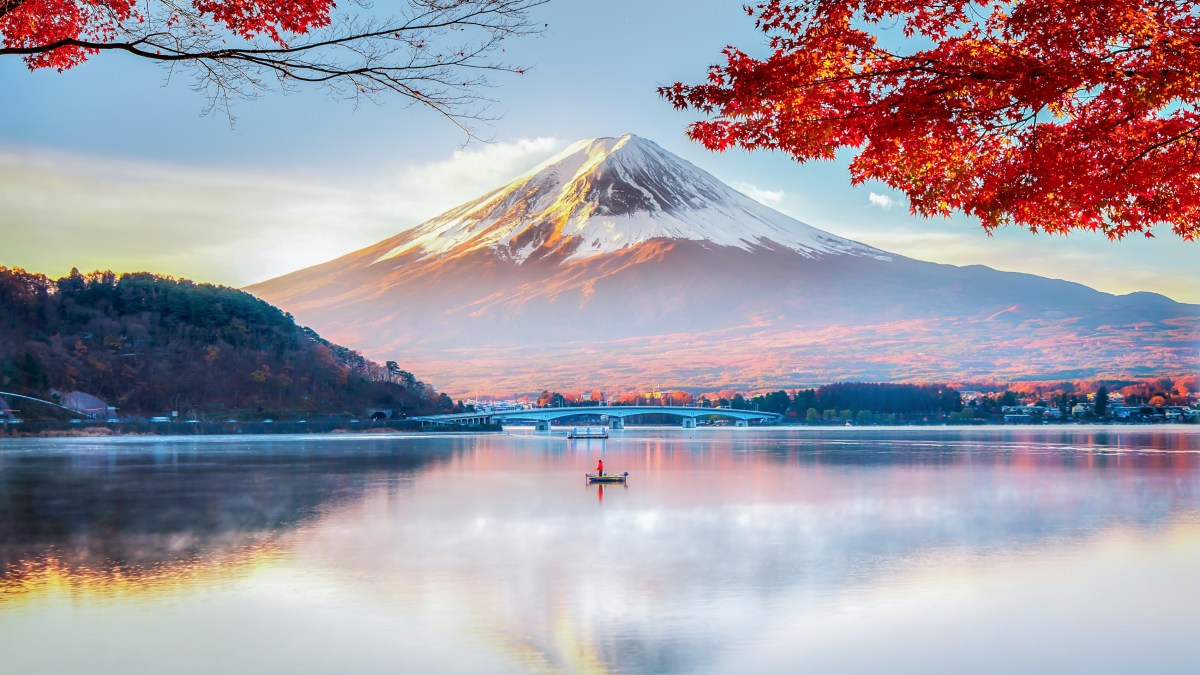
Seeing sunrise from high on a mountain feels so special that the Japanese have a specific word for it, goraiko. You’d think it was the heavenly view, the sensation of standing on top of the world, but for me what made the “coming of the light” sublime was the joy of earning the moment step-by-step with my son.
Angst and disbelief had brought us to Mount Fuji, about 60 miles west of Tokyo. Hunter turns 18 next month; university beckons. Like many parents I’m dreading my firstborn flying the nest. Still, his wings are ready and fly he must. But first, I decided, we needed to create one last childhood memory. And for that, we needed a summer challenge.
In a humid 30 degrees, we set off in the late morning from the Fifth Station, an official starting point for the Subashiri Trail, 1,970m above sea level. A team from Fuji Mountain Guides led our 31-strong group along the well-marked route, the path weaving between Japanese birches and cypresses. Boy, did we need their shade in August, during the hottest Japanese summer on record. For the first time in 130 years Japan’s highest mountain would still have no snow by November. Within minutes we were drenched in sweat.

Far from wi-fi, Hunter began to talk freely with his mother, Rosalind
Naturally, pace broke up our group, leaving Hunter and me alone. In the peacefulness we admired birdsong, alpine flowers and tree roots meandering over volcanic rock. Steadily, we climbed.
In Tokyo the night before, staring at the ceiling at 3am, I’d worried that I’d hold Hunter up, so I was secretly relieved when he slipped off his backpack to rest in the shade. The cocktail of jet lag and altitude was tiring us both. In the long grass we found wild strawberries. What a treat.
As we pressed on — sometimes clambering, sometimes walking — something quite unexpected happened. With the forward motion, both of us looking ahead, my son opened up like a lotus flower. Far from the reach of wi-fi, neither of us clutching our phones, we talked freely, sharing our feelings about the future. I could hear, in his voice, enthusiasm about volunteering, excitement about university.

Hikers start the Subashiri Trail at 1,970m above sea level
GETTY IMAGES
Above the 2,700m treeline, the sun was fierce. Out came the hat, the shades, the sun cream. Rhythm kept us going. We’d lift our eyes to scan the upward slopes for the next mountain station — mountain huts positioned half an hour to an hour’s climb apart. With no running water, we filled our own bottles from plastic ones sold at the huts and returned empties; there are no bins on the hike.
Food on the trail is so pricey that we were advised to bring our own, but the scent of miso made our mouths water. And why had I chosen salad? I needed a doorstep protein sandwich, nuts, seeds. I needed a lunch like Hunter’s. He shared, of course — dried cranberries never tasted so good. Hunter scrunched his sandwich wrapper into a pocket-sized ball. I, meanwhile, spent the rest of the climb with a salad-box-in-plastic-bag tail swinging ridiculously from my backpack; everything you take up Fuji must leave the mountain with you.
• 29 best things to do in Japan
Still, it gave Hunter a laugh. And being with him always reminds me to laugh at myself: my tail of rubbish; my cautionary loo stops at every hut. Well, we can’t all have a teenage bladder.

Hikers stay on Fuji overnight to wake and catch the sunrise
The higher we climbed the steeper the gradient of Fuji’s famous cone became. Though we geed each other on — “Look how far we’ve come” — we kept sitting on boulders to catch our breath. When Hunter lay fully down in the volcanic scree I began to wonder if we’d been fools to attempt Fuji having barely slept. What had I been thinking? He wasn’t yet 18, after all — still my responsibility. Growing cold we sprawled on the mountainside, Fuji-Hakone-Izu National Park stretching as far as we could see.
The desire to reach our beds by nightfall dragged us to our feet. We helped each other on with our backpacks, reattached each other’s water bottles and ploughed on. It was like climbing a steep shingle beach, every step up the volcanic gravel sliding half a step down. Cue walking poles. Hunter wouldn’t be seen dead with them, but I have no shame. Not with my creaky hockey knees.
Determined, we trudged towards our overnight hut, drawing our energy from the enchanting view: a never-ending duvet of fluffy white clouds. Our guides encouraged us, the gazelle-like Takumaru Hotta explaining, astoundingly, that they all climb Fuji three times a week.

The Fujisan Hotel is run by a father and son duo
Standing at 3,400m, Fujisan Hotel is run by a father and son who responded warmly to Hunter’s Duolingo Japanese. In a dormitory with over 50 others, we flopped on our bottom-bunk mattresses after seven hours on the trail. Dinner was rice with a heated packet of meat sauce; gladly, we still had a few coins for the outside loo. We chatted with climbers from all over the world. Even Japanese climbers, here on pilgrimage, were apprehensive about scaling the mountain. Now a Unesco world heritage site, Fujisan, as it is reverentially known here, has been worshipped since ancient times as a dwelling of deities. I lay awake, again, listening to snoring climbers, wondering when the sacred mountain would let me dream.
At 2am we gathered outside, wearing all our layers. Hunter and I had butterflies; the volcano hasn’t erupted for more than 300 years, but its upper trails are very narrow. Our guides led us single file, instructing us to stick together, for safety. The slope was so steep, the air so thin, our hearts beat fast.
More than 200,000 people climb Fuji every year. Where trails merge it’s crowded, despite a new daily cap of 4,000 walkers on the popular Yoshida trail. Our guides chose their “secret” longer route and, from a distance, other groups became lines of headlamps in the dark, like glowing millipedes inching up the mountain.
Climbing Mount Fuji under the stars rekindled the sense of awe I had at Hunter’s age. Gazing in wonder at the night around us, we forgot the strain. Above us, the Milky Way sparkled clearly in the unpolluted sky. To one side of us, the flank of the mountain, to the other, nothing. From this dark void, the unseen sun gilded the underbelly of the moon. Beauty to blow your mind.
• Best time to visit Japan: when to go and what to do
When, finally, we reached the summit — 3,776m (12,388ft) — Hunter and I hugged. That grin! We were just in time at 4.30am. Near the crater we found a spot among many nationalities, all facing east. In moments, across the sea of cloud, the horizon flared orange. Then the great red orb surfaced. The collective sigh felt like humanity worshipping nature. That sunrise, witnessed with my son, was pure euphoria.
Descending the mountain is serious fun. You let your weight take you ski-skating down the gravel. Hunter was in his element, whizzing down the slope in a cloud of volcanic dust. I let him go.
I caught up with him pouring stones from his boots, near the forested lower paths. At a shrine we gave thanks, both of us brimming with a sense of shared achievement. Back at Fifth Station, limbs depleted from our eight-mile round trip, we cooled down by eating shaved ice.
As our bus to Tokyo wound down Fuji’s foothills, Hunter fell asleep. I watched him, filled with gratitude that, when he leaves, our memories and our bond will endure, wherever he’ll be watching the sun rise.
Rosalind Upton travelled independently. Fuji Mountain Guides has group treks from £363pp, including one night’s accommodation in a mountain hut at 3,400m; dinner and breakfast, national park admission fee, guides and bus transfers from Tokyo (fujimountainguides.com). The official climbing season is July to September. Fly to Tokyo
The best things for teens in TokyoShop for vintage clothes in Shimokitazawa
There are bargains to be found in the neighbourhood of Setagaya
ALAMY
This bohemian neighbourhood in Setagaya has an abundance of second-hand clothing shops. Ignore the expensive American imports; there are bargains if you rummage. Some shops give discounts if you show your passport. The narrow streets are also home to trendy cafés and live music venues.
Catch a baseball game 
Baseball is Japan’s most popular spectator sport
ALAMY
Baseball is by far Japan’s biggest spectator sport. Whole families cheer on star players with flags, songs, even brass bands. The atmosphere is electric. If you’re lucky enough to be in Tokyo for a Yomiuri Giants game at Tokyo Dome, book well in advance (tickets from £15; giants.jp).
Digital art immersion
The teamLab Borderless digital art museum has plenty of interactive artworks
The teamLab Borderless digital art museum in Azabudai Hills, near Roppongi, is full of playful, interactive artworks and installations. Wander through seamless sculptures whose light-flows create lifelike entities (from £19; teamlab.art). Or, go barefoot at another teamLab digital museum, Planets, in Toyosu, where you walk through shallow water that has projections on the surface and floating orchids (from £19; teamlabplanets.dmm.com).
Become a subscriber and, along with unlimited digital access to The Times and The Sunday Times, you can enjoy a collection of travel offers and competitions curated by our trusted travel partners, especially for Times+ members
Sign up for the travel newsletter and follow us on Instagram and X
AloJapan.com