
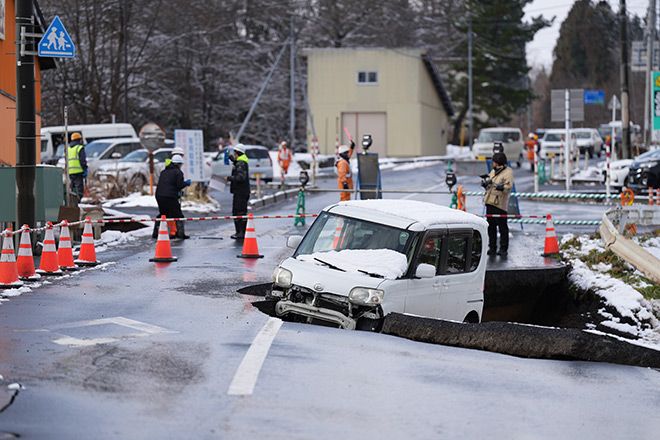
The Dec. 8 earthquake caused damage in the city of Hachinohe, Aomori Prefecture. (Video provided by @torinohitonikki)
Aftershocks continued into the morning of Dec. 9 following a magnitude-7.5 earthquake that struck off Aomori Prefecture, injuring at least 30 people, triggering a tsunami and severing water supplies.
The quake hit off the eastern coast at 11:15 p.m. and registered an intensity of upper 6 on the Japanese seismic scale of 7 in Hachinohe, Aomori Prefecture.
As of 8:30 a.m. on Dec. 9, 35 people were taking shelter at 11 evacuation centers in Aomori and Iwate prefectures and the northernmost main island of Hokkaido, Jiro Akama, minister for disaster management, said.
About 1,360 households were without water service as of 5 a.m. in the towns of Hashikami and Shichinohe in Aomori Prefecture and Karumai in Iwate Prefecture, according to the infrastructure ministry.
The Tohoku Shinkansen halted operations between Morioka and Shin-Aomori stations starting with the first trains on Dec. 9. East Japan Railway Co. expects services to resume around 3 p.m.
In Aomori Prefecture, 139 public elementary, junior high and senior high schools were suspended, according to the education ministry.
Intensities of lower 6 were recorded in the towns of Oirase and Hashikami in Aomori Prefecture.
Shaking with an intensity of 1 or higher was felt across a wide area from Hokkaido to the western Kinki region.
It was the first time that an upper-6 intensity has been recorded in Aomori Prefecture since observation equipment was installed in October 1996.
The JMA and the Cabinet Office on Dec. 9 issued an advisory on subsequent earthquakes to 182 municipalities across seven prefectures, primarily along the Pacific coast from Hokkaido to Chiba Prefecture.
The advisory calls for heightened vigilance against possible quakes with an intensity of lower 6 or stronger or a tsunami of 3 meters or higher for one week until midnight on Dec. 16. But it does not mandate blanket pre-emptive evacuations.
This is the first time the advisory has been issued since it was introduced in December 2022.
“Some people may feel confused by this first-of-its-kind advisory, but we ask everyone to calmly prepare for the possibility of another earthquake,” a Cabinet Office official said. “Essentially, social and economic activities will continue, so schools and public transportation should operate as usual.”
After the Dec. 8 earthquake, the JMA issued tsunami warnings for the central Pacific coast of Hokkaido, the Pacific coast of Aomori Prefecture, as well as Iwate Prefecture.
All tsunami warnings were downgraded to advisories at 2:45 a.m. on Dec. 9, and all advisories were lifted by 6:20 a.m.
Tsunami waves were observed along coastal areas from Hokkaido to Fukushima Prefecture.
Maximum wave heights recorded were 70 centimeters in Kuji, Iwate Prefecture, 50 cm in Urakawa, Hokkaido, and 40 cm in Hachinohe and Rokkasho, both Aomori Prefecture.
As of just after 8 a.m., no damage had been confirmed along the coastline, according to the 2nd Regional Coast Guard Headquarters.
Tokyo Electric Power Co. announced that it suspended the release of treated water from the Fukushima No. 1 nuclear power plant into the ocean at 11:42 p.m. on Dec. 8, following the issuance of the tsunami advisory.
The company will decide when to resume the discharge later since the advisory on subsequent earthquakes off the coast of Hokkaido and the Sanriku region remains in effect.
The maximum seismic intensity around the plant was 4, and no new abnormalities have been detected.
At Japan Nuclear Fuel Ltd.’s reprocessing plant in Rokkasho, Aomori Prefecture, the shaking caused about 450 liters of water to overflow from a pool storing spent nuclear fuel, according to the Nuclear Regulation Authority.
NRA officials said there are no safety issues, and no impact on the external environment has been reported.
A seismic intensity of lower 5 was recorded at the plant.
No abnormalities have been found at Tohoku Electric Power Co.’s Higashidori nuclear power plant in Aomori Prefecture or the Onagawa nuclear power plant in Miyagi Prefecture.
AloJapan.com