
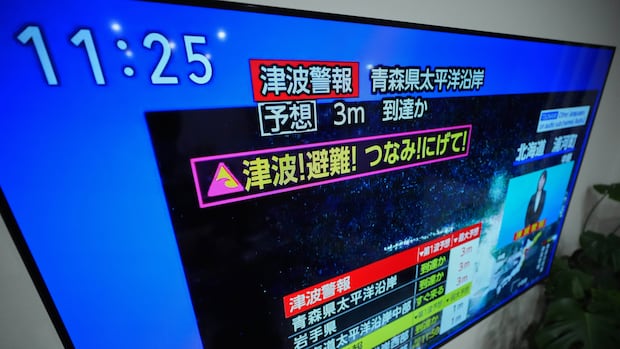
What’s a thrust-fault earthquake?
Johanna Wagstaffe here in Vancouver. I’m a science reporter and I have a background in seismology.
We are already able to tell based on the seismic data what kind of earthquake this was: a thrust-fault quake.
These happen when a locked section of rock suddenly gives way and the overlapping piece of rock jolts upward. That vertical motion is the reason a tsunami is a concern because even a small lift of the sea floor can displace a lot of water.
At roughly 50 kilometres deep, it’s not a shallow rupture, but is still well within the range where seafloor deformation can happen.
This earthquake struck on the boundary where the Pacific plate dives beneath northern Honshu (Japan’s largest island). British Columbia has a similar set-up where the other end of the same Pacific plate pushes under North America.
These subduction zones spend years storing stress before releasing it, often in patches. And because the zone is made up of many locked and partially locked sections, one rupture doesn’t reset the whole system. Japan records more than 100,000 earthquakes a year, mostly tiny ones, because the tectonics here are incredibly active and complex.
AloJapan.com