
HAKODATE, Japan – Oak wilt, a lethal tree disease in which species such as Mizunara and Kashiwa oaks are attacked by insects and eventually die, is advancing north and spreading at an alarming pace across Hokkaido, the northernmost of Japan’s main islands.
Experts warn that rising temperatures are allowing the insects that transmit the disease to survive the winter, accelerating an outbreak that threatens local wildlife, valuable timber resources and the forestry-related industries that depend on them.
As field workers struggle to keep up with the expanding damage, a new strategy is emerging: harvesting oak trees early before they become infected.
In mid-October, during the autumn foliage season, officials from the Hokkaido government set out on a field survey in mountainous areas of Hakodate, a city in the island’s southwest.
Drone footage, captured from above the forest, revealed a colorless patch — an area where the seasonal reds and golds had been replaced by a stark void.
“The leaves fall early at this time of year. Maybe it’s dying,” one official said as he examined the aerial images and identified a likely infected tree.
The team set out to locate it on foot. Hiking without a trail, they pushed up and down steep slopes for about 15 minutes, bear repellent spray strapped to their waists. Among the healthy foliage, they found what they were looking for: a single Mizunara oak stripped completely bare, its leaves long gone while others nearby retained their autumn color.
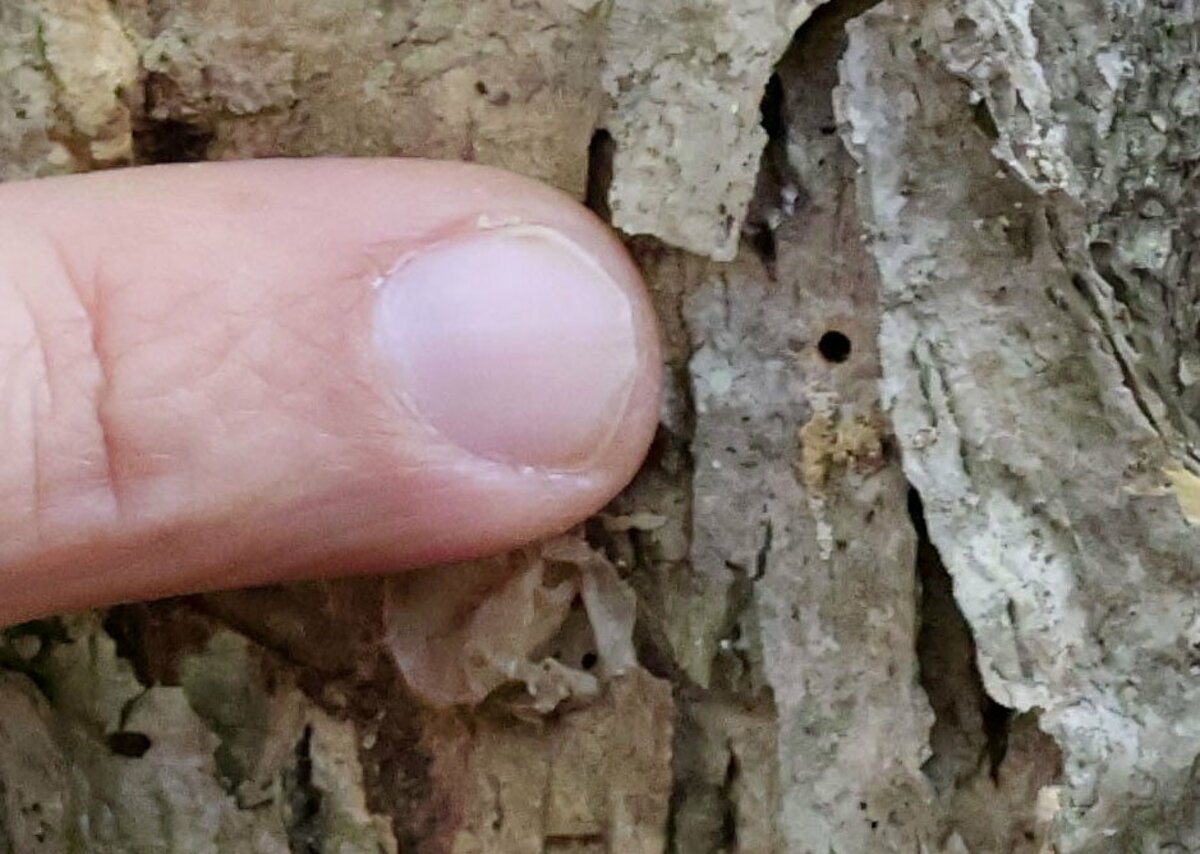
At the base of the tree lay “frass” — a mix of wood chips and insect droppings that signals oak wilt infection. Tiny holes, just 1 millimeter wide, dotted the trunk where insects had bored their way inside. “We have to treat this tree before summer, when the insects begin to fly,” one official said, underscoring the urgency of the response.
The oak ambrosia beetle, the insect species responsible for transmitting the pathogen, was first confirmed in southern Hokkaido in 2020.
Takuya Kobayashi, a senior researcher at the Forestry and Forest Products Research Institute’s Hokkaido branch, says warming temperatures are likely playing a key role in the sudden expansion.
“Global warming may have allowed the oak ambrosia beetle to survive the winter and grow into an adult,” he explains.
A recent survey shows just how dramatically the situation has escalated. This year, officials confirmed 1,637 damaged trees across two cities and nine towns in southern Hokkaido.
In fiscal 2011, only 15 trees in two towns showed signs of damage. As recently as last year, the figure was 213 trees in three towns. The disease is now spreading too rapidly for current countermeasures to keep pace.
“It’s difficult to stop it,” Kobayashi says. “The more it spreads, the more budget and manpower we need, and we can’t keep up with extermination and countermeasures.”
Field crews must also operate in untouched forests where there is a risk of encountering brown bears, placing an additional burden on limited personnel.
Oaks native to Hokkaido make up about 7 percent of the region’s forest tree population. Mizunara, one of the most sought-after species, is widely used in furniture manufacturing — a major industry centered in Asahikawa.
But wood from trees weakened or discolored by oak wilt cannot be used. The ecological stakes are also significant. “There are many wildlife species that depend on oak, including brown bears that feed on acorns and insects that feed on leaves,” Kobayashi says. “We are concerned about the impact on industry and the ecosystem.”
Faced with the possibility that eradication efforts alone will not halt the spread, some communities are looking for ways to make early use of the timber.
The town of Mori, which confirmed oak wilt damage for the first time this year, entered into an agreement with a company in July to process the wood before widespread deterioration sets in. The town has already begun trial production of Western-style barrels using Mizunara and other oaks from town-owned forests.
A Mori official expressed cautious optimism. “Construction of whiskey distilleries is progressing throughout Hokkaido, and there is demand for Western-style barrels. We hope this will lead to business opportunities.”
But the official also acknowledged the urgency of the situation. “We have heard that oak wilt spreads rapidly, so we cannot afford to take our time. We want to make use of our timber resources before they lose their value.”
AloJapan.com