
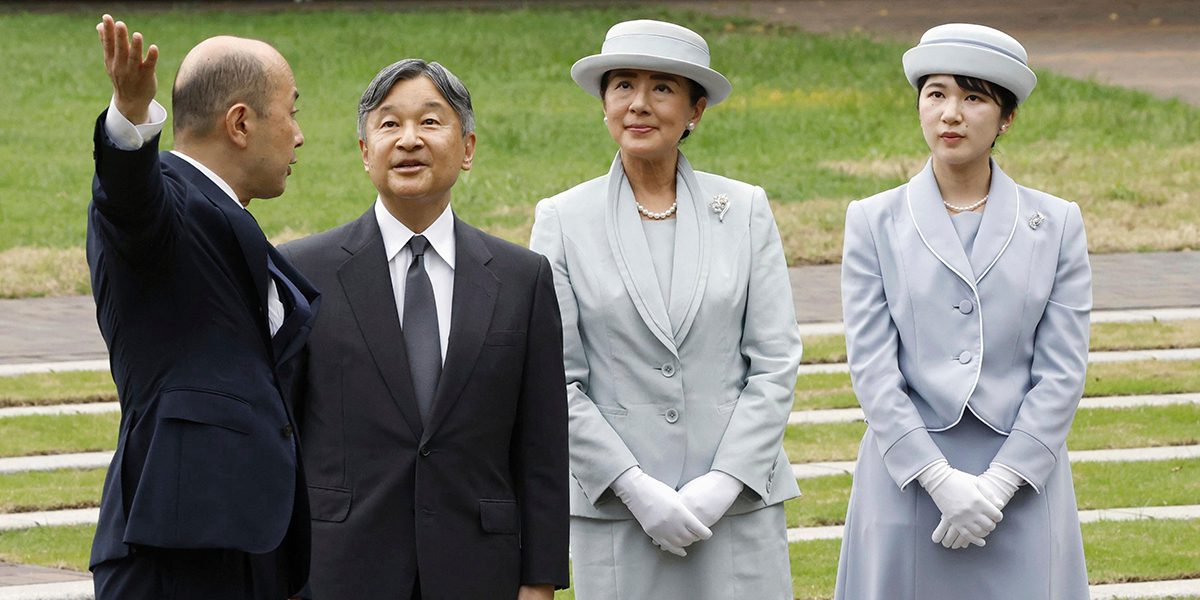
Japanese Emperor Naruhito, center left, Empress Masako, center right, and Princess Aiko, right, listen to Nagasaki Mayor Shiro Suzuki, left, as they visit the cenotaph for the atomic bombing victims at the peace park in Nagasaki on Sept. 12. (Kyodo News via AP)
TOKYO — Japan’s beloved Princess Aiko is often cheered like a pop star.
During a visit to Nagasaki with Emperor Naruhito and Empress Masako, the sound of her name being screamed by well-wishers along the roads overwhelmed the cheers for her parents.
She turned 24 on Monday, and her supporters want to change Japan’s male-only succession law, which prohibits Aiko, the emperor’s only child, from becoming monarch.
Along with frustration that the discussion on succession rules has stalled, there’s a sense of urgency. Japan’s shrinking monarchy is on the brink of extinction. Naruhito’s teenage nephew is the only eligible heir from the younger generation.
Experts say the female ban should be lifted before the royal family dies out, but conservative lawmakers, including Prime Minister Sanae Takaichi, oppose the change.
Aiko has gained admirers since debuting as an adult royal in 2021, when she impressed the public as intelligent, friendly, caring and funny.
Support for Aiko as a future monarch increased following her first solo official overseas trip to Laos in November, representing the emperor. During the six-day visit, she met with top Laotian officials, visited cultural and historical venues and met with locals.
Earlier this year, Aiko accompanied her parents to Nagasaki and Okinawa. She has followed the example set by her father, who places great importance on passing down the tragedy of WWII to younger generations.
Ikuko Yamazaki, 62, has been using social media to advocate for the succession of the emperor’s first child regardless of gender. She says not having Aiko as a successor and the insistence on male-only monarchs will cause the monarchy to die out.
“The succession system conveys the Japanese mindset regarding gender issues,” Yamazaki said. “I expect having a female monarch would dramatically improve women’s status in Japan.”
The 1947 Imperial House Law only allows male-line succession and forces female royals who marry commoners to lose their royal status.
The rapidly dwindling Imperial Family has 16 members, down from 30 three decades ago. All are adults.
Naruhito has only two potential younger male heirs: his 60-year-old younger brother, Crown Prince Akishino, and Akishino’s 19-year-old son, Prince Hisahito. Prince Hitachi, former Emperor Akihito’s younger brother and third in line to the throne, is 90.
Akishino acknowledged the aging and shrinking royal population, “but nothing can be done under the current system.”
“I think all we can do right now is to scale back our official duties,” he told reporters ahead of his 60th birthday Sunday.
Japan traditionally had male emperors, but there have also been eight female monarchs. The last was Gosakuramachi, who ruled from 1762 to 1770.
The male-only succession rule became law in 1889 and was carried over to the postwar 1947 Imperial House Law.
Experts say the system had only previously worked with the help of concubines who, until about 100 years ago, produced half of the past emperors.
The government proposed allowing a female monarch in 2005, but Hisahito’s birth allowed nationalists to scrap the proposal.
In 2022, a largely conservative expert panel called on the government to maintain its male-line succession while allowing female members of the family to keep their royal status after marriage and continue their official duties. The conservatives also proposed adopting male descendants from defunct distant branches of the royal family to continue the male lineage, an idea seen as unrealistic.
The United Nations women’s rights committee in Geneva urged the Japanese government last year to allow a female emperor, saying that not doing so hindered gender equality in Japan.
Japan dismissed the report as “regrettable” and “inappropriate,” saying the imperial succession is a matter of fundamental national identity.
“Though it’s not spelled out, what they’re saying is clearly in favor of male superiority. That’s their ideal society,” Kawanishi, the professor, said.
AloJapan.com