
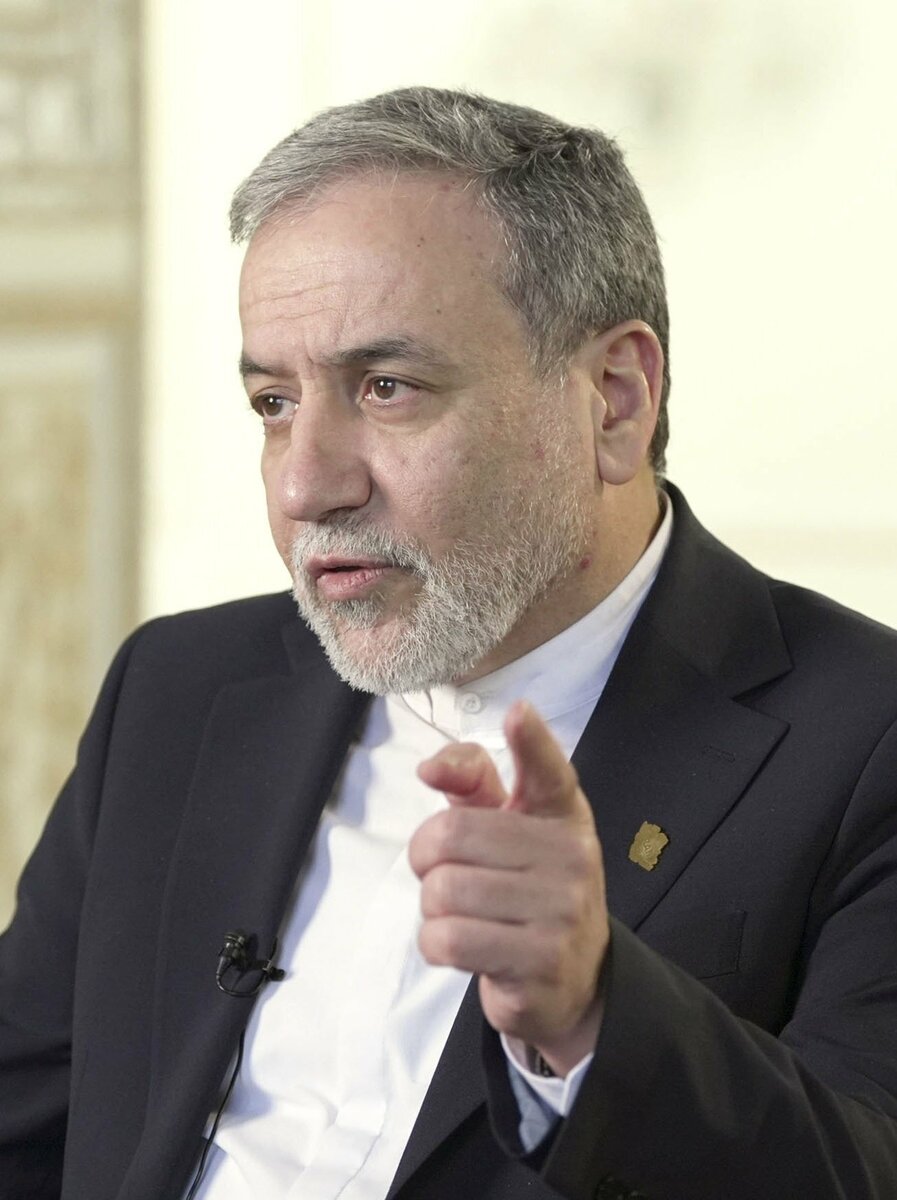
TEHRAN – Iranian Foreign Minister Abbas Araghchi on Saturday called for Japan to share its expertise with past atomic disasters and help Iran secure facilities severely damaged by recent Israeli and U.S. strikes.
In an exclusive interview with Kyodo News, Araghchi said Iran’s nuclear sites were “bombarded, destroyed and heavily damaged” during the attacks that he said was “perhaps the biggest violation of international law” ever committed against a safeguarded nuclear facility under the monitoring of the International Atomic Energy Agency.
Touching on the prospects for stalled nuclear negotiations with the United States, Araghchi also said Iran is open to diplomacy but only under conditions that guarantee a “fair and balanced” outcome. “It depends on the United States,” he said.
The nuclear talks have hit an impasse as the United States under President Donald Trump wants Iran to completely halt its uranium enrichment, a demand that Tehran has rejected.
“I have no doubt that Japan has good knowledge on how to improve the safety of nuclear facilities, and that knowledge can be shared with Iran,” he said, citing extensive work on environmental, medical and technical safety measures in the aftermath of nuclear crises.
Japan experienced the 1945 U.S. atomic bombings of Hiroshima and Nagasaki and the Fukushima Daiichi nuclear accident in 2011.
Araghchi emphasized that potential cooperation would pertain to technical safety, not to inspections, which is an IAEA mandate. “On the technical aspects of these safety challenges, cooperation with Japan can be very useful.”
He said Iran faces a complex mix of safety and security threats that it has never seen before, citing structural damage and potential radiation leaks after the June strikes.
As there is “no precedent of a peaceful nuclear facility being bombarded,” the foreign chief said the strikes exposed a critical procedural gap within the IAEA, in terms of how to inspect such a facility.
Earlier this year, Iran and the IAEA reached a framework of cooperation during talks in Cairo to define a workable mechanism for inspecting and stabilizing sites damaged by military action.
Araghchi said, however, that the agreement was undermined when the United States and the three European parties to the 2015 nuclear deal sought to restore past U.N. Security Council sanctions.
On the future of nuclear negotiations with the United States, the minister said Tehran is unconvinced about its prospects, due to its withdrawal from the 2015 nuclear accord and its support for the recent Israeli attacks on Iran.
“If they change their approach and are prepared for a fair and mutually beneficial negotiation, we are prepared as well. But negotiation is different from dictation. For the time being, we are not convinced they are ready for a real, serious negotiation,” he said.
The 2015 nuclear deal placed strict limits on Iran’s enrichment activities in return for sanctions relief. Following the U.S. withdrawal during Trump’s first term in 2018, Tehran expanded its nuclear activities in response.
Araghchi said the core sticking point remains Washington’s reluctance to acknowledge Iran’s right to peaceful nuclear technology, including uranium enrichment, under the Nuclear Non-Proliferation Treaty, of which Japan is a member.
Tehran is prepared to accept limitations “on levels of enrichment” and centrifuge types, he said, adding that negotiations could proceed quickly once the United States takes a reciprocal approach by allowing Iran’s peaceful nuclear program and lifting sanctions.
AloJapan.com