
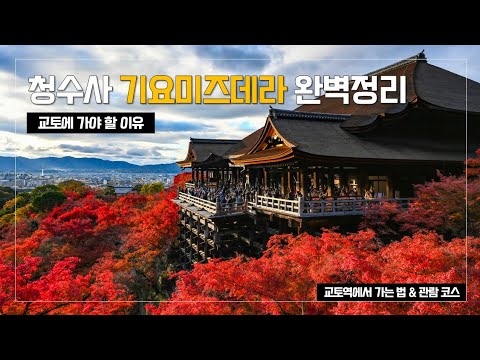
교토 청수사(기요미즈데라) 완벽 정리 – 교토역에서 가는법, 단풍시기 야간 라이트업 l 교토 단풍 여행
Hi! I’m a travel writer – INSTAGRAM @jeymin.ny This is a complete guide to Kiyomizu-dera temple Key viewpoints at Kiyomizu-dera and Kyoto’s foliage timing I’ve also captured the crowds during the night illumination. If anything doesn’t come through clearly in translation, feel free to leave a comment. Check Chapter 8 at the end for the access guide. Temple halls glowing in deep red on the mountainside Kiyomizu-dera sits halfway up Mt. Otowa, and the entire temple feels like a viewpoint. The scenery changes completely depending on the season. Generally, visiting in the morning is recommended for fewer crowds. But Kiyomizu-dera is known for its beautiful “afternoon light.” Sunlight sinking toward the west sets the maple forest on fire. Peak foliage in central Kyoto usually falls from late November to early December. Because the sun sets early, reach the viewpoint before 3–4 PM to see the leaves in full light. Search “Nio-mon Gate” on Google Maps for the exact location. Always filled with Japanese students taking group photos and travelers passing by There’s no ticket booth here. This entire area is a free zone open to everyone. Climb the steps and turn around, and you’ll see Kiyomizuzaka leading up to the temple. After the free area, you’ll reach the ticket booth. Show your ticket here and enter the inner grounds. The maple forest spreads out right in front of you. The wooden terrace is built on the cliff in front of the Main Hall Eighteen massive pillars support the 13-meter-high stage. Originally designed for rituals and performances, it is now beloved as a scenic viewing platform. This grand stage was rebuilt in 1633. A forest of a thousand maple trees swaying like waves Kiyomizu-dera was founded in 778. Most of the structures you see today were rebuilt around 1633. It is part of the “Historic Monuments of Ancient Kyoto,” and is designated as a UNESCO World Heritage Site. The statue of Kannon in the Main Hall is revealed only once every 33 years. The iron bar the students try to lift? A 90-kg iron staff said to have belonged to the monk Benkei. Now we pass the Main Hall and begin walking up the hill. You’ll see a place where visitors tie omikuji fortune papers. And ema plaques where wishes are written. Do not go down the stairs here! Be sure to continue up to Okunoin at the end of the hill. This is where you can see both the Main Hall and Kyoto city in one frame. It was peak foliage, and everything was glowing in a vivid red. A “kakezukuri” structure—wooden beams interlocked without nails Don’t miss the harmony of the Sanjunoto Pagoda with the maple forest. I’ve walked down the path below. From below, you can feel the full scale of the Main Hall stage. Everything is covered with autumn leaves. Choose one or two of the three water streams and make a wish. This ever-flowing “pure water” (Seisui) is the origin of the name Kiyomizu-dera. Okunoin is right above the waterfall. Very close. It takes about 30–40 minutes to walk slowly from Nio-mon to the waterfall. After the afternoon walk, it’s time to wait for the night illumination. It’s 4:30 PM now, sunset at its peak. It’s 4:30 PM now, sunset at its peak. I came down briefly to have dinner in the shopping street. And now I’m back again. It’s 5:30 PM, and it’s already this dark. At Nio-mon, I pause for a moment to listen to the temple bell. Then I walk up the same path again. It was crowded in the afternoon, but at night it feels ten times busier. The terrace at Okunoin is packed shoulder to shoulder. I move forward little by little, waiting for people ahead to step aside. After quite a long wait, the blue beam behind the Main Hall and the night foliage look breathtaking. It’s even more beautiful in person. The biggest crowds in Kyoto gather here. Paths are narrow and dark at night, so be careful when moving around. Shall we look at how to get to Kiyomizu-dera? From Kyoto Station (Kyoto-eki-mae), take Bus 206 at stop D2. Here’s something to watch out for. A bus that looks identical will pull in. The EX bus, which runs only on weekends, costs twice as much. On weekends, staff often direct people to line up at D1 for Kiyomizu-dera-bound buses. D1 = EX bus / D2 = regular bus
If you have a day pass, the EX bus is fine. If you’re paying by IC card, take the regular 206 at D2. Regular buses board from the rear door. Regular buses board from the rear door. About 15 minutes passing by the Kyoto National Museum (under normal conditions) Pay the fare when getting off. Get off at Gojozaka or Kiyomizu-michi. But I get off at the next stop, Kiyomizu-michi. Cross the street, turn the corner, and Yasaka Pagoda appears straight ahead. Follow this road for 1 km to Nio-mon Gate. Sannenzaka and Ninenzaka, Kyoto’s most popular lanes These streets are charming enough to deserve a separate video. Please subscribe and like, and join me on the next walk!
교토 여행을 계획하고 있다면
#기요미즈데라 #청수사 방문하기 전에 감상해보세요!
오사카&교토 책을 쓴 작가가 직접 교토역에서 기요미즈데라 가는법, 야간 개장(라이트업) 일정, 최고의 단풍 명소까지 실제 동선 그대로 구성했습니다.
00:00 1️⃣인트로 & 교토타워 뷰
00:53 2️⃣교토 단풍 시기🍁
01:25 3️⃣인왕문에서 매표소(입장료,오픈시간)
02:27 4️⃣본당과 기요미즈의 무대
04:49 5️⃣청수사 전망 포인트
06:42 6️⃣오토와 폭포 소원 비는 법
07:58 7️⃣기요미즈데라 야간 라이트업
09:52 8️⃣교토역에서 청수사 가는법
11:07 9️⃣정류장에서 산넨자카까지
※주의 – 단풍 라이트업 입장 마감은 21시. 너무 늦게 가면 중간 도로부터 인파가 몰려 입장이 자체가 어려워질 수 있습니다.
📷 가모강 맛집 소개 영상도 함께 참고하세요! https://youtu.be/mT2MFCYgn0M
#교토12월 #교토여행 #교토단풍 #청수사가는법 #기요미즈데라가는법 #교토가볼만한곳 #교토브이로그 #여행브이로그 #京都 #京都旅行 #Kiyomizudera #KyotoTravel #KyotoAutumn
#vlog #yt:cc=on
5 Comments
확실히 고층건물이 없으니 시원시원하네요 한국은 죄다 아파트 박아서,, 사회미관은 아예망
언제가셨던걸까요? 저도 부모님모시고 12월초에가는데 너무멋져요❤ 음성과설명도 너무 좋았어요 감사합니다:) 혹시 청수사라이트업 8시반뒤에 입장해도 사람이저렇게많을까용?? 부모님모시고가려니 좀 걱정되서😅
2:10 12월14일날은 개장 하지 않은건가요?
청수사 너무 좋더라구요
혹시 낮이랑 라이트업 둘다보고싶으면 표를 두번 끊어서 봐야할까요? 😂 내려가서 상점가에서 저녁을 먹고 다시 올라가셨을때 야간권을 다시 끊으셨을까요?