
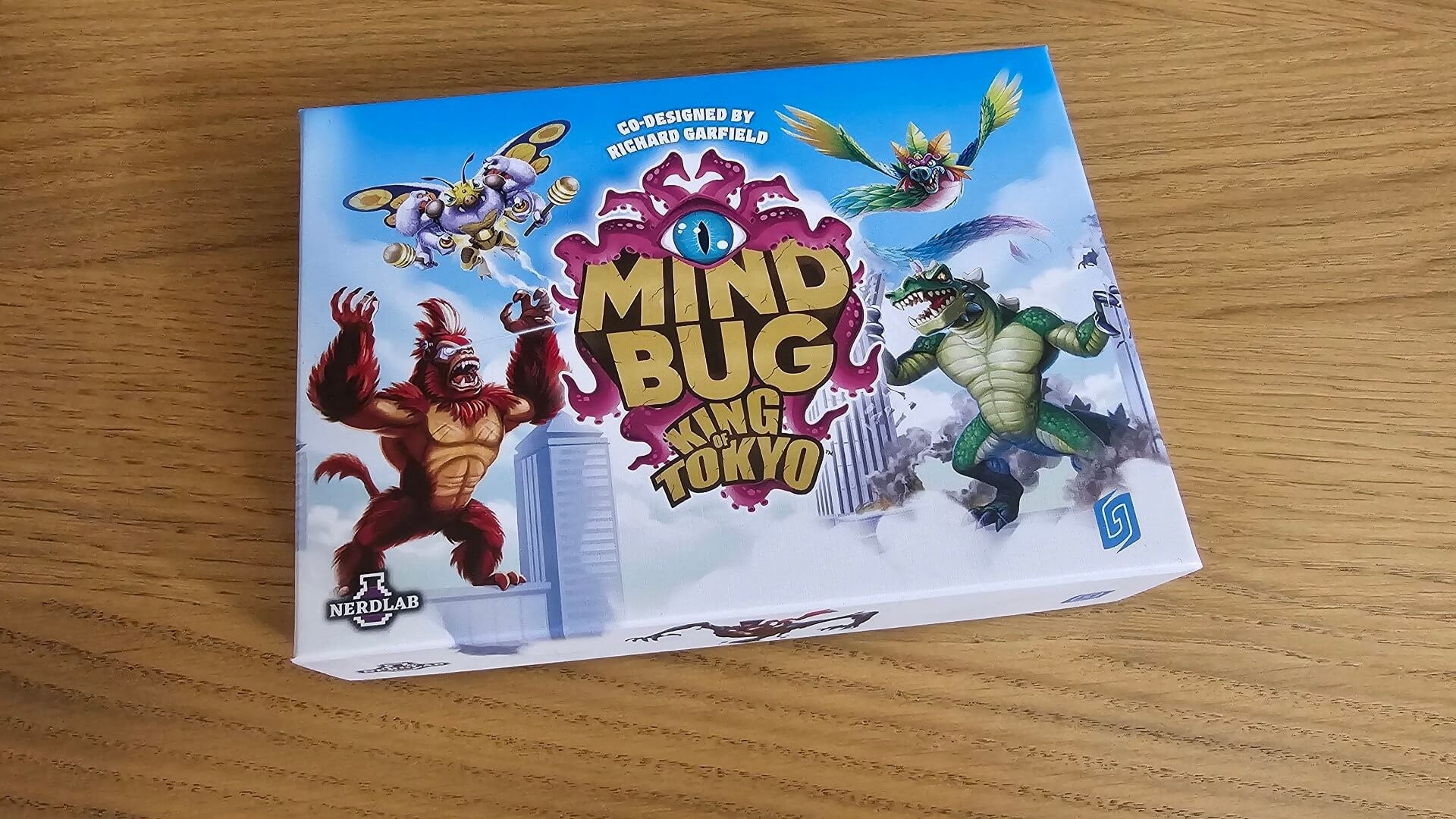
Richard Garfield, most famous for creating Magic the Gathering in the early 90s, has also created several successful and awesome games since. 2 such games, King of Tokyo and Mindbug, one a card game, one a dice game, both with quick, simple mechanics, but great strategic depth, have been smashed together in one incredible collaboration. In this article, we check out this game mashup in our Mindbug x King of Tokyo review.
I’m a huge fan of King of Tokyo, and I’ve reviewed several editions on the site, including the latest core box, King of Tokyo Dark Edition, and produced a guide to King of Tokyo/King of New York editions and expansions.
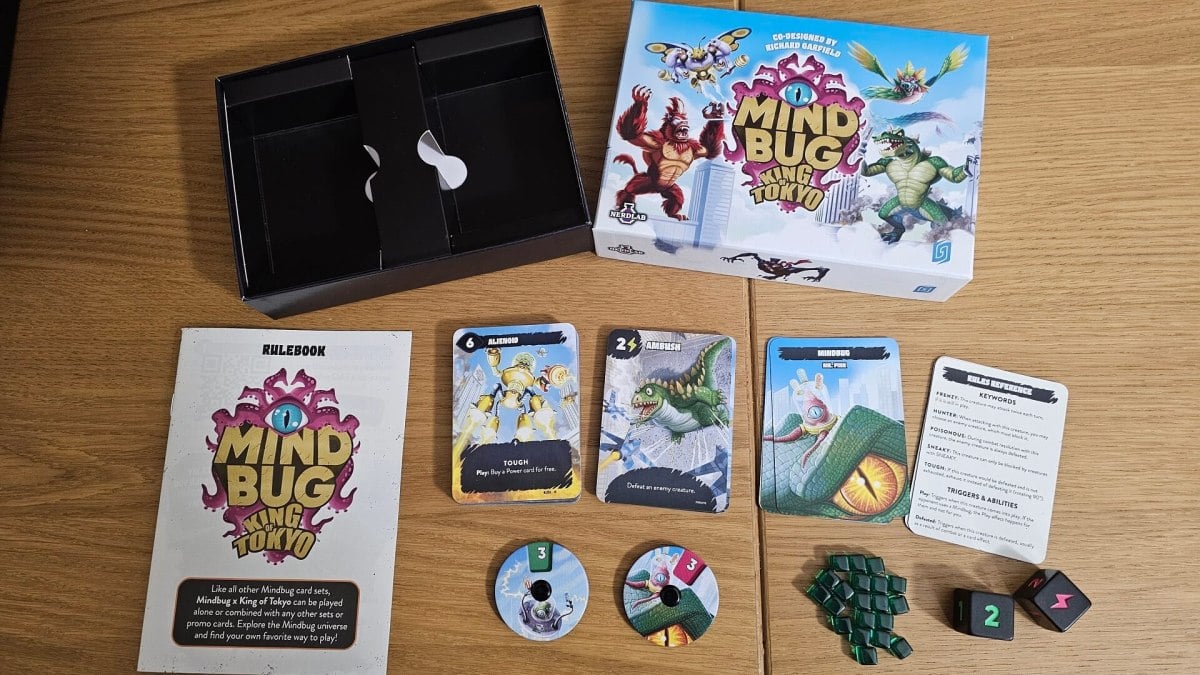
I’m a huge fan of components light but strategic deep games, as Mindbug x King of Tokyo is perfect for that.
To Mindbug Or Not To Mindbug
Mindbug x King of Tokyo is a standalone expansion to Mindbug. This means that it can be played by itself or combined with the original Mindbug or any of its expansions.
The core mechanics of Mindbug are the same across all expansions. Players randomly deal 10 cards from the MBxKoT set, or a combination of sets they have, and draw 5 as their starting hand. Each turn, you can either play a monster from your hand or attack. If you attack and your opponent doesn’t block, you lose 1 life point. You start with 3 life points, and if you’re ever reduced to 0, you lose.
Combat is straightforward in that the monster with the highest power value wins, and the other monster is removed. As well as a power value, monsters also have unique abilities, like gaining life when played, and/or keywords, like tough, where the monster has to lose twice to be removed.
The twist for Mindbug is that whenever you play a monster, your opponent can steal that card by playing 1 of 2 mindbugs they have access to. If your opponent uses their mindbug, they steal it before it hits the table, so they get any play benefit, and then you take another turn. There’s a bit of strategy for the core rules of Mindbug, but the mindbug stealing element of it adds a new dimension in that you have to guage when your opponent will steal your cards, baiting them before playing a card you don’t want them to steal, and also trying to work out when to use your mindbug, and guage if your opponent is just trying to bait you in return.
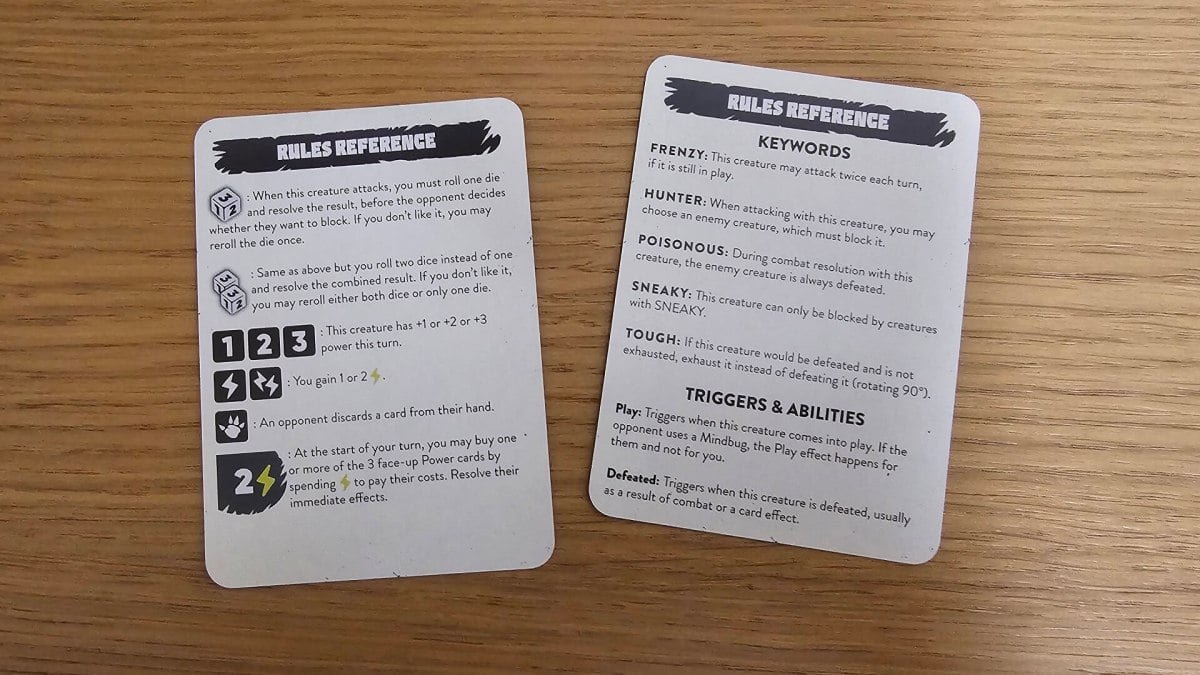
Mindbug x King of Tokyo has super simple rules, but still provides handy reference cards to keep gameplay going.
The King of Tokyo
In KoT, players roll 5 custom dice, which can deal damage to your opponents, gather energy, gain victory points, or heal your monster. Energy is then used to buy power cards, which unlock other abilities. MBxKoT adds some of these elements into Mindbug, introducing monsters with a KoT dice symbol on their card. When these monsters attack, they get to roll a custom dice which either adds 1, 2, or 3 power to their attack, gains you 1 or 2 energy, or forces your opponent to discard a card.
The energy that’s collected from these dice can then be used to buy power cards. There are 16 power cards in MBxKoT, and 3 are placed face up at the start of the game, being replaced when any are bought. Each power card offers an immediate effect, such as Mysterious Ally, which lets you draw a card from the pile of unused monsters, giving you access to an extra monster for that game, or Stomp, which lets you remove a creature with 3 power or less.
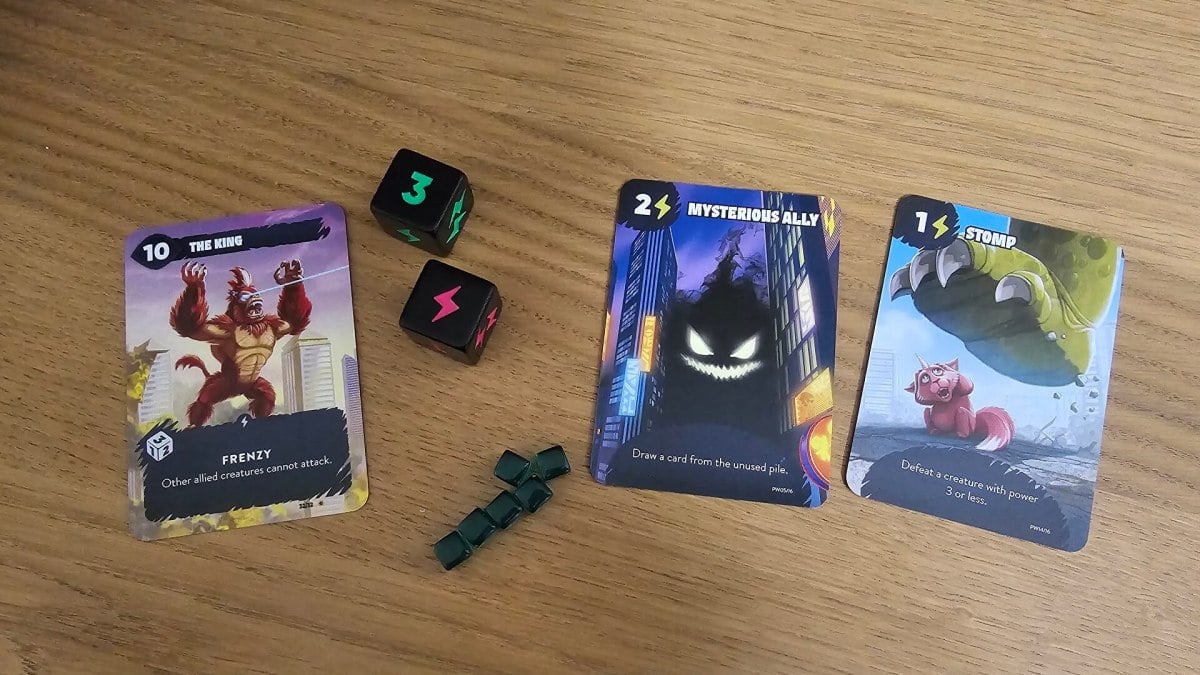
The KoT mechanics in Mindbug x King of Tokyo included the custom dice, and power cards that can be bought with energy.
Mindbug The Gathering
I’m a huge fan of minimalist component games with great strategic depth, and Mindbug is exactly that. This was my first experience with Mindbug, and I’ve heard it described as MtG Lite, which, as a long-time Magic player, really does capture the core gameplay. It feels like everything that makes MtG awesome, without the complexity, which does lessen it to a degree, but also makes games super quick, and allows you to focus on the real depth of the choices.
As a KoT fan as well, the crossover elements are perfect. It perfectly adds some key KoT concepts into the straightforward Mindbug rules, without changing the core gameplay, or providing a skinover theme simply with card art. It does have great card art though, and your favorite monsters are there, with some great thought into how to port them over, and capture their essence with a single power number and ability. The King, for example, has power 10, the highest in the game, rolls a dice when attacking, and has frenzy for 2 attacks a turn, but you can’t attack with any other monsters, giving you a massive hitter, but taking away any strategy you have for your attacks.
Other Mindbug expansions usually have 44-48 new creatures, and Mindbug x King of Tokyo only gets 32, as you also get the 16 power cards. So if you’re only playing with this set, then you’ll have a little less variety than the other standalone sets do, but you are also getting the mini power cards expansion. The issue with the power cards is that if you mix this setup with other sets, only 17 monsters in this set have the dice symbol, so by adding more monsters, you reduce the chances of being able to gain energy to buy power cards. So for this set, I wish they’d included the same number of monsters as the other sets, just to keep that balance of being able to use the power cards rules when combining with other sets.
It’s worth noting that there is also a King of Tokyo x Mindbug expansion coming for King of Tokyo, which will introduce Mindbug elements into King of Tokyo, so be careful of that if you’re looking to pick up this game, as they are different.
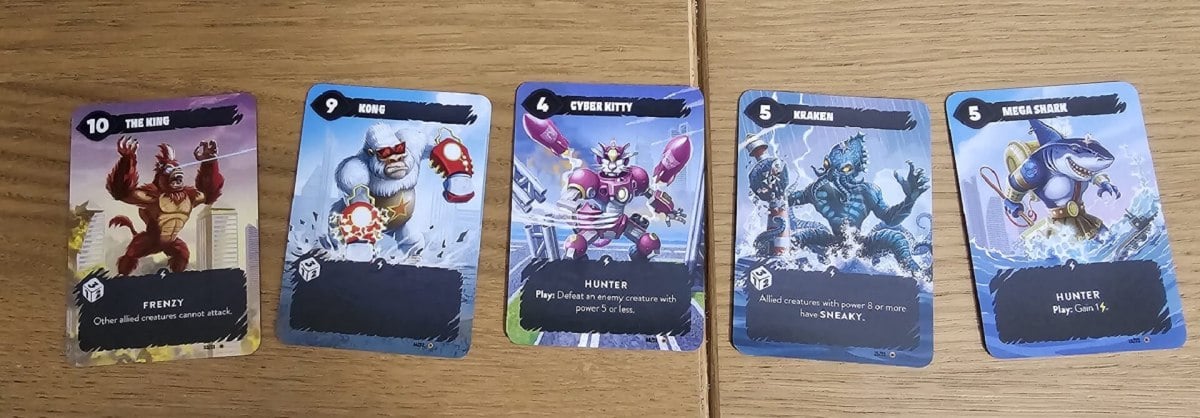
All of your favoruite KoT characcters are in Mindbug x King of Tokyo, incluing my favourites, The King, and Kong.
What Are Our Final Thoughts On Mindbug x King of Tokyo?
Mindbug is an incredible game, and Mindbug x King of Tokyo introduces some awesome new elements that are in keeping with the King of Tokyo theme. Mindbug has incredibly simple rules, but great strategic depth, and the randomised elements introduced here with dice and power cards keep things very interesting. I would have liked to have seen more monster cards, as the number here makes mixing them with other Mindbug sets too diluted to really make use of the power cards. As a standalone set, it’s still fantastic and has a lot of replayability. Fans of both games will find a lot to love.
The copy of Mindbug x King of Tokyo used to produce this review was provided by Ghost Galaxy.
AloJapan.com