
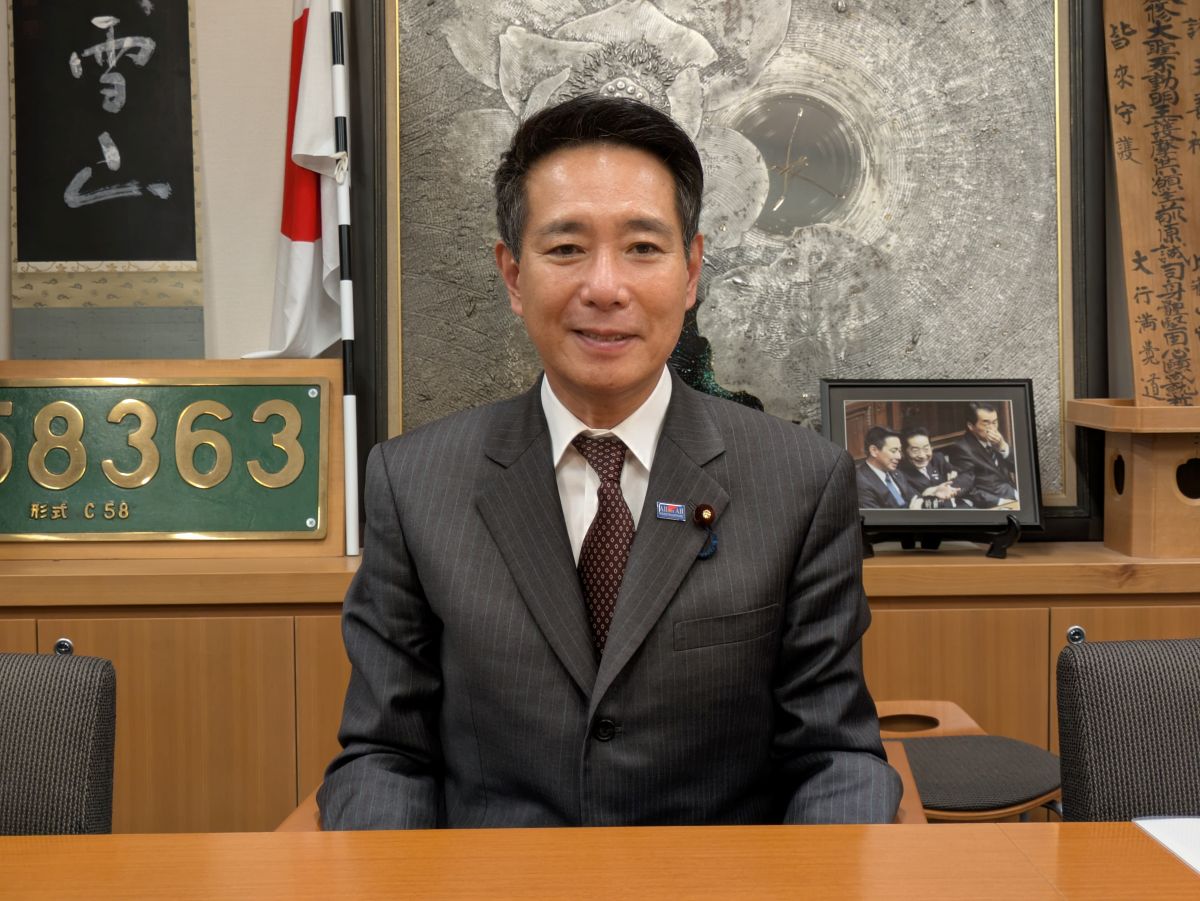
As Japan navigates a major political realignment under Prime Minister Sanae Takaichi, Nippon Ishin no Kai policy chief Seiji Maehara says his party’s mission can be distilled into three core pillars: investment in people, national self-reliance, and sweeping administrative reform.
Ishin is a reform-oriented, fiscally conservative party founded in Osaka, known for advocating smaller government, deregulation, and education reform. Now a formal coalition partner to the Liberal Democratic Party (LDP), Ishin positions itself as an independent reform driver within the government
In a JAPAN Forward interview, he discussed how Ishin intends to define itself within a new governing framework — and how it plans to push the coalition toward deeper structural change.
Investing in People as the Foundation of National Strength
According to Maehara, Ishin’s first priority is clear: “People-building is nation-building.” That means major investment in education, talent development, and human capital formation. He pointed to the recent agreement with the Liberal Democratic Party and Komeito to make high school tuition-free from April 2026. Ishin’s principle, he said, is that “every child should have access to education regardless of family income.”
For Maehara, expanding opportunities requires more than eliminating tuition fees. It demands sustained public and private investment in people, which he argues is essential to revitalizing Japanese society and restoring long-term economic dynamism.
Defense, Energy, Food, and Digital Security
Ishin’s second pillar is the idea that “Japan must be able to defend itself.” While Maehara stresses that the Japan-United States alliance remains indispensable, he says Japan must rapidly raise its own defense capabilities — “not only in conventional fields, but in emerging domains such as space, cyber, and electromagnetic warfare.”
He highlights three priorities:
Strengthening unmanned systems, including drones
Expanding stand-off strike capabilities
Rebuilding the country’s defense industrial base, including the ability to design and manufacture equipment domestically.
Defense, however, is only one part of Ishin’s self-reliance agenda. Maehara argues that Japan must also improve its energy self-sufficiency, food security, and especially digital sovereignty.
Japan’s reliance on foreign cloud providers, particularly Microsoft’s Azure, is a vulnerability, he says. Even if government services are digitized, “the data ultimately sits on overseas infrastructure.” To him, building domestic digital capacity is now as critical as securing oil supplies was in earlier decades.
 From Government to the Private Sector
The third pillar is Ishin’s signature theme: eliminating waste through thorough administrative and fiscal reform. That includes shifting as many functions as possible from government to the private sector through tools such as the Private Finance Initiative and concession models.
Maehara argues that Japan cannot ask its citizens to shoulder additional burdens, including higher social-insurance premiums, unless lawmakers themselves commit to cuts. He says this logic underlies Ishin’s push for a 10% reduction in the number of Lower House seats.
While critics say this could dilute rural voices, he insists that structural adjustments can be made to ensure regions “remain represented without sustaining excess Diet seats.”
Battling the LDP
Maehara acknowledges the challenges of working with a much larger partner. The LDP–Ishin coalition agreement includes broad commitments to tax, social-security, and governance reform. However, implementation will require constant pressure.
Tax reform is one battleground. The LDP, he says, wants to maintain preferential corporate tax breaks for wage hikes, R&D, and capital investment. Ishin argues these should be phased out, insisting companies should raise wages simply to retain talent, not because the government subsidizes them.
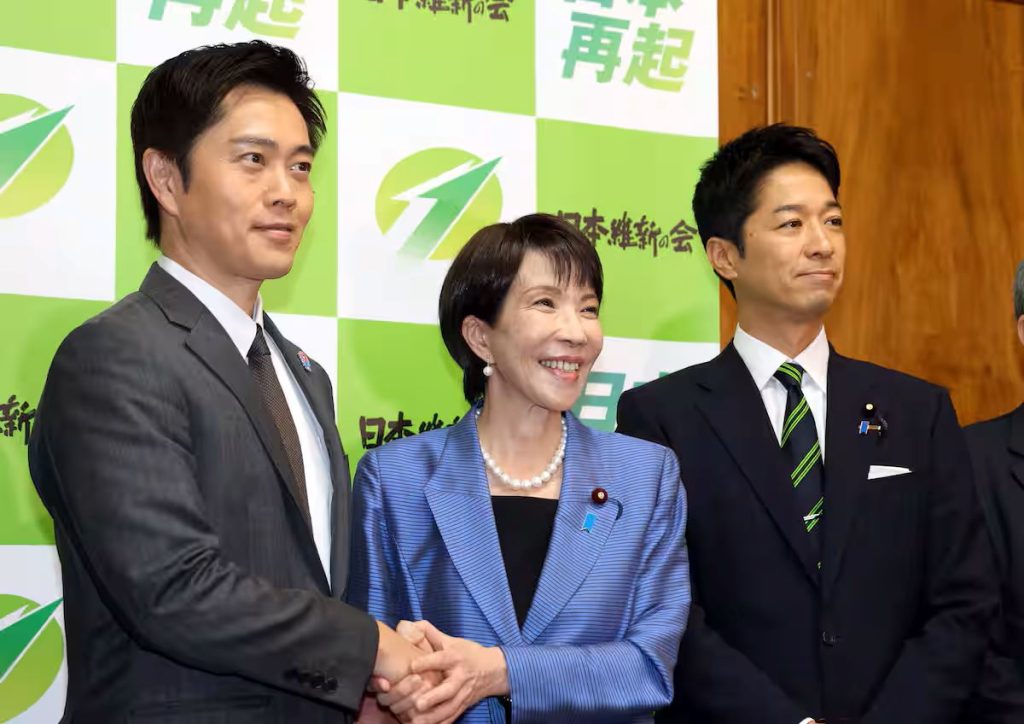 Hirofumi Yoshimura and Fumitake Fujita, co-leaders of the Japan Restoration Party, pose with LDP president Sanae Takaichi on October 21. (Courtesy, National Diet)
Another fight concerns social-insurance reform. The LDP, aligned with the Japan Medical Association, tends to resist cuts. Ishin wants to reduce waste through policies such as tightening rules for over-the-counter equivalent drugs and accelerating hospital bed reductions. Without visible clashes on these issues, Maehara warns, Ishin would simply be “absorbed” by the ruling party.
Although Ishin entered a governing arrangement with the LDP, the party declined to take Cabinet posts. Maehara says this was intentional: Ishin wants to see “whether the LDP will honor the 12-point coalition agreement.” Ishin has kept its options open, reserving the right to withdraw if commitments falter or to take Cabinet posts if trust deepens.
Security Reform
In areas of national security, he says, Ishin’s role is already defined. “Under the LDP–Komeito coalition, Komeito has been the brake. Ishin will be the accelerator.” That means pushing forward long-stalled reforms, such as revising the Five Categories that limit defense-equipment transfers to foreign partners.
For Maehara, enabling Japan to export not only non-lethal equipment but also items such as missiles, soldiers, and tanks is essential. Otherwise, he argues, “Japan weakens both its own defense industry and the region’s collective deterrence.” For example, by limiting support to countries like the Philippines, which are facing rising pressure in the South China Sea.
He also calls for a long-term debate on revising the Three Non-Nuclear Principles, especially the ban on “introducing” US nuclear assets during port calls. And he emphasizes strengthening Japan’s weak intelligence capabilities, which he says currently make entry into frameworks like the Five Eyes impossible.
Revising Article 9
Asked which constitutional revision Ishin most wants to advance, Maehara is unequivocal: Article 9, Clause 2. Japan’s Self-Defense Forces were created seven years after the Constitution took effect — a mismatch, he says, “should have been corrected decades ago.”
He argues that Japan should explicitly recognize a national defense force and eventually move toward a true mutual defense treaty with the United States, similar to agreements Washington holds with NATO, South Korea, and the Philippines. Under current interpretations, Japan alone among America’s allies is not obliged to defend the US.
Demographics, Wages, and Economic Renewal
On tackling population decline, Maehara stresses two fronts. First, reducing the cost of child-rearing through expanded free education. Second, raising wages by boosting labor productivity and increasing the labor share of corporate profits.
Japan ranks near the bottom of the Organization for Economic Co-operation and Development in productivity, he notes. That is due to delays in digitalization, slow AI adoption, and insufficient reskilling opportunities for adults.
Meanwhile, profits overwhelmingly flow to internal reserves and shareholders rather than workers. Ishin supports policies to raise the minimum wage, remove “income-barrier” disincentives, and penalize excessive retained earnings.
A Future from ‘Pessimism to Optimism’
Looking ahead, Maehara says Ishin’s mission is to build a society in which Japan’s declining population, economic strain, and security threats no longer make people fear for their children’s and grandchildren’s future.
“We must shift from pessimism to optimism,” he says. “By strengthening self-reliance, investing in people, and reforming government, we can create a sustainable and confident Japan.”
RELATED:
Author: Daniel Manning
Continue Reading
AloJapan.com