
 German Chancellor Friedrich Merz attends a press conference in Brussels, Belgium, May 9, 2025. (Xinhua/Peng Ziyang)
A nation that lacks the courage to confront its past will never truly earn the world’s respect and trust.
BERLIN, Dec. 5 (Xinhua) — Back in 2015, then-German Chancellor Angela Merkel reminded Japanese leaders during a visit to Tokyo that Germany’s postwar reconciliation was only possible because it had chosen to confront its past honestly.
Her pointed message was widely interpreted as a history lesson for then-Japanese Prime Minister Shinzo Abe. A decade later, with a new leader in Berlin and an even less repentant one in Tokyo, Germany has delivered that same lesson again and louder.
During recent talks with visiting Polish Prime Minister Donald Tusk in Berlin, German Chancellor Friedrich Merz reiterated that the memory of World War II (WWII) is not a closed chapter but an ongoing responsibility.
“The past never ends,” said Merz, noting that remembering and coming to terms with history “will never be complete,” and Germany stands by its historical responsibility.
Merz also announced a plan to establish a memorial for Polish victims of WWII and the restitution of historical and cultural artifacts to Poland.
Merz’s statement is part of a long and deliberate tradition among postwar German leaders of openly confronting the country’s historical guilt and offering sincere apologies.
From former Chancellor Willy Brandt’s kneeling in Warsaw in 1970, to former President Richard von Weizsaecker’s declaration in 1985 that “anyone who closes his eyes to the past is blind to the present,” to Merkel’s reaffirmation in 2013 of Germany’s “permanent responsibility” for wartime atrocities, each moment has reinforced a consistent political ethos: reckoning with history is not just a choice, but a moral duty.
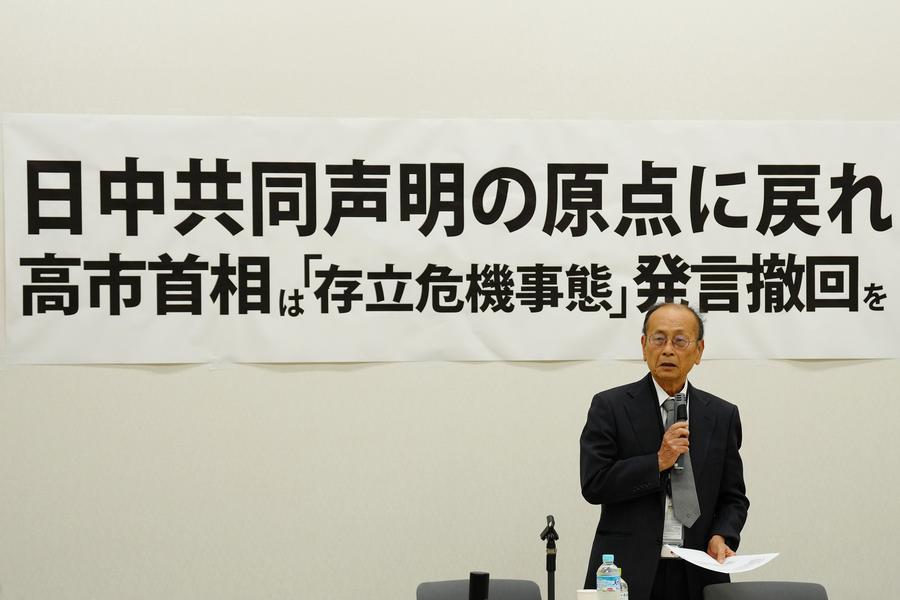 Ukeru Magosaki, a former official of the Japanese Foreign Ministry, speaks during a gathering in Tokyo, Japan, Dec. 2, 2025. (Xinhua/Jia Haocheng)
These were not mere symbolic gestures. They played a crucial role in restoring Germany’s credibility, particularly in a Europe marked by shared trauma and mutual suspicion. Through apology, restitution and remembrance, successive German governments have demonstrated that confronting the past — however painful — is the only path to genuine reconciliation.
While both Germany and Japan were aggressor states and defeated powers in WWII, their approaches to historical responsibility have diverged sharply. Under pressure from nationalist factions, Japan has repeatedly blurred the lines of historical accountability, avoiding recognition of its wartime atrocities.
Few figures embody this trend more clearly than Sanae Takaichi, a self-proclaimed heir to Abe’s political legacy. Her political identity is shaped as much by nationalist posturing as by her refusal to confront Japan’s history of wartime aggression with honesty.
She has repeatedly paid tribute at Yasukuni Shrine, where Class-A war criminals are honored; openly questioned the 1995 Murayama Statement that expressed remorse for Japan’s imperialist actions; and even posed for a photo with Kazunari Yamada, the leader of an openly neo-Nazi group in Japan. She has also cast doubt on or downplayed well-documented wartime atrocities, including the Nanjing Massacre and the forced sexual enslavement of women, known euphemistically as “comfort women.”
Taken together, these actions are not signs of ignorance; they reflect deliberate intent.
When Brandt knelt in Warsaw, Germany rose stronger. Japan, still unwilling to bow to history, stands with its back “straight”, its conscience buried.
The past doesn’t vanish because a government wishes it away. History can not be rewritten, and justice must not be defiled. A nation that lacks the courage to confront its past will never truly earn the world’s respect and trust.■
AloJapan.com