
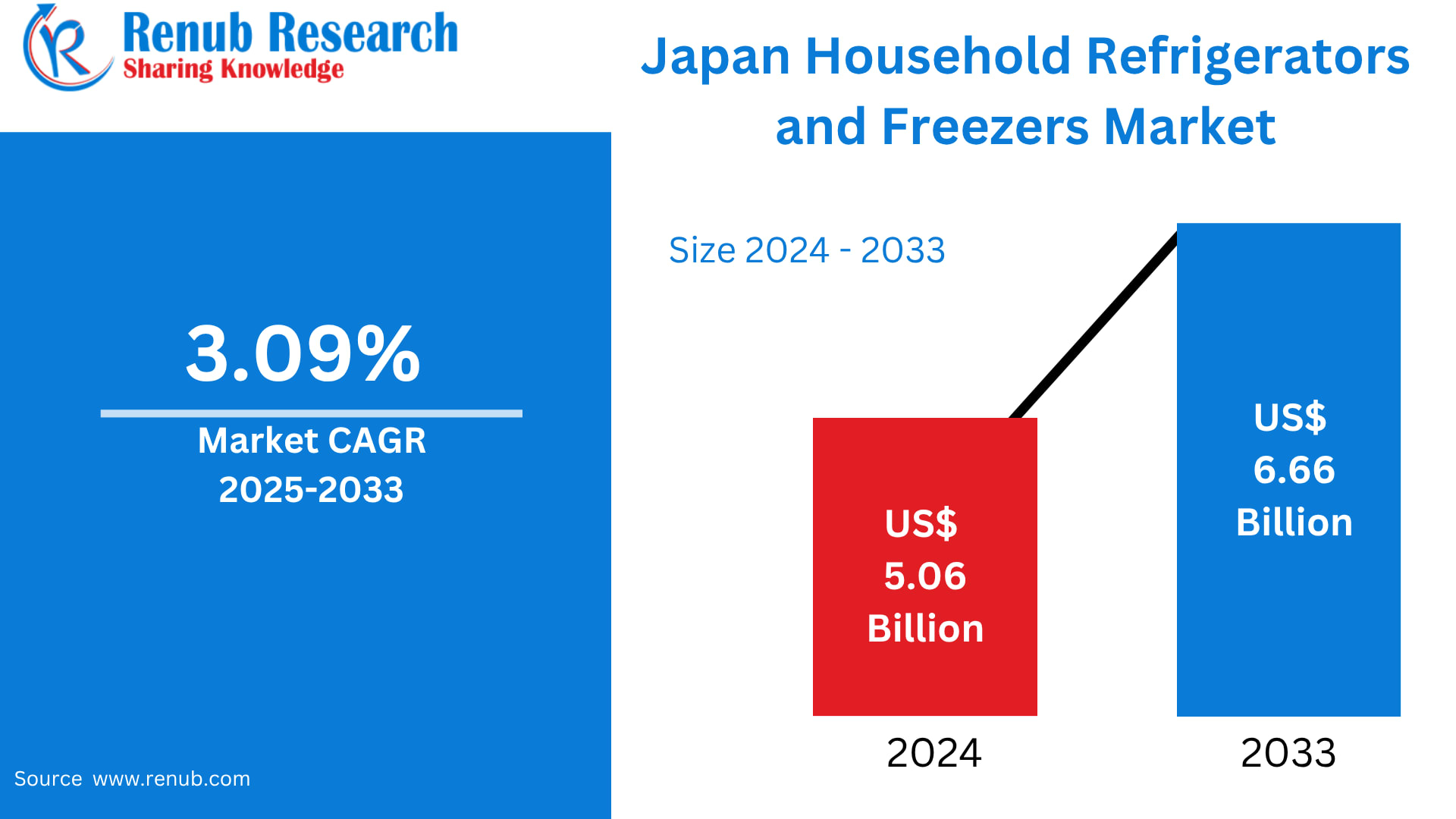
The Japan Household Refrigerators and Freezers Market, valued at US$ 5.06 billion in 2024, is projected to rise to US$ 6.66 billion by 2033, growing at a CAGR of 3.09% during 2025–2033, according to Renub Research. The consistent market expansion reflects Japan’s evolving consumer lifestyles, rapid technological advancement, demographic transformation, and a strong national emphasis on energy conservation.
From compact apartments in Tokyo to multi-generational households in Shizuoka, refrigerators remain an essential component of Japanese living. But unlike many global markets driven by first-time buyers, Japan’s growth stems from replacement demand, innovations in smart connectivity, and the rising need for energy-efficient, ergonomically designed appliances suited to an aging population.
Download Free Sample Report
Japan Household Refrigerators and Freezers Market Overview
Refrigerators are universal in Japanese homes, where freshness, hygiene, and culinary culture are core values. Japanese households prioritize appliances that are space-efficient, quiet, and packed with smart technology—reflecting both compact living environments and the country’s thriving digital ecosystem.
Modern Japanese refrigerators are typically equipped with:
Inverter compressors for energy savings
Vacuum insulation to retain cooling
Multi-door formats, especially in urban centers
Smart controls and app integration
Ergonomic layouts for improved access
The growing popularity of home cooking—even among younger demographics—also increases dependence on functional cold-storage solutions. Government incentives for eco-friendly appliances further push consumers to upgrade older units, fueling the replacement cycle.
The merging of AI and IoT into everyday appliances is setting Japan apart globally. As highlighted by an April 2025 ITBusinessToday report, Japan’s home appliances—from smart rice cookers to intelligent refrigerators—exemplify how technology is transforming lifestyle convenience and energy savings.
Growth Drivers in the Japanese Household Refrigerators & Freezers Market
✔ Rising Domestic Demand for Energy-Efficient Appliances
Japan enforces some of the world’s strictest energy-efficiency standards, influencing both consumer choices and manufacturer strategies. Higher utility prices, environmental awareness, and government-led sustainability campaigns have created strong demand for:
Energy Star-compliant models
Advanced inverter technologies
Improved insulation materials
Eco-friendly refrigerants
Manufacturers are responding by designing greener models that appeal to budget-conscious and eco-conscious buyers alike. Notably, in May 2025, AKAI introduced its Direct Cool Single Door Refrigerators in India, showcasing Japan’s influence in producing globally appealing, energy-saving appliances across sizes ranging from 48 to 230 liters.
✔ Impact of Japan’s Aging Population
Japan’s rapidly aging demographic is reshaping product design across industries. For refrigerators, this means:
Easy-to-open doors
Wider shelving and accessible compartments
Intuitive, simplified controls
Bottom-freezer and side-by-side layouts to minimize bending
Voice-assisted or touchless access features
The aging population not only shapes consumer priorities but also inspires manufacturers to design appliances suited for small families, assisted living homes, and seniors living independently.
✔ Smart Home Integration and Technological Advancements
Japan’s smart home ecosystem is expanding swiftly. Connected refrigerators equipped with:
AI monitoring
Interior cameras
Wi-Fi connectivity
Remote temperature control
Inventory tracking systems
are now increasingly common in metropolitan hubs.
Humidity control, multi-zone cooling, dual-inverter compressors, and antibacterial coatings are becoming mainstream for higher-end models.
In line with these innovations, the Japanese Ministry of Economy, Trade and Industry (METI) updated its energy labeling system in 2022 to improve consumer understanding—a move that supports adoption of next-generation, energy-efficient appliances.
Market Limitations and Challenges
■ Limited Living Space in Urban Japan
Tokyo, Osaka, and other dense urban regions face unique challenges due to compact housing layouts. Many apartments are too small for large refrigerators, limiting consumer options and pushing manufacturers toward compact, high-functionality designs.
Manufacturers must balance:
Storage capacity
Energy efficiency
Performance
Slim, space-saving builds
Additionally, delivery and installation in narrow stairways and tightly constructed buildings remain operational challenges.
■ Market Saturation and Replacement-Driven Growth
With nearly every household owning a refrigerator, Japan’s market is mature. Growth depends primarily on:
Replacement cycles
Technological upgrades
Differentiated features
Brand loyalty
Consumers hesitate to replace appliances due to cost and the long lifespan of energy-efficient units, making innovation essential for market competitiveness.
Analysis by Refrigerator Type
Top-Mounted Refrigerators (Freezer on Top)
These models remain highly popular due to:
Affordability
Simplicity
Space efficiency
Practical vertical storage
Ideal for small families, rental apartments, and elderly consumers, this category continues to be a reliable revenue stream.
French Door Refrigerators
Demand is rising among premium buyers and large households. Benefits include:
Large interior space
Flexible shelving
Lower freezer drawers
Energy-efficient two-door design
These models appeal to families embracing open kitchen designs and premium aesthetics.
More Than 30 cu. ft Refrigerators
A niche but growing category, dominated by:
High-income consumers
Tech-heavy smart households
Rural or suburban families with larger kitchens
These refrigerators often include temperature zones, touchscreens, and advanced smart-home integration.
Distribution Channel Dynamics
Specialty Stores – Still a Trusted Option
Japanese consumers value in-store demonstrations and expert advice for high-value appliances. Specialty stores offer:
Personal guidance
Installation support
In-store warranties
Product comparisons
They remain especially popular with older buyers and premium shoppers.
E-commerce – A Fast-Expanding Channel
Online platforms such as Rakuten, Amazon Japan, and Yodobashi are reshaping refrigerator purchasing behavior.
Drivers include:
Competitive pricing
Wide product availability
Consumer reviews
Convenience of home delivery
Challenges include installation logistics and returns management.
Increasingly, retailers are adopting AR/VR visualization tools to help consumers preview appliances in their homes.
Regional Analysis
Tokyo
Leads market share due to dense population
High demand for smart, compact, quiet refrigerators
Strong e-commerce adoption
Preference for eco-friendly models
Saitama
Suburban families prefer mid-size and multi-door units
Government subsidies boost demand
Mix of online and in-store purchasing
Aichi
Strong industrial and residential base
Preference for high-performance Japanese-made appliances
Growing adoption of energy-saving innovations
Shizuoka
Rural homes favor large-capacity models
Urban centers prefer compact units
Strong preference for durable, long-lasting appliances
Aging demographics increase demand for user-friendly designs
Market Segmentation
By Door Type
Top Mounted
Bottom Mounted
Side-by-Side
French Door
By Capacity
Less than 15 cu. ft
16 to 30 cu. ft
More than 30 cu. ft
By Distribution Channel
Supermarkets/Hypermarkets
E-commerce
Specialty Stores
Others
Top 10 City Markets
Tokyo, Kansai, Aichi, Kanagawa, Saitama, Hyogo, Chiba, Hokkaido, Fukuoka, Shizuoka
Key Players Covered
Each company is analyzed with: Overview, Key Person, Recent Developments, SWOT Analysis, Revenue Analysis.
General Electric
Haier Group
LG Electronics
Robert Bosch GmbH
Panasonic Holdings Corporation
Samsung Electronics
Whirlpool Corporation
Final Thoughts
Japan’s Household Refrigerators and Freezers Market is entering a new era defined by smart innovation, demographic transformation, eco-consciousness, and premiumization. While space constraints and market maturity impose challenges, the sector continues to evolve with high-efficiency technologies, voice-enabled interfaces, and compact multi-functional designs tailored to modern Japanese living.
As Japan embraces a future of smart homes and sustainable lifestyles, manufacturers who blend technology, ergonomic design, and energy efficiency will lead the market through 2033 and beyond.
AloJapan.com