
Few challenges for AV professionals are greater than making a splash at a world expo. Countries from all over the globe vie for visibility by packing their pavilions with cutting-edge equipment with national pride on the line. That task is even tougher when the designers are following in the footsteps of an iconic attraction.
Four years ago the United Kingdom pavilion took the pandemic-delayed Expo 2020 in Dubai by storm. Looking like a colossal cream-coloured cone on its side, it won widespread acclaim from architecture critics and visitors. Surprisingly, it wasn’t even home to any exhibits featuring classic British cultural icons and wasn’t a sprawling site as it only had one room, but it made the most of it.
AV Magazine produced a March/April 2022 digital and limited print edition supplement about the Dubai Expo 2020.
As guests poured through the walkway to the entrance they were given tablet computers to enter a world which they would like to send as a message to space. It was inspired by the late Stephen Hawking’s ambitions of communicating with extra-terrestrial civilisations using words which represent humanity. Although the words contributed by Expo guests stayed on terra firma, they were presented in a way which was out of this world.
With help from an ingenious AI program, the words were strung together into an ever-changing poem which streamed across the LED screens lining the pavilion’s 25 metre-high circular facade and its sleek interior.
Inside it resembled the nerve centre of an alien mother ship as pale slats curved around the edges with light flooding in from the windows behind them. Adding to the other-worldly atmosphere, a spooky soundtrack played in the background as the guests’ words flashed up on the LED screens set into the slats.
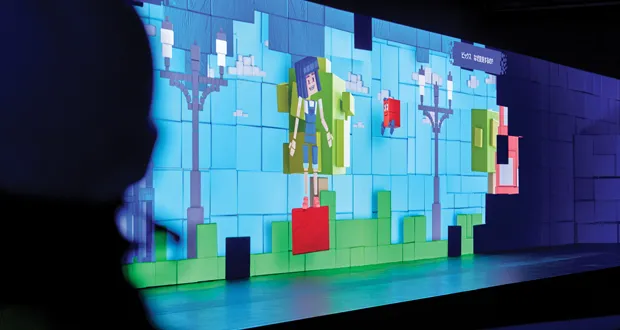
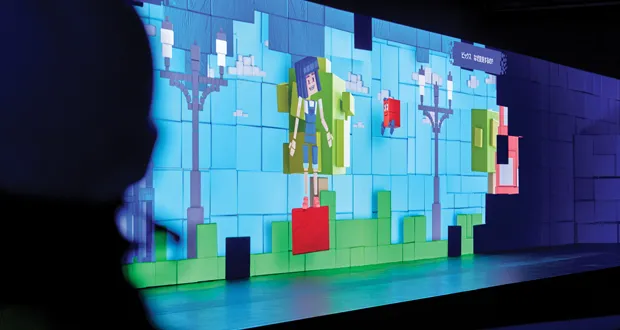
The blocky characters created on screen by Epson’s projectors look so sharp you feel like you could reach out and grab them
This time around
Following in its footsteps was no mean feat but this didn’t deter design specialist, Immersive International when it was appointed to develop the pavilion for Expo 2025 in Osaka. AV was its secret weapon.
The Expo 2020 pavilion was made from pine-coloured wood slats making it seem almost Scandinavian. In contrast, when London-based WOO Architects designed the building for its successor they went with an industrial look on the outside whilst Immersive packed the inside with eye-popping AV installations. The result was an attraction bursting with colour and looking like a giant LEGO set.
Sitting in a serene spot on the waterfront at the southern end of the Expo site, the silvery structure soars 14 metres high. Despite being box-shaped, the pavilion catches the eye as its exterior is coated in sheets of perforated aluminium.
This gives it an ever-changing appearance as the sun casts different shadows through the holes when it rises during the day and, at night, they reveal a glowing Union Jack beneath the aluminium.
The perforations are deliberately designed to reflect punch cards from the early nineteenth century, such as the ones used by British inventor, Charles Babbage in his mechanical computer in 1822. They also give the pavilion a pixelated look and this too is no coincidence.
The experience seems straightforward enough at the outset as it starts with a twist on a tourist video for the UK. Playing on a 20-metre wraparound projection screen in a darkened exhibition hall, it introduces the audience to Kenji and Mei, a father and daughter on holiday in the UK. Whilst daydreaming about the country, Mei conjures up PIX, the pavilion’s playful block-shaped mascot who takes the audience on a journey through the history of British inventions.
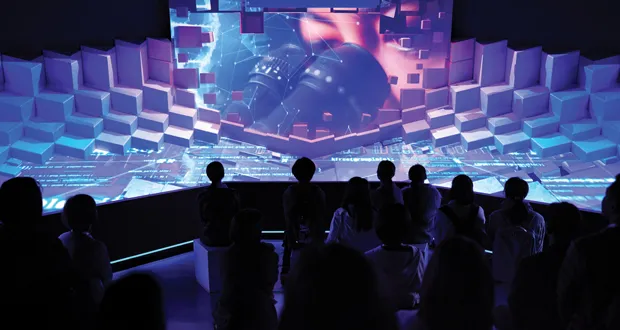
The finale features layered projection screens to create a 3D effect without the need for glasses
From steam train to Aston Martin
It starts with the invention of the steam train and runs right up to the aerodynamic advancements from Formula One which Aston Martin has incorporated into its Valkyrie hypercar. The entire story is set in a computer-animated world which is entirely formed from colourful blocks but not to cash in on the tremendous popularity of LEGO and Minecraft.
The audience is told that PIX is short for pixel and that the smiling red block represents an idea. Just as pixels combine to create an image on a screen, when ideas come together they can make transformative change and the aim of the pavilion is to show that the UK is the place to make that happen.
It takes more than the wave of a magic wand to bring the character to life. At the heart of the sweeping display are seven Epson 4K 16,000 lumen 3LCD projectors accompanied by an HD 5,000 lumen 3LCD ultra short throw projector, also from Epson. They are fed by a dual GPU AMD Ryzen server with 8GB of RAM and up to 4TB of storage. It runs the Dante Virtual Soundcard software to transmit and receive high-quality audio over an existing wired network connection.

The UK pavilion at Expo 2025 is bursting with colour
That’s just the start…
“The AV experience is powered by a hybrid system built on the Screenberry media server platform, which enables playback across extensive video canvases and multi-channel audio,” explains Anton Kononov, Immersive’s chief creative technologist. He adds that the setup required “customised node-based architecture to address the diverse requirements of each exhibition space. We also integrated TouchDesigner for interactive elements. This approach balances proven reliability with the flexibility needed for innovation.”
No stone (or block) is left unturned with the PIX character’s shape changing on-screen as the inventions it describes evolve over time. Even the lights hanging from the rafters fit the theme as they are cube-shaped and glow in waves of colour to direct visitors to the next part of the pavilion.
“The Light Lab created a large number of frosted acrylic RGBW LED cubes,” says Dan Sloane, technical director of British company, Sloane Squared which led lighting procurement for the pavilion. “They spent a lot of time ensuring the custom PCBs in the top of each cube provided an even colour and illumination across all the various sizes Immersive designed. I was very impressed that they even rotated the 5050 RGBW chips to ensure the white element was orientated correctly away from the cube surface to balance the illumination in the corners.”
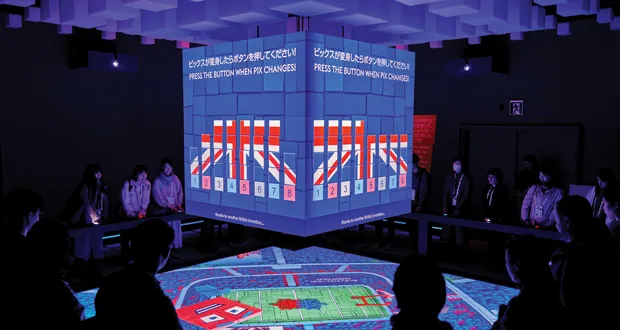
A cube formed from projection screens is the innovative display for an interactive game
The next part of the pavilion casts an equally powerful spell
The room is illuminated by several projection screens hanging from the ceiling to form a 1.8 metre cube showing an over-sized version of the pavilion’s mascot. Again, Epson projectors beam on to the panels including four with 6,000 lumens and a wide throw lens. They are so sharp you can even see the gain in the side of the beaming block.
Underneath the cube, a flat projection screen is set into the floor and shows an overhead map of the UK in block form. It zips to different parts of the country to show where different inventions were born, from the game of rugby to drugs made by pharma giant, Astrazeneca.
Thanks to an ultra short throw lens, the blocks look so solid that it seems you could reach out and touch them. Instead, the audience is encouraged to push blocky buttons on the rails around the room when the cube changes from the PIX character into an interactive game.

The UK pavilion is designed to capture the imagination of content creators
Earlier design re-imagined
It all looks like it was designed this way from the start but that is actually far from the case.
The room was originally due to have a domed screen but Immersive’s CreaTech manager, Alex Buckley says this was changed at the last minute. “Over the period of a month we totally re-imagined the room, rapidly moving between LED and projection options and giving PIX a space in the middle of the room. The game moved from OLED button to a more retro arcade style in line with the ‘building blocks of Ideas’ leitmotif.” It is perfectly suited to the theme.
The main event comes when the audience is led to another dimly-lit room where a film about future inventions plays on an array of panels arranged in layers so it looks like the footage is in 3D as it moves from the front to the back and vice versa.
“The finale was our most challenging scene,” says Kononov. “This alone contains over 220 separate projection-mapped surfaces, requiring exceptional precision to translate digital renders into flawless real-world execution.”
This wouldn’t have been possible just a few years ago. “Our technical foundation includes the latest 4K projection systems, including new Epson 4K LCD projectors that were barely on the market when we finalised our designs,” says Kononov. “Visitors don’t merely observe – they become immersed participants in a technically sophisticated environment.”
The pin-sharp images come from yet more Epson projectors fed by a Dante-equipped server. Across the entire pavilion, there are 28 projectors, countless speakers as well as 16 monitors and screens, largely made by Japanese manufacturer, iiyama.
It takes around 20 minutes to get through the pavilion which ends on the uplifting note that someone in the room could have an idea that changes the future. Its edutainment theme will seem familiar to anyone who has visited Disney’s futuristic Epcot park in Orlando but it was a whole new world for the UK government.
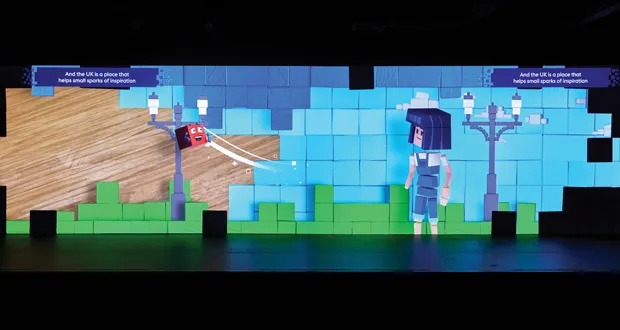
The bricks in the pavilion’s films represent the building blocks of ideas and inventions
Commissioning of AV partners
“This pavilion is groundbreaking as the UK’s first Expo pavilion structured around a multi-act, linear, narrative-driven visitor experience,” says Kononov. “This innovative format transforms traditional exhibitions into cohesive, emotionally engaging immersive narratives.” It was a group effort.
The original concept and creative direction was handled by Immersive which was also behind the spectacular installations in the Mobility Pavilion at Dubai’s Expo 2020. It also devised the idea to insert 70,500 pixel tablets in the audience seating at the London’s Olympic Stadium to create the world’s largest LED screen during the opening of the 2012 Olympic Games.
Immersive was appointed to work on the Expo 2025 UK pavilion in March 2023 and after it had defined the concept, contracting firm ES Global was hired as the design-and-build delivery partner. In turn, it engaged WOO Architects to translate Immersive’s original vision into the pavilion’s physical structure whilst Creative Technology (CT) was responsible for technical delivery.
“Immersive International were responsible for selecting equipment and the systems integration team was appointed by ES Global,” says Ben Stern, Immersive’s technical director. “Final decisions on vendors were made by ES Global and CT. This required a tight collaboration between Immersive International as designers and CT and ES Global who were delivering our design intent.”
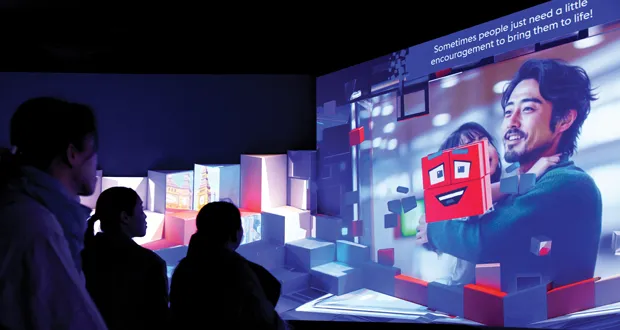
Expo 2025 is home to the first-ever, story-driven UK pavilion and a cheery cube-shaped character is at the heart of it
UK manufacturers wherever possible
Sloane adds that “we decided to use UK manufacturers wherever possible since the UK pavilion was funded – with sponsorship – by the UK government.” It explains why the pavilion used speakers from British brand Martin Audio instead of local manufacturer NEXO, favoured by Expo 2025’s France pavilion and the events space in the Yoshimoto pavilion, notable for the smiling red sphere at its entrance.
Martin Audio is far from the only British brand in the UK pavilion. Sloane says it also features Pharos lighting controls, Ricoman lighting and DVS for PC hardware as well as SignageLive for the digital signage displays around the building. CT London’s systems integration team installed the AV equipment and are providing ongoing support. Worthing-based DZA:Technical was the lighting contractor and provided several custom products to support the installation.
Immersive’s senior project manager, Rebecca Saunders says that as a result of “multiple suppliers working on the project and multiple systems needing to communicate to each other, establishing a robust network was a key part of the integration phase.” She adds that “the protocols we used (MQTT, Artnet, OSC), alongside Q-SYS touch panels for host control and Dante-based audio distribution, meant the networking requirements were pretty complex.
Creative Technologies – the systems integrator – overcame this with complex programming which also involved extensive multi-supplier technical team collaboration. They developed a sophisticated VLAN architecture to ensure reliable communication between disparate systems while maintaining operational stability. Carefully selecting AV manufacturers was crucial to this.
“Performance, value and a proven track record of delivery,” are the key criteria that Saunders looked for. Some tech is relatively generic and some components of the design are much more specific.

The projection screens hanging from the ceiling are so sharp you can see the grain of the character which appears on them
Projector choice
Projectors are one example. “We always want to avoid recommending single chip DLP (Digital Light Processing) projectors in exhibition settings because of the visual artefacts they create on camera. Audience photography and video, and the subsequent posting to social media is an important part of many things we work on,” says Saunders.
“The new Epson 4K LCD were ground breaking in their ability to deliver beyond HD resolution with the LCD display technology at a significantly lower price than 3-chip DLP display technology. During a value engineering phase we were able to make significant savings in projectors by moving to this new technology.
“Media servers are another example. It is usual for us in a complex set up to require support from the developer team and this trust and collaborative relationship is something one builds up over time. The Screenberry developer team actually put a handful of new features in place to make this specific show work. We also find great value in having the developer team on call during the install to support commissioning remotely if required.”
Saunders believes there is no magic formula for creating an unforgettable Expo pavilion. “What’s key is close collaboration with both the client and the creative and technical workstreams to ensure there is clear alignment between the brief, narrative and production.”
Immersive’s chief executive, John Munro adds that “just as importantly, the technology needed to be invisible, so guests could lose themselves in the experience without distraction.”
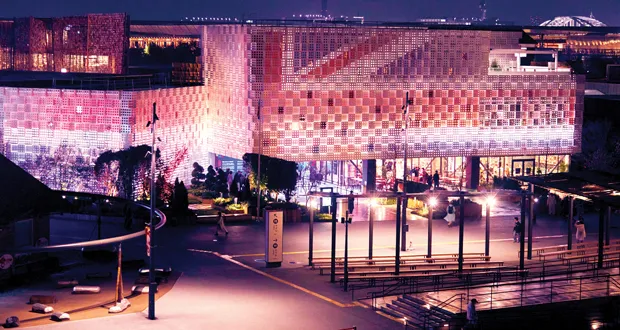
At night an illuminated Union Jack shines through the pavilion’s perforated exterior
Audio concealment in the rooms
Even the loudspeakers in the attraction rooms are architecturally concealed though this attention to detail is less essential outside them.
In addition to the attraction itself, the pavilion also includes a hospitality suite, two meeting rooms, a rooftop terrace bar, a tea room and gardens which are inspired by traditional British landscapes as they have layered platforms and shaded seating which evoke rolling hills and natural clearings. There’s also a display area called ‘Come Build the Future’ which showcases creative innovation from the UK.
This all comes at quite a cost and although the precise price of the UK pavilion hasn’t been revealed, the German government has disclosed that its outpost cost a total of $43.2 million (€50 million). It has a magic touch.
A month after the Expo opened in April, the Japan Association for the 2025 World Exposition revealed that 1.5 million people had visited the event and 84 per cent said they had at least “some desire” to return.
By the middle of July, the attendance tally had surged to 10 million with 164,000 general visitors streaming through the turnstiles on 12 July alone. It put the event on course to attract 28.2 million visitors by the time it ends in October. Ironically, not a trace of Immersive’s hard work will be left on the Expo site.
That’s because the pavilion has been designed to be demountable. “From the outset the client and event organisers were clear that the UK pavilion needed to put sustainability at the heart of the project,” says Saunders. “ES Global used the modular system that was used to deliver the Nightingale Hospitals during the Covid-19 pandemic.” She adds that “ES Global will deconstruct the UK pavilion and the modular system will go back into their stock for use on other buildings in the future.”
So although the pavilion won’t remain in Osaka, it may return and that really would be a happy ending.
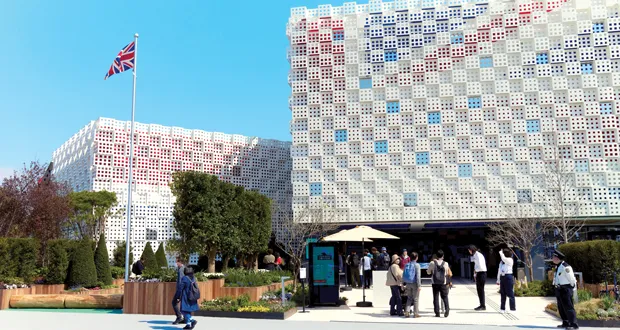
The pavilion’s elaborate aluminium cladding gives it an eye-catching appearance
AloJapan.com