
This article appeared in the November 26, 2025 edition of The Film Comment Letter, our free weekly newsletter featuring original film criticism and writing. Sign up for the Letter here.
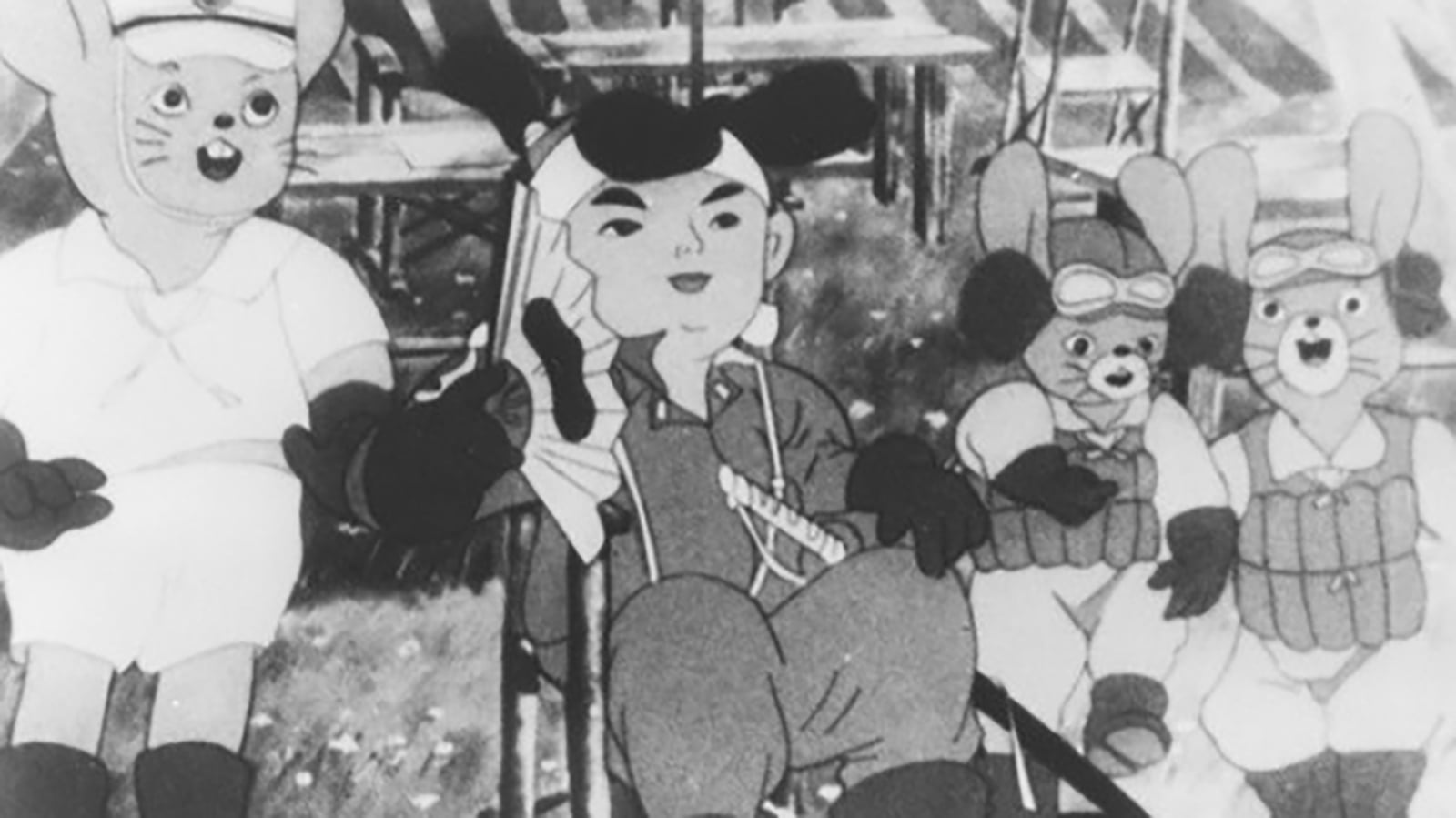
Momotaro, Sacred Sailors (Seo Mitsuyo, 1945)
It was fitting that the top competition prize at the 2025 Tokyo International Film Festival went to a period epic—Palestine 36, Annemarie Jacir’s impressively mounted dramatic account of events leading up to the 1937 British proposal to partition Palestine, the arrival of Jewish settlers, and the emergence of the Palestinian resistance movement. The past loomed large at this year’s edition, not least because the festival hosted the long-overdue Japanese premiere of Paul Schrader’s 1985 biopic Mishima: A Life in Four Chapters, about the controversial right-wing novelist Yukio Mishima, 40 years after its initial release. For decades, even as the film garnered awards and achieved cult status around the world, screenings in Japan were quietly blocked—likely due to the backlash Schrader had faced from Japanese ultranationalist groups enraged that an American was “desecrating” an icon. (Rumor has it that Mishima’s widow also had objections, particularly to allusions to Mishima’s purported bisexuality.)
The belated arrival of Mishima: A Life in Four Chapters in Tokyo, timed serendipitously to the centennial of Mishima’s birth, created a frenzy (tickets were sold out in 10 minutes) and reflected the cultural shifts of the intervening decades. A different (and frankly contrived) anniversary provided the rationale for another controversial screening: a 4K restoration of the first-ever animated feature made in Japan, the 74-minute Momotaro: Sacred Sailors (1945), a piece of unbridled military propaganda and pioneering artistry, screened to mark 80 years since the end of World War II. The movie was commissioned in 1944 by the Imperial Japanese Navy as part of its wartime propaganda campaign, and it was directed by animator Mitsuyo Seo at Shochiku, one of Japan’s Big Four studios. The film deploys the popular folktale hero Momotaro—a chubby-cheeked boy, born from a peach, who defeats a band of evil ogres—as a not-so-veiled metaphor for Japan’s military efforts against the Allied Powers and its imperial conquests in Southeast Asia.
Following an incongruously idyllic, Disney-inspired first half involving cutesy animals frolicking in meadows and rivers, the film takes a bombastic turn when Momotaro becomes an army general, leading cadres of forest creatures through training and into battle. One section offers a rousing account of Japan’s invasion of Celebes (now Sulawesi, part of modern-day Indonesia, and here renamed the “Kingdom of Goa”), framing its takeover from the island’s Dutch colonial rulers as an act of glorious liberation. The film’s concluding sequence is its most grandiose flight of fantasy. After a confrontation in which Japanese forces prevail over Western armies, Momotaro engages in a negotiation with caricaturish British generals whose jowls jiggle as they grow increasingly intimidated by the round-faced little boy—and finally give in. The screening confirmed the film’s incredible artistry; its intricate line drawings and exceedingly fluid movements are hypnotic to watch, recalling Fantasia (1940), which the Naval Ministry apparently showed Seo in preparation. It’s all the more impressive given that, unlike Disney artists, Seo worked with extremely limited resources, hand-washing the cels (transparent celluloid sheets on which the animation is drawn) with acid in order to reuse them.
It is, however, the story behind Momotaro: Sacred Sailor’s production—and all the contradictions involved—that underlines its significance. As animation critic Jonathan Clements writes in his book Sacred Sailors: The Life and Work of Seo Mitsuyo, Seo was actually a left-wing activist who had worked with the Proletarian Film League of Japan before the police ransacked their office, and arrested and tortured him and other members. He wound up working on Momotaro in a moment of desperation, as opportunities for artists going against the government were drying up. Seo kept losing his animation crew to the draft, and ultimately had to train and employ waitresses—who remain uncredited—to finish the movie. The film’s release was another ordeal, delayed by four months because the Naval authorities felt that it dwelled too much on scenes of homelife as opposed to war; further, the lead animator was accused of being an “unpatriotic” pacifist. By the time Momotaro: Sacred Sailors hit theaters in April 1945, it was already a revisionist narrative. Not long after, all materials were believed to be lost, likely destroyed during air raids. But a print was discovered in a warehouse in 1983 and restored, allowing us not only a glimpse at Japanese animation’s early days, but also the industrial and political conditions under which these films were made.
The saga of the loss and rediscovery of Momotaro: Sacred Sailors offered an interesting counterpoint to the 1985 documentary Yama: Attack to Attack, which I caught at an independent screening at Sawa Sawa House, a radical community space in Tokyo. The documentary was begun by activist Mitsuo Sato to chronicle the struggles of the day laborers of Sanya, a neighborhood in East Tokyo, where the poor, outcasts, and foreigners (many of them descendants of forced laborers brought from Japanese colonies) were exploited by factory owners in collaboration with the yakuza and the police. As Sato declares in his voiceover early on, his mission was to assert that the everyday existence of these workers was worthy of preserving—both on film and in life. Less than a month after he began production, Sato was stabbed to death by the yakuza. A collective of activists, headed by Kyoichi Yamaoka, decided to finish the film; eventually, Yamaoka was also murdered.
Nevertheless, Yama: Attack to Attack was completed, and for the last several decades it has been presented occasionally in Japan and throughout the world by the “YAMA” Screening and Exhibition Committee, always accompanied by a discussion. The film is shocking right from the beginning, when Sato’s scene-setting and narration is cut short by close-up footage of his dead body and the protest rallying around it. It then unfolds in jagged chapters that feature interviews with laborers; portraits of their living and working conditions, including the squalid streets and overcrowded hostels where they sleep; and thrilling scenes of them publicly berating factory owners and municipal officials over their connections to the mafia. Though its fragmentation is a product of the circumstances of its production, Yama: Attack to Attack evokes the work of the Black Audio Film Collective, particularly Handsworth Songs, their 1986 portrait of Black and brown folks’ resistance to police brutality in Birmingham. In both films, a deeply felt rage against injustice manifests as a kind of expressionist audiovisual poetry; and both insist on presenting their subjects not as victims, but as self-determining agents of their own lives.
Yama: Attack to Attack underlines the fact that the work of recording and amplifying the struggles of the oppressed cannot happen only in retrospect—it has to be an ongoing process in the present. This responsibility propels one of my favorites from among the contemporary selections at Tokyo: Akio Fujimoto’s Lost Land, which screened in the “Nippon Cinema Now” section for new works by Japanese directors. Having lived and worked in Myanmar for several years, Fujimoto set out to address the lacunae in media coverage of the current genocide against the Rohingyas and the resulting refugee crisis—crucially, in collaboration with Rohingya crew and cast members who have survived those terrible experiences. The film opens with two young siblings and their aunt preparing to make an arduous journey, via boat and through jungles, to reach Malaysia.
I assumed, from the early scenes, that I was watching a documentary—the cinematography is close and handheld, and the dialogue unnervingly naturalistic—which made the scenes of the kids being herded onto a flimsy boat by ruthless smugglers, fed rationed bits of food, and abandoned on remote coasts gutting to view. Then a scene, scored with sentimental string music, suggested that this was a carefully calibrated fiction, offering me a tenuous bit of reprieve. Throughout, the film draws you into its world with the promise of authenticity, before gentle dramatic flourishes pull you out—an oscillation that made me wonder about the use of fiction to insulate us from reality, and of documentary to make us demand reality as a prerequisite for empathy. Even though the film involved dramatizations, it is of course real in the sense that it depicts events that are likely unfolding at this very moment, while we go on with our lives.
Another highlight of Nippon Cinema Now, In Their Traces by Shigeru Kobayashi, also pondered the task of empathy and cinema’s role in it. The documentary opens with a phone call between the director and his friend, an older woman, who continues to be plagued by flashbacks to being raped as a child and abandoned by her mother. Against images of green fields passing by the windows of a train, we hear their conversation in voiceover: she is in pain and wants to end her life; he struggles to hold the frightening weight of her hurt. From there on, Kobayashi accumulates a portrait of survivors of abuse navigating its aftermath. There’s a photographer who takes evocative pictures of (and with) other survivors, and works with a group of offenders as her means of processing her experiences. Another woman runs a “free school” for young victims where they can experience a safe environment and rebuild their sense of trust. Halfway through, Kobayashi reveals that he, too, has a personal connection to the subject matter—after suffering abuse at the hands of a father scarred by World War II, he ran away from home and was adopted by another family.
Films about the tricky subject of sexual assault can be schematic or platitudinous in an attempt to contain what are, often, uncontainable experiences. In Their Traces stands out for its refusal of certainties and resolutions. The film is lensed by Japanese filmmaker Kaori Oda and has an incredible visual delicacy. The camera dwells on hands, feet, and objects, and plays with focus and depth of field, to bring us close to the people on screen without ever allowing us a complete picture, lest we assume we know them in their full complexity. In the film’s telling, survival is not a journey with a destination, but a moment-to-moment, day-to-day negotiation; and abuse is not an insurmountable, isolating experience, but one of the many interconnected violences—patriarchy, prison, poverty, war—that scar the world we all share.
AloJapan.com