
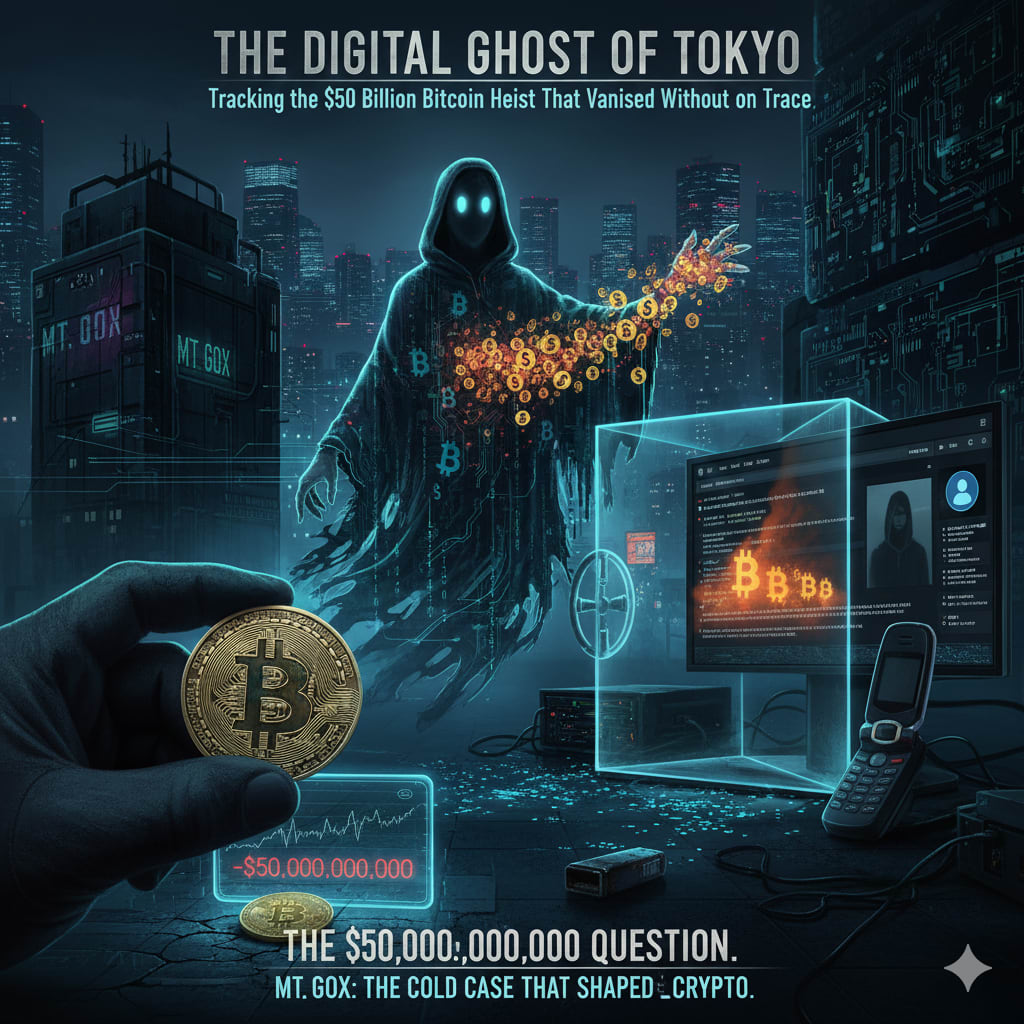
1. The Day Bitcoin Died (The Setting )
It was the Wild West of the early 2010s, and Bitcoin was the shiny, new gold rush. If you wanted a piece of the action, you went to one place: Mt. Gox.
This wasn’t a sleek financial institution;
it was a ramshackle operation based in Tokyo, run by a French programmer named Mark Karpelès. Oddly enough, it began its life as an exchange for Magic: The Gathering trading cards (hence, Magic: The Gathering Online Xchange). By 2013, this quirky startup was handling over 70% of all global Bitcoin transactions. Mt. Gox wasn’t just an exchange; it was the digital heart of the nascent cryptocurrency world. When it sneezed, the entire market caught a cold.
But in this hyper-speed, unregulated gold rush, security was an afterthought, and chaos reigned supreme. The system creaked under the weight of exponential growth, and danger was brewing in the digital shadows.
2. The Silent Bleed: February 2014
For months, warning signs were flashing red. Users complained about withdrawal delays. Technical glitches became daily occurrences. Then, on February 24, 2014, the inevitable happened: Mt. Gox went dark. Its website vanished, replaced by a blank void.
The formal announcement came days later:
Mt. Gox was filing for bankruptcy. The reason was staggering. They hadn’t lost a few thousand dollars; they had lost an astronomical amount of Bitcoin—744,408 BTC belonging to customers and 100,000 BTC belonging to the exchange itself.
In the market conditions of 2014, the total value was around $473 million. That was already a historic loss. But here’s why this case is still relevant and terrifying today: At Bitcoin’s peak, that missing stash was worth over $50 billion. A fortune larger than the GDP of many small nations had simply evaporated.
3. The Digital Phantom: How Did the Coins Vanish?
This is where the story pivots from a simple corporate collapse into a true mystery.
Karpelès initially claimed the coins were stolen over a period of years due to a flaw in Bitcoin’s protocol known as “Transaction Malleability.”
The Technical Breakdown:
Imagine sending a letter with a tracking number (the transaction ID). Transaction Malleability meant a hacker could intercept the letter, change the tracking number slightly, and tell Mt. Gox, “Hey, I never got that letter!” Because the ID was changed, the system thought the payment failed and resent the coins. The hacker ended up with two copies.
While Transaction Malleability was a real vulnerability, investigators quickly determined it didn’t account for the massive, systematic disappearance of nearly a million Bitcoins.
The truth was darker and simpler:
The keys were left on the digital doormat. Mt. Gox was a chaotic mess, using unprotected “hot wallets” (digital wallets connected to the internet) that were trivially easy to breach. The theft wasn’t one massive smash-and-grab; it was a silent, long-term bleed—a digital ghost repeatedly dipping into the vault.
4. The Usual Suspects: The Three Leading Theories
Who was the “Digital Ghost” who committed the heist of the century? Authorities and crypto-sleuths have narrowed it down to three main possibilities:
Theory A: The Insider Job (The CEO)
The immediate finger of suspicion pointed at CEO Mark Karpelès. He was the one steering the ship, and he was the one who filed for bankruptcy. Japanese authorities arrested him in 2015, not for the theft, but for embezzlement (misappropriating funds) and data manipulation.
The Evidence:
Investigators found a large discrepancy in the exchange’s books, suggesting some funds were moved internally and used for Karpelès’s personal spending (like a very expensive custom bed).
The Verdict:
He was ultimately convicted only of data manipulation, not embezzlement or the theft of the 744,000 BTC. He maintained he was incompetent, not a criminal mastermind. The bulk of the missing Bitcoin was never traced back to him.
Theory B:
The Russian Connection (The Hackers)
Years later, a crucial break came. Investigators followed the money trail of some earlier stolen Mt. Gox funds (a separate batch from the main 744,000) to a shadowy, Russia-based exchange called BTC-e.
The Suspect:
In 2017, Russian national Alexander Vinnik was arrested in Greece. US authorities alleged that Vinnik’s BTC-e exchange laundered billions in criminal proceeds, including Bitcoins stolen from Mt. Gox.
The Status: Vinnik’s case is highly complex, involving multiple international jurisdictions. While Vinnik is allegedly connected to the laundering of some stolen funds, it is still not definitively proven that he or his team were the ones who executed the initial, massive 2014 hack.
Theory C:
The Unseen Cyber Mastermind
Many seasoned crypto analysts believe the crime was executed by a highly sophisticated individual or group who spotted the gaping security holes in Mt. Gox early on.
This hacker quietly siphoned off the Bitcoin, used sophisticated mixing services (programs that scramble the source and destination of crypto to hide the trail), and then converted the fortune into cash or other untraceable assets. This theory suggests the money is long gone, dissolved into the global financial system, leaving behind no digital fingerprints clean enough to trace.
5. The Legacy of the $50 Billion Cold Case
Today, the Mt. Gox story is a haunting tale of digital assets and analog security flaws.
For the victims—the thousands of traders who lost their life savings—the case is far from over. A lengthy rehabilitation process is underway, overseen by a trustee in Japan, to distribute the Bitcoins that were eventually recovered (around 200,000 BTC were later “found” in an old digital wallet). But the process has been agonizingly slow.
The Mt. Gox collapse taught the world three painful lessons:
Not Your Keys, Not Your Coin:
The foundational rule of crypto security—never leave large amounts of money on an exchange.
The Need for Regulation:
The disaster accelerated the need for stricter security and regulatory oversight in the crypto industry.
The Permanence of Digital Crime:
Unlike traditional bank heists, once Bitcoin vanishes, the trail is often cold forever, making it the ultimate financial crime.
The Digital Ghost, the one who walked away with potentially $50 billion, is still out there. The Bitcoins sit in wallets, occasionally moving just enough to remind the world that the unsolved mystery of Mt. Gox is still the most enduring, chilling cold case of the Internet Age.
AloJapan.com