
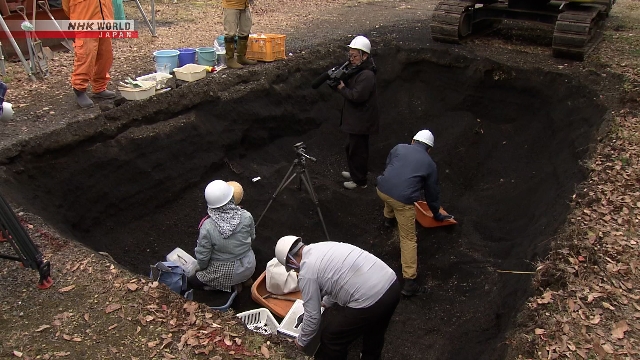
Japanese researchers have launched a large-scale project to excavate houses buried by ash during an eruption of Mount Fuji more than 300 years ago.
The volcano last erupted in 1707, spewing a massive amount of ash.
Researchers from Yamanashi Prefecture’s Mount Fuji Research Institute and the University of Tokyo began the excavation on Thursday in the Subashiri district of Shizuoka Prefecture’s Oyama Town.
Settlements in the district — about 10 kilometers east of the crater that erupted — were buried by up to about 3 meters of ash.
The researchers discovered a charred house pillar at a depth of 1.5 meters as they excavated a site using both hand tools and heavy machinery. The pillar was possibly charred by hot pumice.
The research team says this is the first large-scale excavation research of houses damaged by an eruption of the country’s highest mountain.
The team will study how the houses were constructed and what timbers were used. The researchers also plan to examine the occurrence of fires, how long it took for the houses to collapse and how much ash accumulated on them.
In the eruption, a massive amount of ash also fell over a wide area of the Kanto region, including central Tokyo.
University of Tokyo researcher Sugiyama Cohe noted that it is important for society to study a disaster involving Japan’s most iconic symbol. He says he hopes the research yields results that can help prevent disasters.
AloJapan.com