

Japan is a lion in kittens’ clothing. In both land area and population, it pales in comparison to the likes of the United States, China, India, Brazil, and Russia. In influence, significance, and impact, however, it consistently punches above its weight. In fact, Japan’s economy is the world’s fourth largest, according to the International Monetary Fund, which says the country’s GDP is a massive $4.28 trillion—despite a shrinking population and a paucity of natural resources.
Japan owes its success to its rapid postwar industrialization. In the decades after World War II, it revolutionized manufacturing with the Toyota Production System, whose focus on just-in-time production and “automation with a human touch” are the foundation of the modern lean-manufacturing movement. Toyota’s emphasis on increasing efficiency and reducing waste transformed not only the automotive sector, but also industries like health care, logistics, and technology. In the latter, Japanese innovators like Sony, Nintendo, and Honda built electronics empires that were bedrock for the Digital Age. And in industries as varied as fashion, hospitality, design, and robotics, the Japanese principles of monozukuri and kaizen—dedication to craftsmanship and continuous improvement, respectively—have made enduring impressions on an international scale.
There’s at least one industry, however, where Japanese excellence has been conspicuously absent from global discourse: the space industry.
Tokyo-based Axelspace is on a mission to change that. Driven by a desire to make Earth observation data accessible to everyone, everywhere, it has spent nearly two decades developing commercial space capabilities that leverage Japanese strengths and sensibilities for the benefit of all humankind. Now, on the eve of launching its new GRUS-3 constellation of next-generation microsatellites, Axelspace is commencing a new chapter that promises to make Japan a cornerstone in the space ecosystem of tomorrow just like it is in the automotive, electronics, and robotics landscapes of today.
Made in Japan, serving the world
When they reflect on space greatness, space historians unanimously favor the achievements of legacy nations—the United States and Russia—as well as the contributions of emerging space innovators like China and Europe. If those space pioneers are gale-force winds, then Japan feels like barely a breeze.
But Japan’s space industry is neither new nor insignificant. Japanese scientists were experimenting with rockets as early as 1955; the country launched its first satellite in 1970; and in 2003, the government established the Japan Aerospace Exploration Agency (JAXA)—now one of the world’s largest space agencies, formed by consolidating three predecessor organizations: the National Aerospace Laboratory of Japan (NAL), the National Space Development Agency of Japan (NASDA), and the Institute of Space and Astronautical Science (ISAS).
Also in 2003, students at the University of Tokyo and the Institute of Science Tokyo (formerly the Tokyo Institute of Technology) developed and launched the world’s first successful CubeSats: XI-IV and CUTE-I, both of which weighed just a single kilogram. From that legacy came Axelspace, which was established in 2008. Founded primarily by Yuya Nakamura and Takashi Eishima—, it has since grown to encompass the comprehensive satellite service AxelLiner and the Earth observation platform AxelGlobe.
“When Axelspace was founded in 2008, space was still something only governments and major corporations could access. Our founders saw a gap: Small organizations had no way to use satellites for their own missions,” said Tatsuhiko Fukasawa, head of AxelGlobe. “By developing affordable microsatellites, we aimed to make space truly accessible. That idea became our vision: ‘Space within Your Reach.’ Today, that vision drives both our businesses.”
 Tatsuhiko Fukasawa: Director / Head of AxelGlobe Business Division
Because it represented the dawn of a new, more entrepreneurial era, the birth of Axelspace was a major milestone for Japan’s commercial space industry. “Japan’s space sector used to be led almost entirely by large institutions like JAXA and major aerospace companies. Axelspace became the first Japanese startup to build and operate microsatellites independently,” continued Fukasawa, recalling early successes like the 2013 launch of the Arctic Sea-ice monitoring WNISAT-1 microsatellite for Japanese company Weathernews Inc. and the 2014 launch of the Hodoyoshi-1 microsatellite, a business demonstrator developed with the University of Tokyo and the Next-Generation Space Systems Technology Research Association (NESTRA). “Over the past 17 years, Axelspace has grown from a small startup into a global space company.”
Fukasawa said Axelspace attributes its growth to “strong in-house engineering, automated satellite operations, and global partnerships that … bring space data to industries around the world.” Just as instrumental, however, are the company’s Japanese roots, which give it unique advantages within the global space marketplace.
“Japan’s space industry is often underestimated globally, but it has deep technical expertise and a culture of steady, long-term innovation. Unlike countries that focus mainly on speed or scale, Japan values precision, safety, and reliability,” Fukasawa explained. “We combine that with a startup mindset, small teams, fast decisions, and strong technical depth to create something uniquely Japanese but globally competitive.”
GRUS-3: a new epoch in Earth observation
While it’s true that Axelspace embodies Japanese values, it’s also true that it defies Japanese stereotypes. “If I could highlight one point to the world, it would be that Japan’s private space industry is not only reliable, but also highly innovative,” Fukasawa said.
The balance between “reliable” and “innovative” is prominently on display within Axelspace’s AxelGlobe line of business, which provides commercial Earth observation data worldwide through partners in more than 30 countries, including customers in diverse industries like agriculture, forestry, finance, infrastructure management, and disaster response.
“AxelGlobe stands out for its flexibility and efficiency. All operations, from tasking and ordering to data delivery, are fully automated and managed online,” Fukasawa explained. “With our in-house AI engineers and consultants, we can also develop custom products and provide data consulting services to meet each client’s needs. Our own satellite technology, short revisit cycle, and open API access make AxelGlobe easy to use for both technical and non-technical users.”
The lifeblood of AxelGlobe is Axelspace’s GRUS microsatellite constellation, which provides 2.5-meter ground resolution imagery that helps users monitor changes anywhere on Earth.
“The GRUS program started with GRUS-1A in 2019, proving that a 100-kilogram-class microsatellite could deliver high-quality Earth observation data,” Fukasawa said. “In 2021, we launched four additional GRUS-1 satellites, creating Japan’s first commercial EO constellation. From those missions, we learned how to mass-produce satellites efficiently, streamline integration and testing, and operate multiple satellites reliably from our own ground segment.”
Those lessons have directly shaped Axelspace’s next-generation microsatellite: GRUS-3, which will begin orbiting Earth in 2026 with the launch of seven GRUS-3 satellites. “GRUS-3 … represents the next step—a smarter, more scalable platform designed for higher image quality and simpler global operations,” continued Fukasawa, who said the GRUS-3 generation introduces “major technical upgrades.” Among those upgrades are: improved ground resolution, which is now approximately 2.2 meters; the addition of a new “Coastal Blue” spectral band that enables underwater and coastal monitoring, such as mapping coral reefs or seaweed beds that absorb carbon dioxide; and an enhanced optical system that provides sharper and more radiometrically accurate imagery courtesy of a new, higher-sensitivity image sensor
 GRUS-3 (Artist’s rendition): Axelspace’s next-generation Earth observation satellite, seven of which are planned to launch in 2026.
Most compelling of all, however, is GRUS-3’s superior daily imaging capacity. “Once deployed, the constellation will boost our daily imaging capacity up to 2.3 million square kilometers and achieve a one-day revisit for mid-latitude regions,” noted Fukasawa, who said GRUS-3’s imaging capacity is more than three times greater than that of the GRUS-1 constellation, whose daily imaging capacity is up to 750,000 square kilometers. “This will enable more frequent global monitoring and much faster responses to customer needs.”
GRUS-3 also will prioritize sustainability—both on Earth and in space, where the accumulation of space debris is a growing problem that threatens existing satellites, future space missions, and the health of Earth’s atmosphere.
“Sustainability is a key part of how we design and operate our satellites. We created our own ‘Green Spacecraft Standard’ to guide every step, from material selection to end-of-life disposal. Each satellite is designed to avoid creating debris and to completely burn up when reentering the atmosphere,” explained Fukasawa, who said GRUS-3 satellites will feature a special device called D-SAIL, a deployable deorbit sail that prevents orbital debris by helping satellites leave orbit safely within a few years instead of staying for decades. “By combining cost efficiency, quality, and sustainability, Axelspace is growing responsibly, delivering more data, faster, while protecting both value and the space environment.”
 D-SAIL (Artist’s rendition): The Deployable Deorbit Mechanism, prevents satellites from becoming space debris after mission completions. Leveraging thin atmospheric drag, it shortens the satellite’s entry into the atmosphere.
Democratizing space data
In preparation for its seven new GRUS-3 satellites launching in 2026, Axelspace earlier this year launched the GRUS-3α. “The GRUS-3α demonstrator, launched in June 2025 aboard a Falcon 9, validated and evaluated the performance of the satellite bus system and mission equipment that will be used for the GRUS-3 series,” Fukasawa reported. “Its successful on-orbit results are feeding directly into final design improvements for the seven operational GRUS-3 satellites scheduled for launch in 2026.”
For Axelspace and its growing customer base, the GRUS-3α demonstrator and the GRUS-3 constellation to follow are ushering in a new era of expansion and productivity.
“Looking ahead, Axelspace is entering a new growth phase—moving from building satellites to building a full ecosystem around space data,” Fukasawa said. “Alongside expanding the GRUS-3 constellation, Axelspace is developing new sensor types, including higher-resolution optical sensors that will enable even more detailed Earth observation and support applications such as environmental analysis, resource management, and climate monitoring. Within AxelGlobe, we are also strengthening our analytics and AI capabilities, turning raw imagery into actionable insights for industries such as agriculture, energy, and insurance.”
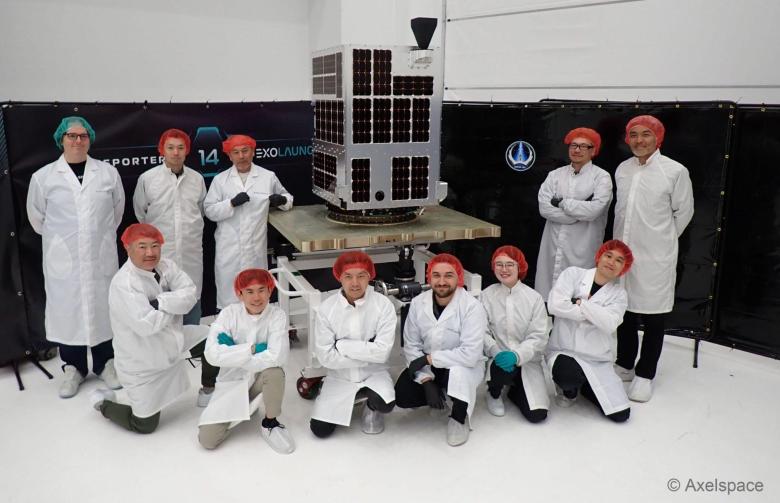 Axelspace members during the launch campaign for GRUS-3α
By scaling its constellation, deepening its data services, and expanding global collaboration, Axelspace is advancing not only its own prospects, but also those of its country.
“By building advanced microsatellites and working with partners around the world, we’re showing that Japan can lead the next generation of sustainable space business,” concluded Fukasawa, who said Axelspace’s ultimate goal is to realize its aforementioned mantra: “Space within Your Reach.” “Anyone should be able to access and use satellite imagery just as easily as checking the weather. We’re moving closer to that vision with our AxelGlobe web platform and API, where users can sign up for free, view sample imagery, and request new captures directly. As our constellation grows with the next-generation GRUS-3 satellites, this goal is becoming more realistic.”
Learn more about GRUS-3
Related
AloJapan.com