
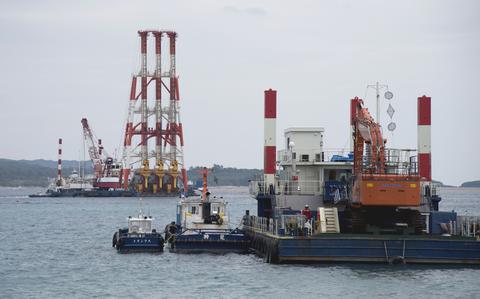
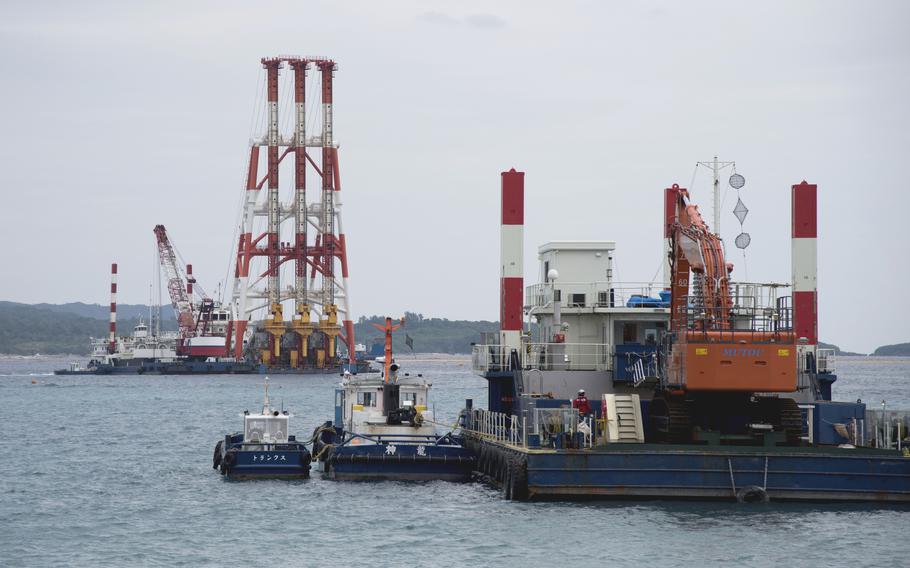
Construction vessels work at the site of a future Marine Corps airfield in Oura Bay at Camp Schwab, Okinawa, on Nov. 27, 2025. (Keishi Koja/Stars and Stripes)
CAMP SCHWAB, Okinawa — After a five-month pause for typhoon season, work will soon recommence at this northern Okinawa base to reclaim seabed from Oura Bay for a new Marine Corps airfield, according to Japanese authorities.
On the Oura Bay side of the emerging airfield a new phase of reclamation “is scheduled to begin today once the necessary preparations are complete,” Defense Minister Shinjiro Koizumi said Friday during his regular press conference.
A Japan-U.S. joint committee Nov. 20 approved the start of that work, according to a document posted on the Japan Defense Ministry’s website the same day.
“It will be the first time that land is reclaimed on a section clearly on the Oura Bay side,” a spokesman for Okinawa prefecture’s Seashore Disaster Prevention Division said by phone Tuesday. The work will take place in an area that does not require further improvement, the spokesman added.
“We haven’t been informed of any details regarding the work,” he added.
The new airfield in rural Henoko is intended to replace Marine Corps Air Station Futenma in urban Ginowan. The project, already behind schedule, also faced a series of legal challenges by Okinawa prefecture that slowed construction.
Construction is expected to last until at least 2033 and cost the Japanese government nearly $6 billion, then-Defense Minister Gen Nakatani said in January. The airfield may be ready for use by 2036, he added.
Work will also soon begin again to strengthen a softer section of seabed before reclaiming it for the airfield.
A vessel contracted by the ministry to drive sand piles into the seabed returned Tuesday to Camp Schwab to begin preparatory work, a spokesman with the Okinawa Defense Bureau said by phone Wednesday. The defense bureau is the regional arm of the defense ministry.
Six vessels evacuated the area on June 10 due to a typhoon, according to the Okinawa prefecture’s Seashore Disaster Prevention Division in July. The first typhoon of the year appeared June 11 west of Taiwan in the South China Sea.
At least one vessel returned to the area on Oct. 1 to resume ground improvement work, but it subsequently evacuated for security reasons, the bureau spokesman said. Another typhoon, which later turned into an extratropical depression, approached the island in mid-November.
Although no sand piles were driven during October, these temporary suspensions are not expected to delay the project, according to the spokesman.
“Generally, port construction projects are planned with consideration given to non-operational days caused by typhoons and other severe weather, and this project is not an exception,” he said.
Three vessels were working in the bay around noon Thursday.
“Once the necessary preparatory work is completed, it will drive sand piles, taking into account weather and sea conditions,” he said.
The cost estimate announced in December 2019 took account of design changes, additional site improvement required and the scope of construction, according to the spokesman.
That estimate “needs to be reviewed based on the progress of the construction, and we are not currently at the stage of making specific revisions,” the spokesman said.
Contractors began driving sand piles on Dec. 28. About 2,900 piles out of 71,000 had been driven as of Oct. 31, according to the bureau spokesman.
Some Japanese government officials may speak to the media only on condition of anonymity.
AloJapan.com