
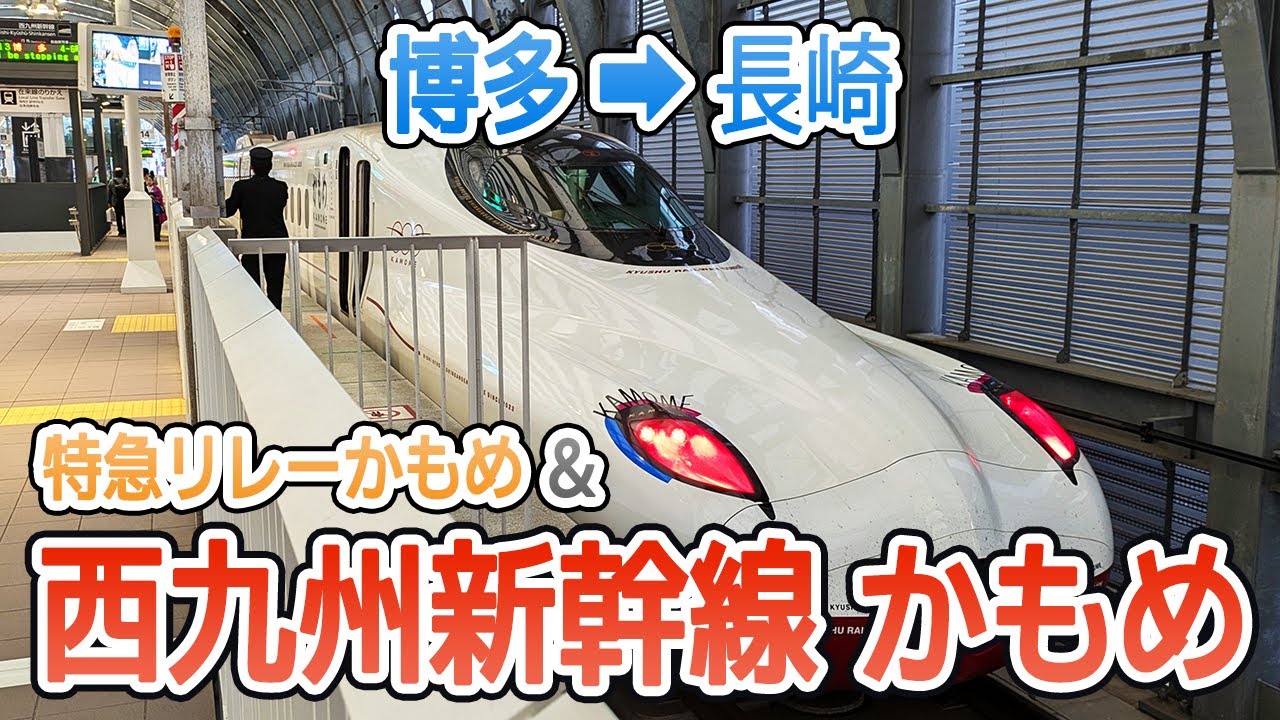
【車窓】特急リレーかもめと西九州新幹線かもめに乗車(博多→長崎)
I’m here at JR Hakata Station. This time, I’ll be taking the Nishi-Kyushu Shinkansen (Nagasaki Shinkansen) to Nagasaki! That said, you can’t get on the Nishi-Kyushu Shinkansen directly from Hakata Station. Currently, only the blue section from Takeo-Onsen Station to Nagasaki Station is open. The orange section from Hakata to Takeo-Onsen must be traveled by limited express train. So, at Hakata Station, I’ll enter through the regular train gates instead of the Shinkansen gates. From Hakata Station, I’ll take the Limited Express Relay Kamome. I booked my ticket online, so I’ll use a QR ticket (ticketless boarding) to pass through the gate. I hold my smartphone with the QR code over the reader at the QR ticketless gate. The Limited Express Relay Kamome I’m taking today is a coupled formation with the Huis Ten Bosch and Midori services (Series 783). Taking a commemorative photo of the front Huis Ten Bosch train (Series 783). My seat is in the rear Midori car. Departing from Hakata Station. Until now, it took 1 hour and 50 minutes to travel from Hakata to Nagasaki on the conventional limited express. With the Nishi-Kyushu Shinkansen, the travel time has been shortened by 30 minutes—to 1 hour and 20 minutes. In the future, there are plans to extend the Shinkansen to Shin-Tosu Station, but it’s still undecided if that will happen. Minami-Fukuoka Depot Takashita Branch. Passing Takashita Station. Junction with the Kyushu Shinkansen. Passing Sasahara Station. Crossing the Fukuoka Urban Expressway Loop Line. Crossing the Nishitetsu Tenjin-Ōmuta Line. Passing Minami-Fukuoka Station. You can see the Minami-Fukuoka Depot tracks in the distance. Running between Mizuki and Tofurōminami Stations. Crossing the Kyushu Expressway. Running between Tofurōminami and Futsukaichi Stations. Passing Futsukaichi Station. Running between Tenpaizan and Haruda Stations. Passing Haruda Station. Crossing the Kyushu Expressway again. Passing Keyakidai Station. Running between Kiyama and Yayoi-ga-oka Stations. Passing Yayoi-ga-oka Station. Crossing the Kyushu Transversal Expressway. Passing Tashiro Station. This is the nearest station to Hotel AZ, which I introduced in a previous video. Arriving at Tosu Station. Departing Tosu Station. Branching from the Kagoshima Main Line. Arakawa River. Arriving at Shin-Tosu Station. When will the Nishi-Kyushu Shinkansen be extended to here, I wonder? Departing Shin-Tosu Station. Passing Hizen-Fumoto Station. Running between Nakabaru and Yoshinogari-Kōen Stations. Passing Yoshinogari-Kōen Station. You can see Yoshinogari Historical Park. Running between Igaya and Saga Stations. Arriving at Saga Station. Departing Saga Station. Tafuse River. Passing Nabeshima Station. Passing Balloon Saga Station. This is a temporary station used during the Saga International Balloon Fiesta. Kase River and Gion River. Running between Kubota and Ushizu Stations. Passing Ushizu Station. Ushizu River. The white building on the hill is the Hizen Peace Pagoda. Passing Kōhoku Station. Running between Kitagata and Takahashi Stations. Crossing the Kyushu Transversal Expressway again. Passing Takahashi Station. Arriving at Takeo-Onsen Station. Here at Takeo-Onsen Station, I’ll transfer from the Relay Kamome to the Nishi-Kyushu Shinkansen. The Shinkansen is already waiting on the next platform. Since the transfer time is only 3 minutes, there’s no time to relax here. It would be nice if there were a bit more time, though… 😅 Departing Takeo-Onsen Station. Branching from the Sasebo Line. From here, a series of short tunnels continues. Crossing the Nishi-Kyushu Expressway. Note: The N700S trains on the Nishi-Kyushu Shinkansen do not have tray tables on the seatbacks. Since the ride is short, they likely assumed few passengers would eat or work onboard. However, each seat has a power outlet and free Wi-Fi is available. Arriving at Ureshino-Onsen Station. Departing Ureshino-Onsen Station. Another series of tunnels follows. After exiting the tunnels, Ōmura Bay comes into view. Arriving at Shin-Ōmura Station. Departing Shin-Ōmura Station. Arriving at Isahaya Station. Departing Isahaya Station. A series of tunnels continues again. After the final tunnel, the cityscape of Nagasaki appears. Arriving at Nagasaki Station. Now getting off the Shinkansen. Since I didn’t have time at Takeo-Onsen, I’ll take a commemorative photo of the N700S “Kamome” here. Walking toward the end of the Shinkansen platform. There’s a panel here that says “Japan’s Westernmost Shinkansen Station.” Heading toward the ticket gates. Inside the station, there’s a photo panel commemorating the Nishi-Kyushu Shinkansen. At Nagasaki Station, I’ll exit through the QR ticketless gate. I planned to film myself scanning the QR code here too, but… The machine wasn’t working properly, so I had to just walk through 😅 That’s all for this video. Thank you very much for watching!
博多から長崎まで、特急リレーかもめと西九州新幹線(長崎新幹線)かもめに乗ってきた様子を車窓風景のダイジェストを中心にお伝えします
今回乗車した特急リレーかもめは特急ハウステンボス号と特急みどり号の783系併結編成でした
チケットはオンライン予約でQRチケレスを選択したので、スマートフォンのQRコードだけで乗車することができました
0:00 博多駅
11:04 鳥栖駅
14:36 新鳥栖駅
19:50 佐賀駅
28:22 武雄温泉駅
33:20 嬉野温泉駅
36:51 新大村駅
40:05 諫早駅
43:17 長崎駅
#西九州新幹線
#長崎新幹線
#特急リレーかもめ
#QRチケレス
AloJapan.com