
【ロングシートの指定席!!】321系 快速「うれしート」 学研都市線にデビュー!! 実際に乗ってきた!!! 宝塚→木津
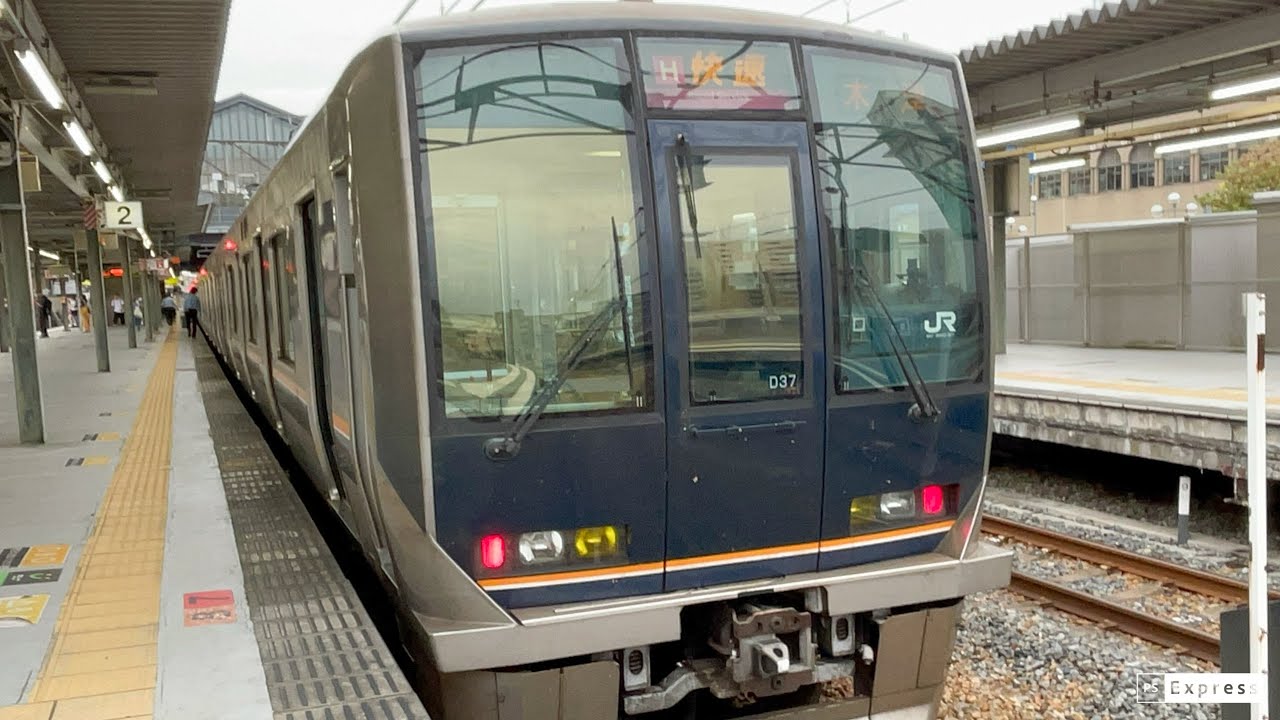
Thank you for watching. I’m currently in Takarazuka. This is JR Takarazuka Station. This time, I traveled from JR Takarazuka Station to Kizu Station, taking the JR Takarazuka Line, the Tozai Line, and the Gakkentoshi Line . Opposite JR Takarazuka Station is Hankyu Takarazuka Station. We boarded the rapid “Ureshi To” service, which was newly added to the Gakkentoshi Line with the timetable revision on October 14th . This time, the new service was added to the 207 series and 321 series that run on the Tozai Line and Gakkentoshi Line . These cars are long-seat cars, and there was a lot of discussion about the fact that these long seats will have reserved seats before they were introduced . I wanted to experience what it’s like to actually ride on one. “Soon at platform 2, departing at 4:11pm.” “The seven-car train bound for Kizu via the JR Tozai Line Rapid is arriving. ” “It’s dangerous.” “Please step back to the yellow tactile paving.” At 4:04 PM, the return train bound for Kizu arrived. The train used was a 7-car 321 series. Part of car 1, the very last car of this train, was designated as a “Ureshi Route” (reserved seating). The “Ureshi Route” sign was also displayed on the boarding location guide on the platform. The paid area inside the car was separated by a large noren curtain installed at eye level. On the other side of this noren curtain was the “Ureshi Route” ( reserved seating) . The same noren curtain was hung at the very end, near the boarding door. Seat numbers were also displayed on the luggage rack above the seats in the “Ureshi Route” . These are the long seats facing each other. Two of the train’s 12 seats are “Ureshi Routes,” which are paid seats. This is the reserved seat I rode in this time. I think “Ureshi Routes” are a truly innovative idea, as they transform a completely ordinary long seat into a paid seat just by adding a seat number and a noren curtain. I have ridden many reserved seat carriages, but this was the first time I had to pay for a reserved seat in an ordinary long seat. The 321 series is equipped with LCD displays inside the carriage. We departed Takarazuka Station at 4:11 PM, right on schedule, and arrived at our final destination, Kizu Station, at 5:53 PM. The 1 hour and 42 minute journey began. “Thank you for using JR West today.” “Thank you.” “This is the JR Tozai Line Rapid bound for Kizu.” “This train has seven cars.” “The very back car of this train, towards the back of car 1,” “is a paid seat, the Rapid Ureshio.” ” Please note that you will need a reserved seat ticket in addition to your regular ticket to ride. ” “We do not sell these on board.” “Please purchase them in advance.” “The stations that the train stops at on the way to Kyobashi are Nakayama-dera, Kawanishi-Ikeda, Itami , and Amagasaki.” “The stations from Amagasaki to Kyobashi on the JR Tozai Line” “The third car from the front of this train is a women-only car. ” “Thank you for your cooperation.” “Next stop: Nakayama-dera, Nakayama-dera.” “The exit is on the left.” The Takarazuka Line to Amagasaki is a relatively empty section in the opposite direction of rush hour. I think the “Ureshi Route” comes into effect once we enter the Tozai Line and Gakkentoshi Line. When we departed Takarazuka Station, the entire train was empty, both reserved and unreserved. At this point, it seemed like there was no need for a reserved seat at all. “We’re coming soon to Nakayama-dera, Nakayama-dera.” “The exit is on the left.” The “Ureshi Route” between Kizu and Takarazuka stations has two trains bound for Takarazuka in the morning and five bound for Kizu in the evening. All seven of these trains run via the Tozai Line, and all have long seats. Some trains also run to Nara and Shin-Sanda Station. In addition to these “Ureshi Routes,” the Takarazuka Line also has two “Ureshi Routes” bound for Osaka Station in the morning , and five bound for Sasayamaguchi Station in the evening. These trains do not go on the Tozai Line or Gakkentoshi Line, but all depart and arrive at Osaka Station. With this latest timetable revision, the “Ureshi Route” has been introduced on the Hanwa Line and (the Gakkentoshi Line) . This means that the “Ureshi Route” has been introduced on almost all JR lines in the Keihanshin area. The “Ureshi Route” has also been introduced in the Hiroshima area. From now on, the number of “Ureshi Route” trains will increase with each timetable revision. At this point, I realized that even from here on, even when we entered the crowded section, only a maximum of 12 people would be allowed inside this noren curtain. Not only was a seat guaranteed, but it was also guaranteed that no one would stand in front of me. This might be more comfortable than I had imagined. The reserved seat fare is 530 yen, but if you purchase it ticketless, it’s only 300 yen. I think it’s quite advantageous to be able to secure a comfortable space for 300 yen. I think 300 yen is especially useful in the crowded morning section. I think it’s very comfortable to be able to secure your own seat for 300 yen during rush hour. This 300 yen also includes the comfort of not having anyone standing in front of you. Furthermore, since it is 300 yen regardless of the section, if you board from Takarazuka, it will cost the same 300 yen whether you ride partway through the journey or to the final stop, Kizu Station. “Soon, Amagasaki, Amagasaki.” “This train is a rapid train bound for Kizu via the Tozai Line.” “It will stop at every station on the JR Tozai Line up to Kyobashi.” The train makes a sharp left turn before arriving at Amagasaki, where it merges with the JR Kobe Line. Amagasaki Station is a huge junction station where the JR Takarazuka Line, Kobe Line, and Tozai Line converge . It’s a very convenient station where you can transfer to each line from here, but in the event of a disruption, if a delay on one line section affects other lines as well , it’s also a very important station in terms of the timetable. A JR Kobe Line local train was running on the adjacent track. We departed Amagasaki Station. From here, we entered the JR Tozai Line, heading for Kitashinchi and Kyobashi. From Amagasaki onwards, the previously empty car was gradually filling up with people at each station. “The stations it will stop at are every station on the JR Tozai Line up to Kyobashi,” “Hanaten, Suminoe, Shijonawate, Hoshida, Kawachi Iwafune, Nagao.” “This is a local station from Nagao to the last stop, Kizu.” The train leaves Amagasaki Station, crosses the Kanzaki River , and then enters the underground line. The JR Tozai Line runs underground from here until just before Kyobashi Station. “Soon to be Kashima, Kashima.” “Exit on the right.” “There is an empty space between the train and the platform.” “Please watch your step when getting off.” We departed Shin-Fukushima Station. Up until this point, there had been no one sitting on the “Ureshi To” except for us. The “Ureshi To” was empty, but the rest of the car was gradually getting more crowded. At the stops, occasionally people would get on without knowing they had reserved seats, but the conductor would immediately call out to them. The atmosphere inside the car was quite different inside and outside the noren curtain . “Soon to be Kitashinchi, Kitashinchi.” ” Exit on the right.” “You must transfer to the subway line and the Hanshin line.” Many people boarded at Kitashinchi Station. No one was sitting in the reserved seat. “We’re approaching Kyobashi, Kyobashi.” “Exit on the right.” ” Please transfer for the Osaka Loop Line, Keihan Line, and subway line.” “This train is a rapid train bound for Kizu.” “After leaving Kyobashi, the next stop is Hōsen.” We emerged above ground just before Kyobashi Station. From here, we’ll run on the Gakkentoshi Line to Kizu Station . Many people were boarding at Kyobashi Station. There was only one other person on the “Ureshi Route” besides us. “Thank you for riding.” “This train is a rapid train bound for Kizu .” ” From here, we’ll stop at Hōsen, Suminoe, Shijonawate, Hoshida, Kawachi Iwafune.” “We’ll stop at Nagao, in that order.” “From Nagao onwards, it’s the terminal station, stopping at every station until Kizu. ” “Last car, some areas.” “Paid area, Ureshi Route.” “To use this train, you will need a reserved seat ticket in addition to your regular ticket.” “We ask for your understanding and cooperation.” Immediately after leaving Kyobashi Station, the train merges with the Osaka Higashi Line. The next stop is Hōgen, and the train then runs parallel to the Osaka Higashi Line. There were many people on board in the non-reserved seating areas, making the train quite crowded. Perhaps reserved seats on long seats are rare, as everyone was reading the signs on the noren curtains and looking at the empty reserved seating areas. There were crowded areas and empty areas in the same train, and even though I was paying the fare, I felt a little sorry. However, since you can’t buy reserved seat tickets on the train , there were no more seats available, and I felt a bit superior. I think reserved seats are proving to be the most effective they’ve been in recent times. Since the service has only just begun , they’re not very well known, but I think the number of passengers will increase little by little. Like the Gakkentoshi Line, the newly introduced Hanwa Line uses convertible cross-seat cars, but they have three rows of seats, two in a row, and one in a row. There may be demand for the “Ureshi-to” single-seat seats. Currently, the number of trains operating on each line is increasing with each timetable revision. It’s a “happy route,” but I’ll keep an eye on future developments. Departing Matsuiyamate Station. Up until this station, it was double-track, but from here on, it becomes single-track until the terminal, Kizu Station. Departing Doshishamae Station. From Kyotanabe Station to near Kintetsu’s Kizugawadai Station , the Gakuen Toshi Line and Kintetsu Kyoto Line run parallel. If you time it right, you can see the trains running parallel. At this point, the tracks are still far apart, but from here on, they get quite close. While the train was stopped at JR Miyamaki Station, a Kintetsu Line train stopped and passed by . It was getting completely dark. We were almost to the terminal, Kizu Station. Before boarding, I had a negative impression of the long-seat reserved seat, but when I actually got on, it was more comfortable than I expected. While I think the price of 300 yen for a long-seat reserved seat is reasonable, I thought the regular fare of 530 yen was quite expensive. If it was available on my commuter line, I would definitely use it. Departing Nishikizu Station. “Next stop: Kizu, the terminal.” “The exit is on the left.” This time I rode on the long-seat “Ureshi-to.” Before boarding, I thought the seats were a complete rip-off, but once I got on, I found them to be surprisingly comfortable. The long seats, which never have anyone standing in front of you, are very comfortable. I think they’re quite “suitable” for commuting. “Thank you for riding.” “You will soon arrive at the final stop, Kizu, Kizu. ” “The exit is on the left. ” “Yamatoji Line, bound for Kamo and Tennoji, bound for Osaka.” “Nara Line, local train bound for Kyoto, please transfer.” That’s all for today’s video. Thank you for watching. It’s not really suitable for sightseeing, but for commuting , I found it to be more comfortable than I expected . I hope this was helpful when using the new “Ureshi-to” on the JR Gakkentoshi Line. I will continue to post videos about trains, travel, and hotels , so please like and subscribe. I would also be very happy if you left a comment. Well then, everyone, see you in the next video.
ロングシートの指定席が誕生しました!!
JR西日本、10月14日のダイヤ改正でJR学研都市線に新たに導入された有料座席指定サービス「うれしート」
「うれしート」自体はJR西日本管内の多くの路線で、既に導入、運行されていますが、学研都市線の指定席に新たに導入されたのは、なんとロングシートの座席でした
普通の通勤電車の、しかもロングシートの座席に指定席とは!?
果たして需要はあるのか?乗り心地、座り心地、快適性は?
実際乗って来ました
乗車の際の参考になりましたら嬉しいです
++++車両データ++++
JR西日本 321系
座席 ロングシート
トイレなし
チャンネル登録がまだの方は、ぜひ登録お願いします‼️
https://www.youtube.com/@japan-travel-expedition
関連動画❣️
AloJapan.com