
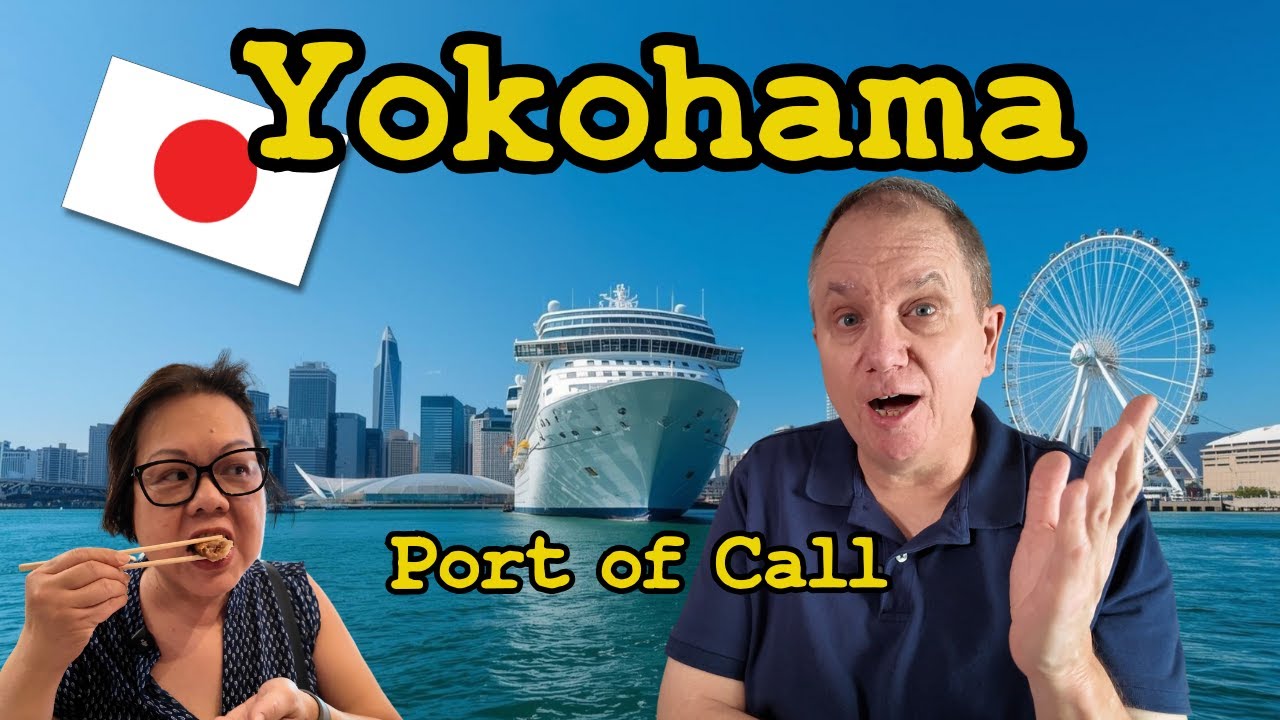
Port of Call Gems of Yokohama Revealed!
Yokohama, Japan is often used as a rough substitute for Tokyo on cruise itineraries. And while it’s certainly possible to day trip to Tokyo and other areas of interest from here, we chose to stay in Yokohama as a port of call. We’re going to show you why Yokohama is cool, exciting, and super convenient. I’m Troy and this is the port lowdown. [Music] Typical ports of call last around 8 to 10 hours. How to spend the time? Day trip outside the city or stay put. Day trips to Tokyo are certainly feasible as long as you account for travel time and know what you want to do. Using the Yokohama Central Train Station as a base, you have several options to reach Tokyo, such as the Tokyo line to Shibuya in 30 minutes or the JR Tokaido line and the Yokosuka line in about 40 minutes. In fact, you can even take a bullet train Shank Kaisen from a separate Shin Yokohama station to Tokyo station in a short 18 minutes. For Kamakura, you can use the JR Yokosuka or Shonen Shinjjuku line in around 30 minutes. Now, from my experience, I always needed a little extra time traveling on the rails. Tokyo’s train system, which involves different rail and subway lines, is super efficient. I mean, Bay is public apologies for being a few minutes late, but the rail and subway stations can be big and confusing with maze-like corridors and batteries of signs going every which way. So, make time to get lost. Now, maybe I’m a weirdo, but I consider getting lost in the system, even just a little bit, be part of the fun of being here. It pays to arrive in Tokyo early enough to get the feel for this wonder of modern efficiency and scale. I’ll leave some of my favorite video links in the description that go over Japan rail travel in way more detail than I can. But staying put has advantages. With much less commute time, you can soak in a vibrant city at a relaxed pace. The city is quite walkable. It’s mostly flat and served by a terrific public transportation system. and pleasant surprise, there’s a lot to take in. A few important notes. One, be sure to buy a transit IC card such as Squea or Pasmo, preferably after you arrive at the airport or soon after. Both of these main cards can be used on most rail, subway, and bus options with the fair automatically deducted from the money you add to it. They usually come in a standard long-term version that’s valid for 10 years and usually has a starting price and a 500 yen deposit. There’s also tourist cards such as welcome suica and pasmo passport that are good for 28 days and have no initial deposit although remaining balances are not refundable. You can also buy these cards at major train station. There’s also an Apple app version for sorry Android where you can have a card in a digital format on your iPhone. Having one isn’t just about public transport. You can even use these for purchases in convenience stores, vending machines, coin lockers, and even taxis. Two, get cash. There’s usually ATMs at the airport or seek one out around your hotel, often at convenience stores like Lawson and 7-Eleven. While more businesses accept credit cards, a lot still don’t, especially if you go to the more local establishments. Cash provides maximum flexibility across everything. Besides, recharging your IC card at convenience stores or train stations will require cash in almost all cases. Back to Yokohama, where we’ll stay put and explore the details. Yokohama is a compact city and an important port in Japan’s history. You’ll likely dock at three principal terminals. Number one, Osamashi, where most of the mid to larger ships dock from, including our ship, the Diamond Princess. It’s famous for its curved wooden deck design, and a popular spot is a public park on its top side. With one of the best 360 views of the city skyline, there’s a good selection of services when you exit. For such a wide space, it’s basically one big floor that contains most of the cruise services with tourist info, lockers, clean and spacious bathrooms, money exchange, mobile nursing room, SIM cards, and vending machines, of course, including a few restaurants and stores on the east end of the complex. Pretty simple, really. They’re pretty generous with their rest areas as well. Taxi cabs are right outside or there’s a bus stop for the Akai Kutsu Red Shoes Bus, a retro style city loop bus, kind of like a Hoo bus that makes a circle route past most of the main attractions here. Cost, as of recording, is 220 yen for an adult single trip or 110 yen for a child. And even though my research said otherwise, it looks like they actually do take credit cards. When in doubt, there’s always your trusty IC card. Now, from here, it’s a 10 to 15 minute walk down the street and follow the signs to the Nihon Odori JR station and a slightly longer one to the Canai JR subway. Nihon Odori station is on the Minato Marai line which covers many points of interest in the city. It also has direct through service with the Tokyo Toyoko line running past Yokohama station and continuing to Tokyo’s major hubs. The main JR line that serves Canai station is the JR Nigishi line which has direct lines to Tokyo Central without transfers as well. And across from this Nihon Odori street level entrance is a post office ATM. This port is also the closest within walking distance to Chinatown and the Yokohama Stadium. Shino Pier, aka Hammerhead. This serves smaller luxury ships and has a boutique terminal to match with a shopping complex, food court, as well as the Intercontinental Yokohama Pier 8 by IHG on site. The dock exits take you inside this first floor concourse with tourist info, currency exchange, and mobile battery chargers. Also available is the Seabbass water bus providing direct travel between Yokohama Hammerhead and Yokohama Station’s east exit in about 15 minutes. Lockers are also here as well as terrific bathrooms. Scooter rentals and a handy 7-Eleven, of course, with an ATM. And this, the beer bike, which is a tour company offering a mobile beer counter that seats six pedaling passengers. Drunk driving jokes aside, I’ll leave a link for these guys. Being small, taxi access is really quick. The Akai Kutsu bus also stops here, as well as the Bayside Blue Bus, a single loop bus that makes rounds around the general tourist areas. But the main advantage of this terminal is its proximity to attractions such as the Cup Noodles Museum, Red Big Warehouse, Shopping Malls, and the Yokohama Cosmo World Amusement Park. And three, Daikoku. This terminal is basic and isolated on an artificial island with no direct access to trains or subways. Across the bay and just east of Yokohama Bridge, this serves the huge mega ships that can’t pass under the bridge. Getting to town from here involves either a cruise ship provided shuttle to town, taxi, or the local 109 bus, which has infrequent schedules. The bus stop is about a 2-minute walk from the terminal. No frrills. From there, it’s a roughly 30inut ride to Yokohama Station. Now, all things considered, I’d look for a cruise line shuttle in this case, or taxi if you have a big group. Now, the main tourist points of interest are clustered close to the port areas. So, in theory, one could walk most of it in a day if you’re energetic. Now, that said, I walked around a lot in Yokohama, about 17,000 steps. So, even though it’s flat, uh, the map’s kind of deceiving. There’s a lot of walking to do. So, it helps to use public transport as an assist if you get tired of walking. We docked at Osbashi. From there, it was a 20-minute walk to the base of Chinatown, the largest in Japan. The Chinatown district was established in 1859 when the port of Yokohama opened to foreign trade, attracting a community of Chinese merchants and traders. Today, it’s evolved into a bustling area with over 600 shops and restaurants alongside temples and beautiful gates, but it’s mainly funky and fun. It reminded me of Osaka’s Doon Buri district, but Chinese. [Music] It’s a food haven, of course. So, this is a beef meat pie. Usually, it’s I think traditionally more in the northern part of China, and it’s a very flaky skin. Oh, yeah. Pandas, animal cafes, [Music] massage, and health treatments are everywhere. And I can only assume Santa’s massage emporium is less painful than the one this seems to be. and along Kantai Bio Street which looks like Fortune Teller row. So we got lucky and today apparently there’s a new business opening up and when they have a new business opening up they hire the dragon dance to celebrate to show that you know they have money and they’re starting a business and also you could hear the drum and the music all miles away. It’s announcing to the other people that hey a new business open come and check us out. I continued walking back towards the water to Yamashita Park about 6 minutes away. Opened in 1930, it became a symbol of Yokohama’s recovery following the Great Kanto earthquake of 1923. Rubble from the disaster was utilized to create Japan’s first seaside park, which is now one of the most popular spots in the city. It’s a delightful stretch of land with fountains and numerous statues. Along the waterfront is also the imposing Hikawa Maru, a classic ocean liner that’s open to the public as a museum. From the far west end of the park and just past the street leading to Osamashi is a small Yokohama Customs Museum located at the ground floor of the Yokohama Customs Building. It’s a free museum dedicated to customs enforcements of course, including smuggling methods, stories of true crime, and all manner of nasty counterband. The official customs office mascot, Custom welcomes you. A plump version of McGuff the crime dog. He’s everywhere here, even in this behind thescenes video, which I’m pretty sure is an AI. The most popular section is find the counterfeit. Can you tell the fake from the real? Lots of fun. And English translations available here as well. Solid bathrooms, too. Continuing west along the harbor, the prominade opens up to a huge and lovely concourse where in about 5 to 10 minutes is the red brick warehouse, a famous local landmark. The two main buildings were originally customs inspection warehouses built in the early 1900s. After falling into disuse, they were carefully restored and reopened in 2002. Now, it’s a major shopping and dining complex with a large space out front for events, which seem to be pretty frequent. Pushing further east for another 10 minutes past Hammerhead is one of the city’s biggest attractions, the Cup Noodles Museum, an interactive museum dedicated to the inventor of instant ramen, Mom Fuku Ando. Not just a display case of all various brands of cup noodles through history, although they definitely have that. It’s a celebration of creativity and innovation. Most of the displays are in Japanese, but there’s a free English audio guide with a QR code. It’s quite big with not just Ando’s personal story and way cool interactive first noodle kitchen, but a kids play area, Cup Noodles Park, Noodles Bazaar serving up noodles from around the world, and a store selling well vintage noodle packs and all manner of funky merch. But the star of the show here is the My Cup Noodles Factory, where you can make your own custom noodle cup. [Music] [Music] complete with a personal art project container. Also, dawn the factory cap and produce noodles in their extensive lab. Needless to say, this is the most crowded and popular part of the museum. Admission is a base fair of a pretty inexpensive 500 yen, free for high school students and below. An additional 500 for each noodle factory cup. Cup Noodles Park for the kids is timed at 30inut intervals at an additional 500. Now, even with a few days here, we still missed a bunch of cool stuff. Sanen Garden, a vast 43 acre garden renowned for its beauty and preservation of historic buildings brought in from all over Japan. Yokohama Stadium, home of the DNA Bay Stars baseball team and loud, boisterous fans. Yokohama Cosmo World, where it’s free to walk the grounds and ride tickets are cash only. Industrial museums from Mitsubishi, who built Diamond Princess, and Nissan at their world headquarters, even a tattoo museum. Check out the local tourist board website if you feel like being overwhelmed. Bottom line, Yokohama is a place to visit again and again with no end to surprises. Day trip if you must. It just means you have catching up to do here next time you cruise. If this video has been informative and cool, be sure to share with your friends and give us a like. We aim to help independent cruisers with helpful and fun port videos, ship tours, and tips. And we also have our website, portlowdown.com, for even deeper dives into our port visits, as well as helpful links. And as always, keep those awesome comments coming. We really look forward to hearing from you. Happy travels.
We cover Yokohama’s travel options, including day trips to Tokyo and Kamakura by rail, and all three Yokohama cruise terminals (Osanbashi, Shinko Pier (Hammerhead) and Daikoku). Then we explore places we’ve been, such as Chinatown, Yamashita Park, The Customs Museum, Red Brick Warehouse, and Cup Noodles Museum). Lots to unpack! We sailed from here for our Japan and Asia cruise last summer on Diamond Princess, Princess Cruise Line’s super popular ship!
Chapters:
0:00 Intro
00:27 Rail options for day trips to Tokyo and Kamakura
01:38 IC cards and Cash
03:06 Osanbashi Dock
05:31 Shinko Pier Dock (Hammerhead)
07:01 Daikoku Dock
07:54 Chinatown
09:20 Yamashita Park
09:48 Customs Museum
10:37 Red Brick Warehouse
11:09 Cup Noodles Museum
*****************
⚓Helpful links
You Tube Videos on Rail Travel
Suica IC Card
https://en.japantravel.com/guide/how-to-get-a-suica-card/22316
Pasmo IC Card
https://www.pasmo.co.jp/visitors/en/
Yokohama Official Visitor Guide
https://www.yokohamajapan.com/
Cup Noodles Museum
https://www.cupnoodles-museum.jp/en/yokohama/
Beer Bike Tour
“Red Shoes” Loop Bus
https://www.yokohamajapan.com/information/getting-around-yokohama/akaikutsu.php
Bayside Blue Bus
https://www.yokohamajapan.com/article/bayside-blue/
*****************
Finding value and getting some tips from our videos?
Support us: Subscribe https://www.youtube.com/channel/UCLdrgdmwIf5Z1qhRf5HIq-g?sub_confirmation=1 and share with your shipmates.
*****************
Disclaimer: This video is NOT sponsored. Some product links are affiliate links which means if you buy something we’ll receive a small commission at no extra cost to you. Thank you for helping us bring more port information and independent excursion to you.
*****************
🎹Theme music by Rafael Deo
🫶Connect with us
Web: http://www.portlowdown.com
Facebook: https://www.facebook.com/profile.php?id=61557696962794
#cruiseport #theportlowdown #cruiseportguide #tokyo #yokohama #japancruise
3 Comments
Thank you. I love Yokohama. I would also recommend Motomachi Street for shopping. It is just a few blocks south from Chinatown and is the Naka Ward area.
Great video!! Thank you! 🚢
Uber from port to Tokyo downtown is good price too.