
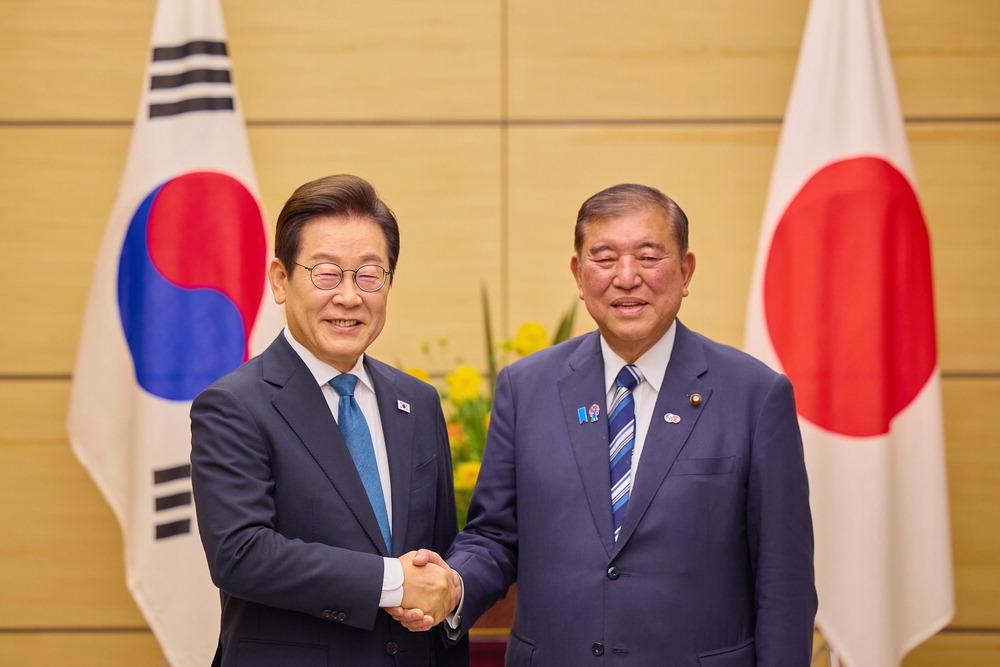
 사진 확대 President Lee Jae-myung (left) and Japanese Prime Minister Shigeru Ishiba shake hands before starting the summit at the prime minister’s residence in Tokyo on the 23rd. The leaders of Korea and Japan agreed to strengthen strategic communication, saying, “We must cooperate together for the common good,” and issued a joint press release for the first time in 17 years. Reporter Kim Ho-young in Tokyo
President Lee Jae-myung and Japanese Prime Minister Shigeru Ishiba met for the second time in 67 days and decided to jointly respond to the rapidly changing trade and diplomatic security environment. It is the first time that a South Korean president has chosen Japan, not the U.S., as his first bilateral summit diplomatic destination since taking office.
It is also the first time in 17 years that the leaders of South Korea and Japan have reached a joint agreement after the talks. Analysts say that the uncertainty in the trade and security order amplified by U.S. President Donald Trump’s “America First” is increasing the solidarity between Korea and Japan. This is a pragmatic diplomatic aspect.
President Lee and Prime Minister Ishiba said in a joint press statement released after two hours of talks at the prime minister’s residence in Tokyo on the 23rd, “The two leaders agreed that Korea and Japan should cooperate for the future-oriented and mutually beneficial common interests of the international community.”
The two leaders agreed to strengthen strategic communication, agreeing that the international situation is changing rapidly in all areas of economy and security, such as reorganizing trade order and military cooperation between North Korea and Russia.
It also agreed to expand cooperation in future industries such as hydrogen and artificial intelligence (AI) and create synergies in the economic and industrial sectors. The Japanese media also responded with a “joyful surprise.”
In response, Japan responded in the joint statement, saying, “We will inherit the historical perception of the Kim Dae-jung-Obuchi Joint Declaration in 1998,” and it is evaluated that Korea-Japan relations have faced a new “honeymoon.” Both President Lee and Prime Minister Ishiba agreed that strengthening Korea-Japan relations is essential to cope with changes in the trade and security environment caused by Trump, taking certain political burdens.
Meanwhile, President Lee left for Washington, D.C., immediately after his two-day trip to Japan. President Lee will hold a South Korea-U.S. summit with President Trump at the White House on the 25th (local time).
[Tokyo Reporter Oh Soo-hyun / Correspondent Lee Seung-hoon]
AloJapan.com