
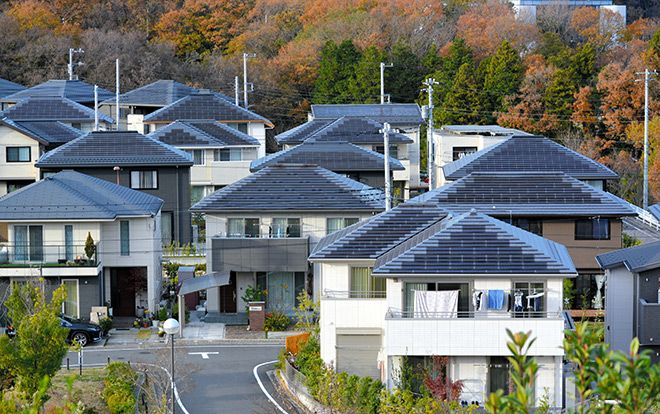
Japan’s first local regulation requiring solar panel installations on new single-family homes took effect on April 1 in Tokyo and Kawasaki in Kanagawa Prefecture.
The new regulation, which also covers larger apartment and commercial buildings, marks a significant step in the country’s efforts to reduce greenhouse gas emissions.
However, its impact remains to be seen as half of new detached houses will be exempt due to technical challenges and administrative burdens.
“Tokyo lacks space for large-scale solar farms,” Tokyo Governor Yuriko Koike said in late March. “As a major energy consumer, it’s crucial that we leverage the potential of rooftops to produce our own energy.”
This view is shared by officials in the neighboring city of Kawasaki, one of the country’s largest greenhouse gas producers due to its extensive industrial area.
Under the new regulation, building owners will be required to install solar panels on apartment complexes and office buildings. For single-family homes with under 2,000 square meters of floor space, the obligation is placed on housing manufacturers.
The metropolitan assembly enacted the initiative in 2022 after Koike pushed for it as a key part of her green policies.
The new regulation comes with subsidies for initial installation costs, including a budget of 900 million yen ($6 million) for a solar panel leasing program in fiscal 2025.
Building and home owners are also increasingly interested in the environmental and economic benefits of solar panels, as well as their advantages in emergencies, according to major housing manufacturer Asahi Kasei Homes Corp.
HALF OF NEW HOMES EXEMPT
While the new regulation appears groundbreaking, its implementation faces challenges.
In the densely populated metropolitan area, many single-family homes are too small to install solar panels or are located in blocks that don’t receive enough sunlight.
In response, the regulation excludes smaller houses and buildings facing north.
Smaller housing manufacturers are also exempt from the new rules due to the substantial paperwork and other challenges involved.
As a result, only half of the 49,000 residential homes built annually in Tokyo are expected to be required to install solar panels.
Nationwide, Kyoto and Gunma prefectures have already implemented similar regulations. However, these policies apply only to large-scale buildings, rather than single-family homes, making Tokyo’s initiative a significant precedent.
GOVERNMENT SUPPORT CRUCIAL
The government has set an ambitious target to have solar panels installed on 60 percent of new single-family homes by 2030.
However, it refrained from implementing an immediate nationwide mandate due to technical and financial challenges.
“Tokyo’s mandatory solar panel installation for new buildings is a step in the right direction for promoting green energy,” said Masayuki Mae, an associate professor at the University of Tokyo, who specializes in energy-efficient housing.
Although Sendai and other cities are also considering introducing similar regulations, they often lack the resources to implement them. Mae stressed that support from the government is crucial to assist these municipalities nationwide.
“Smaller housing manufacturers and existing homes also need to be part of the initiative in the future,” said Mae. “Policymakers should focus on promoting and highlighting the advantages of home solar panels for residents.”
AloJapan.com